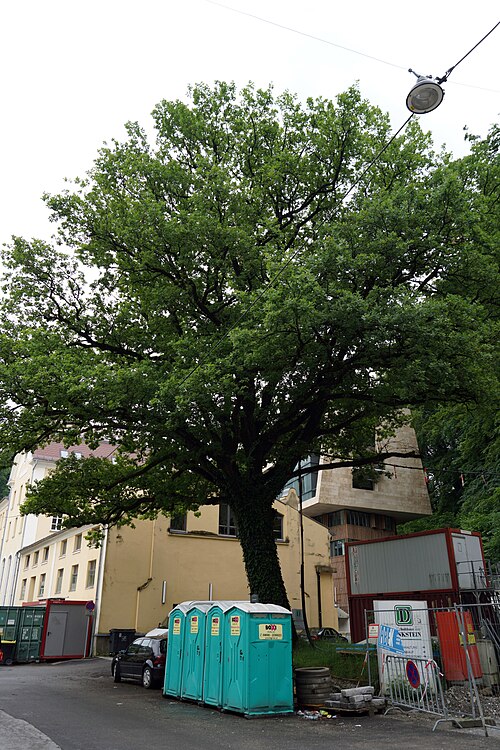
This hornbeam is all that is left of a villa garden, and for years it was the tree outside Salzburg University's biology department. The villa on Freisaalweg dates from the Gründerzeit, the building boom around the turn of the last century, and it later housed the university's Institute of Biology until 1986, when the biologists moved to the new natural sciences building nearby. That same year, on 23 January 1986, the city declared the hornbeam a natural monument. The register entry calls it notably symmetrical and mighty, and the local Wikipedia article on Freisaal singles out its strikingly round, globe-shaped crown. It grows on several stems rather than one trunk. Its age is an estimate and stays one: the Freisaal article puts it at more than 200 years, and nobody has published anything sharper. No source says whether it was planted for the villa's garden or was already standing when the villa went up. Today its neighbour is the Akademiestraße car park, 220 spaces of asphalt, an unglamorous address for a protected tree. The most recent dated sighting we found is a photograph from May 2014, so if you walk past, a new photo or a word that it still stands would help. The same goes for its girth, which no source records: a tape measure answers that in a minute. It is a 15 to 20 minute walk south of the Altstadt.
Freisaalweg, beside the public Parkplatz Akademiestraße car park, Nonntal, Salzburg You can recognise it by its several stems and its round, globe-shaped crown. It stands on Freisaalweg beside the Parkplatz Akademiestraße car park.
Free. Stands beside the public Parkplatz Akademiestraße car park (220 spaces) in Nonntal; publicly viewable, no gate or restriction found.
Bus line 20 (Nonntal route), stop Akademiestraße or Hofhaymer-Allee; about a 15-20 minute walk south from Salzburg's Altstadt (Residenzplatz)