Nine trees, and they do not make one walk. Three stand in or beside the Old Town: a hollow lime beside Niguliste church, generally called the oldest tree in Tallinn, a pair of limes planted for a family's bicentenary, and a fortress-top row with an even older trunk by one tree-ring study. A few streets away grows the largest ginkgo in Estonia, which stopped a Soviet parade grandstand. Kadriorg holds three, among them the city's thickest tree and an oak ranked older still. Two more stand further out, at Maarjamae and in Kopli, where an oak predates its former cemetery.
0 of 9 visited in Tallinn
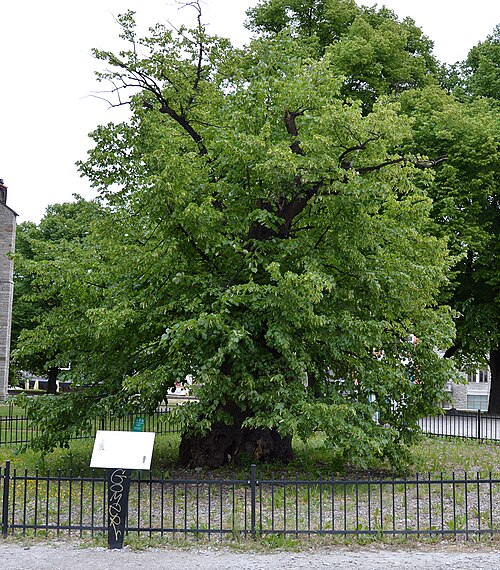
Common Lime (Tilia x europaea) · 350-375 years · Vanalinn (Old Town)
A chronicler is said to lie under this lime. Christian Kelch, the Baltic-German pastor who wrote a chronicle of Livonia and died in 1710, gave the tree the name it still carries, and the tradition in Tallinn is that he is buried at its foot. Nobody has dug to check.
The numbers are firmer than the legend, if older than anyone would like. In 1999 the trunk measured 462 centimetres round at chest height, the tree stood 16 metres tall, and a ring assessment put it at 340 to 350 years. Carry that forward and it lands near 370 now, which sits comfortably with the other date attached to it: a 1938 newspaper gave its planting as 1680. It is generally called the oldest tree in Tallinn.
It looks its age. Two main branches are what remains of the crown, the base is hollow and has been sealed against further rot, and it has been pruned to keep weight off what is still holding. When Tallinn was named European Tree City in 2015, this tree was part of the argument.
It stands beside Niguliste, the church that burned in the air raid of March 1944 and took decades to rebuild. The lime, by then already close to three centuries old, needed no rebuilding.
Photo: Olaf Meister (CC BY-SA 4.0)
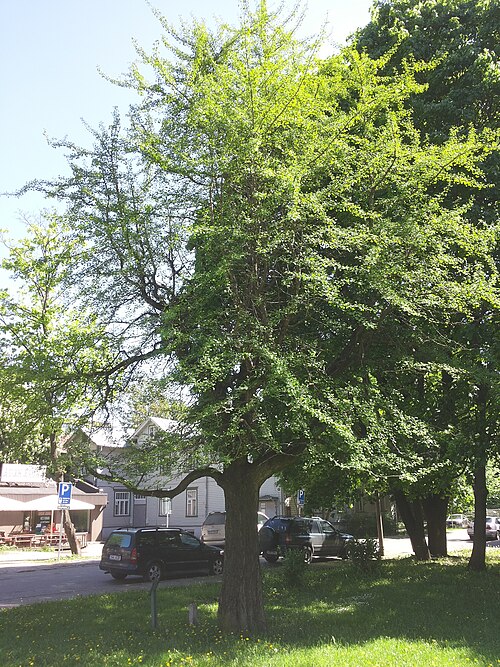
Ginkgo (Ginkgo biloba) · 110 years · Tatari
This tree gave the Estonian language a phrase. In the late 1980s a new Soviet parade grandstand and an annex for the Estonia Theatre would have taken out the ginkgo on the corner of Peeter Süda street. Public opposition stopped the project, and hõlmikpuu sündroom, ginkgo syndrome, has meant a building plan blocked by a protected tree ever since.
It was not born on this corner. Heinrich Kühnert brought ginkgo seed home from Germany in the late 1800s and raised it in the family's private park a few hundred metres away. When the street was widened in 1913 his son Ernst moved the tree here, and it has been measured on and off ever since: six metres tall in 1928, 8.2 metres in 1955, 13 metres with a trunk 164 centimetres round by the 2017 survey, which put its age at over 110 years. It is the largest ginkgo in Estonia and has been protected since 30 April 1966.
Its health is not perfect. In 2017 the Estonian Dendrology Society reported that the crown had gone lopsided in the shade of a neighbouring maple and needed dead wood taken out. Forty years after it beat the grandstand, planning arguments still happen around it rather than through it.
Come in late October. Ginkgos turn a hard clean yellow and then drop the lot within days.
Photo: 03jansa (CC BY-SA 3.0 ee)
Northern Red Oak (Quercus rubra) · 140-150 years · Maarjamäe, Pirita linnaosa
The house burned down in 1995. The oak the owner planted is still standing.
Robert Weisse built Windecki as a summer estate on the terrace below the Lasnamäe cliff and laid out its park before his death in 1886. The timber main house went up in flames a century later and was never rebuilt. What survived is the planting: 32 trees where there were 42 in 1995, a row of seventeen old European larches, and this red oak.
The dendrologist Olev Abner surveyed the ground in 2017 and made the case that it is probably the oldest red oak in Estonia, thicker in the trunk and taller than either of the two others the country protects individually. He recorded it at 24 metres high and 83 centimetres through. The age comes from the park rather than from a ring count: if the oak went in with Weisse's original planting, it is roughly 140 to 150 years old now, and that "if" is the whole basis for the number.
There is a second wrinkle. A 2007 survey of the same park recorded its largest red oak at the same 24 metres but only 61 centimetres through, which is either a different tree or a different tape measure. Estonia gave this one formal protection in 2020.
Maarjamäe is twenty minutes out from the centre, and the park is small enough to find it in.
Common Lime (Tilia x europaea) · 140 years · Vanalinn (Old Town)
Two limes, planted in 1883 to mark two hundred years of one family at one address. The Huecks acquired Lai 29 in 1683 and the trees went in for the bicentenary, which is a grand way to note a property anniversary and has outlived everyone involved. Sirp, the Estonian culture weekly that records the year, hedges it with "apparently", so take 1883 as the best account anyone has rather than a documented planting.
They belong together and are protected together, listed as a single natural monument since 2009: two common limes in front of one house, each around 25 metres tall. There is one obvious place to stand, on the far pavement, where both fit in the frame at once.
The interesting part is underneath. Lai is a paved Old Town street with almost nothing beneath it for a root to work with, and Sirp describes the pair as growing in the middle of a stone desert. Whatever the family thought it was planting, the result has spent 143 years making a living out of the gaps between cobbles and cellar walls, at a size that would be respectable in a park with proper soil.
The house behind them still carries the family's name.
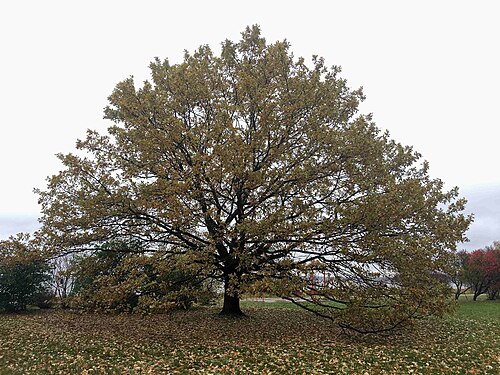
Pedunculate Oak (Quercus robur) · 60-100 years · Kadriorg / Russalka
Estonia moved a road rather than cut this oak down. When the Reidi tee coastal scheme was drawn up, the new carriageway ran straight through the tree; local objection got the alignment bent around it instead, and when the road opened in 2019 the oak was still there. Estonians call it the Reidi tee tamm, after the thing it survived.
That fight is what put it forward. In 2017 it stood as Estonia's entry to the European Tree of the Year and finished eleventh, a respectable placing for a tree this young. The reports put this one at somewhere between sixty and a hundred years, and nobody has published a girth for it, so the age stays a band rather than a number.
It grows on the seafront green beside the Russalka, the bronze angel raised in 1902 for the crew lost when the warship of that name went down crossing to Helsinki. The memorial is older than the tree. Tallinn walks, runs and cycles past both on the Pirita promenade, which puts the oak, the monument and the swerve in the road within a few metres of each other.
Two things are still open here: how old it is, and how thick. If you go past with a tape measure, we would like the number.
Photo: Pilot Lauri Lokotar and CamKaido Kabral, Heiki Hanso (CC BY-SA 4.0)
Pedunculate Oak (Quercus robur) · 300-400 years · Kadriorg
Tallinn's thickest tree was already sizeable when Peter the Great bought the land it stands on. In 1714 the tsar acquired a small coastal manor and its oak grove, then built Kadriorg Palace beside them; a dendrologist who surveyed the grove in 2017 said the oak already had real girth then, meaning it predates both palace and park.
The grove survived because someone kept managing it. For centuries, branches were cut back and young oaks planted in among the old ones to hold a tight canopy, which pushed this one to grow tall and straight rather than spreading wide the way a lone oak does. Landscape architect Georg Kuphaldt folded what was left into Kadriorg Park's naturalistic section from 1897, and the grove, Tammesalu, has outlasted the estate's changes of use since: a private manor, briefly Estonia's presidential grounds, now open parkland.
Two measurements eight years apart agree closely: 637 centimetres round in 2016, 648 in 2024, the kind of slow thickening a tree this old shows rather than one still putting on growth. Kadriorg Park's own site names the same grove as home to its thickest oak. A different tree, a horse chestnut elsewhere in the city, tops Estonia's official monument register, because that one carries its own individual listing and this oak sits inside a protected grove instead.
Nobody has pinned the exact trunk to a coordinate yet. It stands somewhere in the grove's northeastern corner, by Kirdetiik pond.
Pedunculate Oak (Quercus robur) · 390 years · Kadriorg
Tallinn's oldest tree is probably not the one the city points at. The hollow lime beside Niguliste church holds that title by tradition; when Olev Abner, chief dendrologist at Tallinn Botanic Garden, ranked the city's oldest trees for Postimees in 2017, he put this oak above it at 390 years. That ranking is the only source naming this particular tree, so read the number as one expert's reading rather than a settled fact.
Where it came from is not in dispute. It is a remnant of the Kadriorg oak grove, which was standing well before the park that now surrounds it: Peter I bought the small coastal manor and its oaks in 1714 and built Kadriorg Palace beside them. By Abner's figure the tree was already decades old when that sale went through. Kadriorg Park's own history of the grounds says oaks of more than three hundred years still grow in the grove today.
It keeps odd company for something this old. The guardhouse it stands beside went up in 1828, was taken apart and rebuilt to its original appearance in 2006, and now holds the park's museum, library and information point. The oak watched that building arrive, leave and come back.
The pin is the guardhouse rather than the trunk, so the grove around it is where to look. If a plaque there names the oak, we would like to hear about it.
Pedunculate Oak (Quercus robur) · 350 years · Pelguranna / Kopli
This oak was here before the graveyard, and it is still here after it. Tallinn's own park page says it had already grown there before the cemetery was laid out, and it has the age to match: about 350 years by the city's reckoning, 360 by the 2017 survey of Olev Abner, chief dendrologist at Tallinn Botanic Garden, who counts it among the city's five oldest trees. The first burial was on 16 October 1774.
It is what is left of the Kopli tammik, the oak grove that covered this headland before anything was built on it. Soviet authorities closed the cemetery in 1950 and liquidated it into parkland the year after; the writer Eduard Bornhöhe, who had been buried here, was exhumed and reburied at Metsakalmistu on the far side of the city. The oak was left where it stood. Tallinn rebuilt the ground as a proper park between 2002 and 2006, and the children's playground went in beside the tree.
Nobody has pinned it to a coordinate. Both sources place it by that playground, which the city locates opposite Pelguranna 13, and our pin marks the park rather than the trunk, so allow a few minutes of looking. The park's other trees of note, a white pine, alpine and Siberian stone pines and a weeping elm, were all planted after the burial ground was laid out. This one predates it.
Common Lime (Tilia x europaea) · 300-420 years · Kesklinn, on the edge of the Old Town
One of these lindens was already decades old when construction began on the bastion it now crowns.
In 1999 a University of Tartu dendrochronologist cored the two thickest trunks in this row and counted roughly 390 and 300 growth rings, putting their planting near 1609 and 1699. The earlier date sits oddly early: the Skoone bastion's earthworks only went up after 1683. Nobody has resolved the gap. The tree does not need to; it simply kept growing while the fortification rose around it.
The row itself first appears on a 1728 town plan, some nineteen or twenty lindens following the curve of the bastion's outer wall. An 1825 survey counted thirty-nine of them; only thirty-four had survived by the late 1920s. What remains still stands along the earthwork's crest above Rannamäe tee, in a park that has been a Victorian pleasure garden, a Soviet-era dance venue and the edge of a city stadium, and is today mostly just a park again.
The trees have outlasted more than the buildings around them. In 2022 Postimees reported that roots from this same row were pushing apart the three-hundred-year-old stone passage buried in the bastion beneath it, an old fortress losing a slow argument with its own trees.