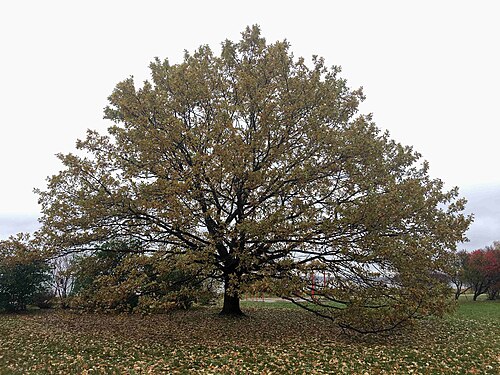
Tallinn's thickest tree was already sizeable when Peter the Great bought the land it stands on. In 1714 the tsar acquired a small coastal manor and its oak grove, then built Kadriorg Palace beside them; a dendrologist who surveyed the grove in 2017 said the oak already had real girth then, meaning it predates both palace and park. The grove survived because someone kept managing it. For centuries, branches were cut back and young oaks planted in among the old ones to hold a tight canopy, which pushed this one to grow tall and straight rather than spreading wide the way a lone oak does. Landscape architect Georg Kuphaldt folded what was left into Kadriorg Park's naturalistic section from 1897, and the grove, Tammesalu, has outlasted the estate's changes of use since: a private manor, briefly Estonia's presidential grounds, now open parkland. Two measurements eight years apart agree closely: 637 centimetres round in 2016, 648 in 2024, the kind of slow thickening a tree this old shows rather than one still putting on growth. Kadriorg Park's own site names the same grove as home to its thickest oak. A different tree, a horse chestnut elsewhere in the city, tops Estonia's official monument register, because that one carries its own individual listing and this oak sits inside a protected grove instead. Nobody has pinned the exact trunk to a coordinate yet. It stands somewhere in the grove's northeastern corner, by Kirdetiik pond.
From people who stood here
No notes yet
Did you visit the tree? Leave a note for the next visitor.
Getting there
Kadriorg Park, the old oak grove (Tammesalu), naturalistic section, near Kirdetiik pond and the Japanese Garden
You can recognise it by the trunk, 6.48 metres round, the thickest in the grove, standing in Tammesalu's northeastern corner near Kirdetiik pond and the Japanese Garden.
Free, public park, open at all times
Tram 1 or 3 to the Kadriorg stop, then roughly a 10 to 12 minute walk through the park to the Japanese Garden / Kirdetiik area
In fruit
October to November: acorns drop, and a good mast year buries the ground in them
The line is our estimate of how much there is to see, not a measurement. Typical for this species where this tree stands; exact weeks shift with the year.
Sources
Where the facts on this page come from. The story was written with AI from these sources, and readers who know the tree correct it.