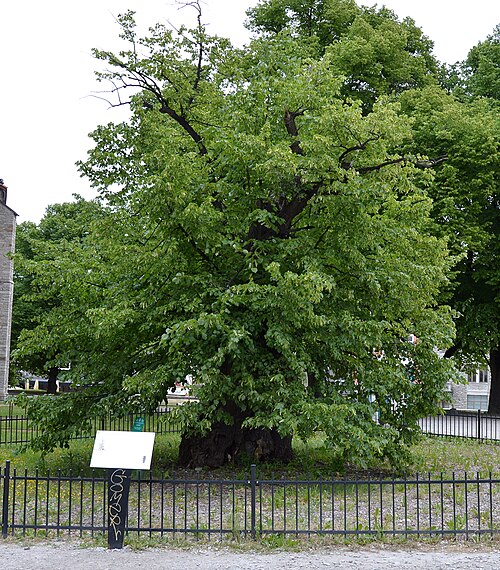
The Kopli Cemetery Park Oak
Pelguranna / Kopli
Approximate location.
This oak was here before the graveyard, and it is still here after it. Tallinn's own park page says it had already grown there before the cemetery was laid out, and it has the age to match: about 350 years by the city's reckoning, 360 by the 2017 survey of Olev Abner, chief dendrologist at Tallinn Botanic Garden, who counts it among the city's five oldest trees. The first burial was on 16 October 1774. It is what is left of the Kopli tammik, the oak grove that covered this headland before anything was built on it. Soviet authorities closed the cemetery in 1950 and liquidated it into parkland the year after; the writer Eduard Bornhöhe, who had been buried here, was exhumed and reburied at Metsakalmistu on the far side of the city. The oak was left where it stood. Tallinn rebuilt the ground as a proper park between 2002 and 2006, and the children's playground went in beside the tree. Nobody has pinned it to a coordinate. Both sources place it by that playground, which the city locates opposite Pelguranna 13, and our pin marks the park rather than the trunk, so allow a few minutes of looking. The park's other trees of note, a white pine, alpine and Siberian stone pines and a weeping elm, were all planted after the burial ground was laid out. This one predates it.
From people who stood here
No notes yet
Did you visit the tree? Leave a note for the next visitor.
Getting there
Kopli kalmistupark, near the children's playground opposite Pelguranna tn 13, Pelguranna, Tallinn
You can recognise it by size and kind: the one big old oak by the children's playground opposite Pelguranna 13. The park's other notable trees are planted conifers and a weeping elm, none of them anywhere near it in age.
Free. Kopli kalmistupark is an open public city park (the former cemetery, closed 1950, turned into a park by 1951 and fully renovated 2002-2006), open at all times.
Bus stop Kari, about a 5-10 minute walk.
In fruit
October to November: acorns drop, and a good mast year buries the ground in them
The line is our estimate of how much there is to see, not a measurement. Typical for this species where this tree stands; exact weeks shift with the year.
Sources
Where the facts on this page come from. The story was written with AI from these sources, and readers who know the tree correct it.