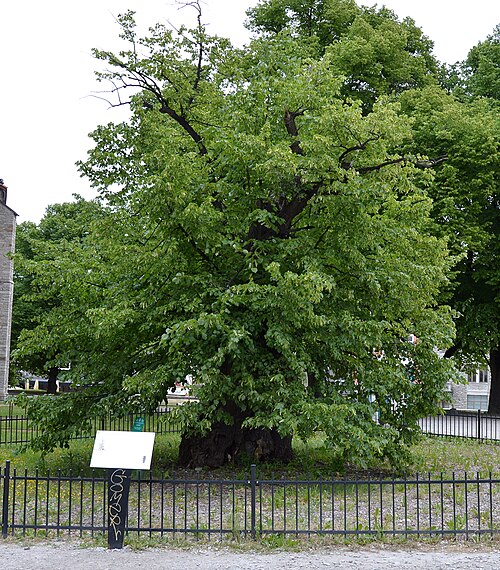
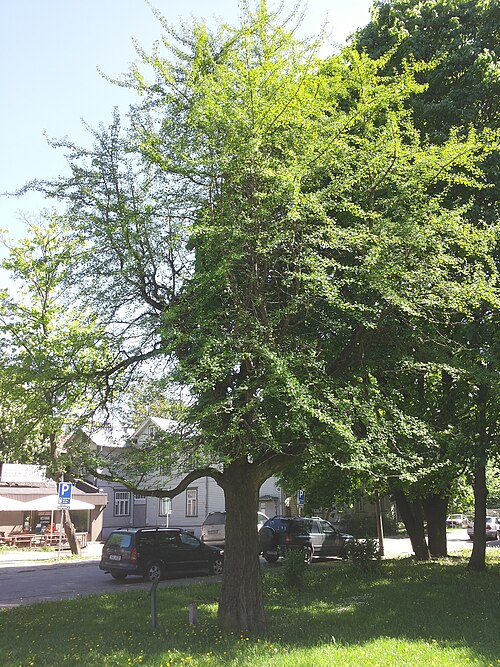
One of these lindens was already decades old when construction began on the bastion it now crowns. In 1999 a University of Tartu dendrochronologist cored the two thickest trunks in this row and counted roughly 390 and 300 growth rings, putting their planting near 1609 and 1699. The earlier date sits oddly early: the Skoone bastion's earthworks only went up after 1683. Nobody has resolved the gap. The tree does not need to; it simply kept growing while the fortification rose around it. The row itself first appears on a 1728 town plan, some nineteen or twenty lindens following the curve of the bastion's outer wall. An 1825 survey counted thirty-nine of them; only thirty-four had survived by the late 1920s. What remains still stands along the earthwork's crest above Rannamäe tee, in a park that has been a Victorian pleasure garden, a Soviet-era dance venue and the edge of a city stadium, and is today mostly just a park again. The trees have outlasted more than the buildings around them. In 2022 Postimees reported that roots from this same row were pushing apart the three-hundred-year-old stone passage buried in the bastion beneath it, an old fortress losing a slow argument with its own trees.
From people who stood here
No notes yet
Did you visit the tree? Leave a note for the next visitor.
Getting there
Rannamägi park (the former Skoone bastion), along Rannamäe tee, Kesklinn, Tallinn
Look along the grassy ridge above Rannamäe tee, on the inside curve of the old bastion: a row of tall lindens, two of them noticeably thicker in the trunk than their neighbours. Those two are the ones the 1999 tree-ring study dated oldest.
About 15 minutes on foot from Viru Gate, Tallinn Old Town
In bloom
July to August, when it flowers
The line is our estimate of how much there is to see, not a measurement. Typical for this species where this tree stands; exact weeks shift with the year.
Sources
Where the facts on this page come from. The story was written with AI from these sources, and readers who know the tree correct it.