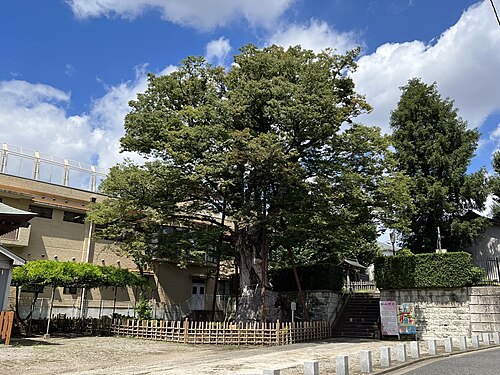
Six great zelkovas stood at this shrine when the Meiji era began.
Zelkova serrata
In Japan this tree is keyaki, the timber temple carpenters and taiko drum makers reach for first, and the giants that survive tend to stand where nobody could cut them. We map 22 of them, in 20 cities.
Japan's largest grows in the playground of Higashine Elementary, on the site of a 1347 castle keep: 16 metres round at chest height, a Special Natural Monument, and the children are taught that catching three falling leaves earns a wish. In Haramachi traffic goes around another of the country's three great zelkovas in the middle of a junction. A Korean queen is recorded resting under the zelkova at Hwayang-dong in Seoul in 1882, in disguise, fleeing soldiers who had stormed the palace; it is about 700 years old. Leiden's are the first zelkovas ever to leave Japan, and Florence's has been measured three times in forty years, growing from 3.30 metres round to 4.40.
Six great zelkovas stood at this shrine when the Meiji era began.
Keyaki, the Japanese name for this species, is the timber temple carpenters and drum makers reach for first, which is one reason very large ones are not common.
A poem about a circus came out of this shrine yard.
This shrine was once called the shrine of the great tree, and the great tree is gone.
The health column for this tree does not say good.
Practically the only thing anybody has published about Miyano Hachiman Shrine is its postal code, and two of its trees are on a national register.
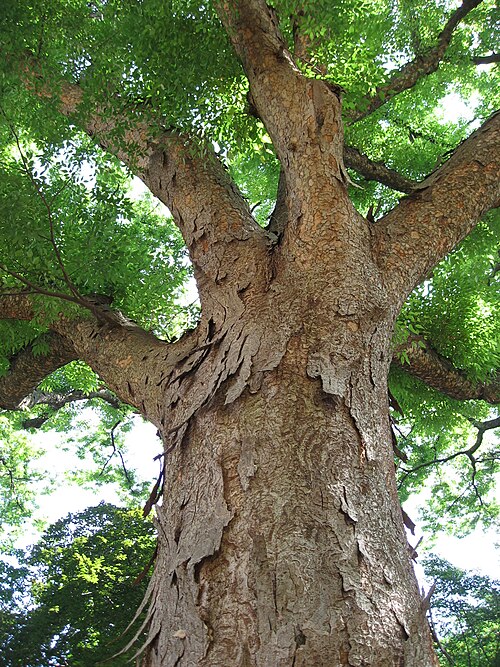
Somebody has put a tape around this trunk three times in forty years: 3.30 metres in 1980, 3.89 in 2001, 4.40 in 2021.
Photo: Line1 (CC BY-SA 3.0)
The shrine this tree served was closed in 1912.
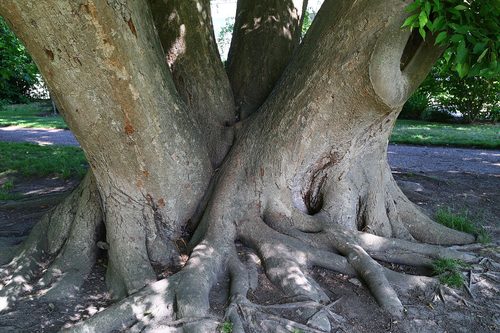
This is not one tree with four stems.
Photo: Hans Erik Lund
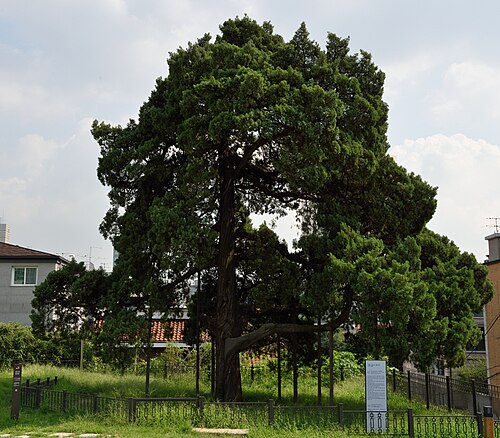
A queen once caught her breath under this tree while fleeing a mutiny.
These are the first zelkovas that ever left Japan.
Twenty-eight metres of zelkova on a shrine slope that most visitors cross without stopping, on their way between the Great Buddha and Nigatsu-do.
The crown of this zelkova spreads 26 metres one way and 33 the other, nearly as wide as the tree is tall.
Uesugi Kagekatsu began building a castle on this ground in 1600 and never finished it.
One of Japan's three great zelkovas stands in the middle of a road junction.
Japan's largest zelkova grows in a primary school playground.
Two zelkovas flank the path to Negoya Shrine, Tagi on the rice-field side and Hatagi on the dry-field side, and Hokuto's farmers still read their spring in the order the pair comes into leaf: Hatag...
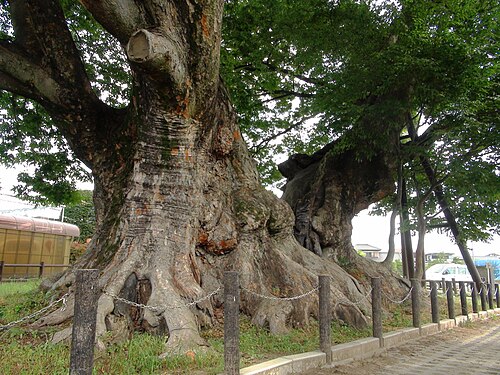
It looks like two trees leaning together.
Photo: Sakaori (talk) (CC BY-SA 3.0)
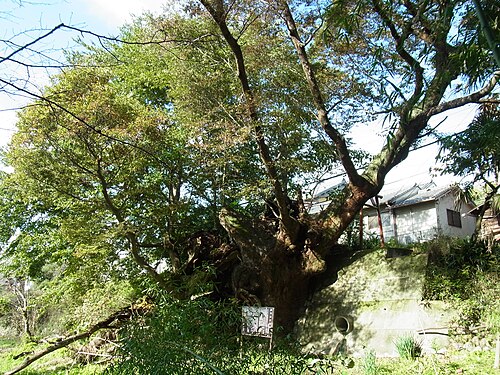
Once a year, priests from another town come down to the riverbank under this tree and fill a vessel with water.
Photo: Nankou Oronain (as36… (CC BY-SA 3.0)
Seven trees line the west and southwest edges of Webster Park, and the city's own heritage register singles out one of them as almost the biggest of its kind in Washington.
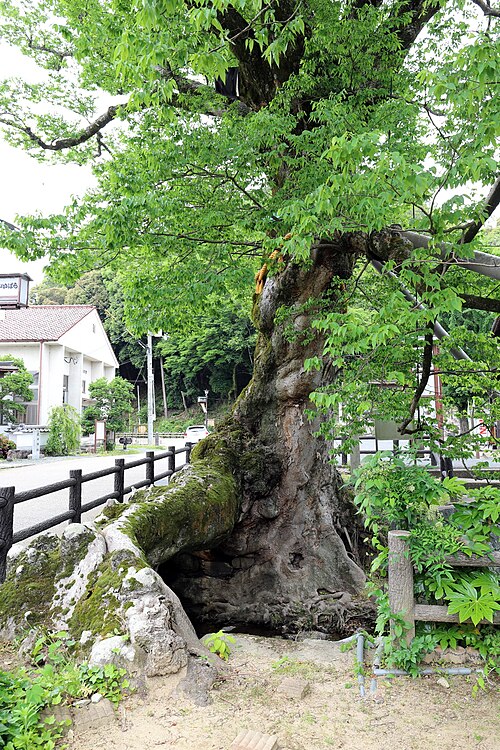
A root did what no engineer asked it to do.
Photo: 藤谷良秀(Fujitani Yoshihide) (CC BY-SA 4.0)
When it was listed in 1928 this was called the finest zelkova in Hyogo Prefecture.
Explore by city: Tokyo · Kyoto · Kanazawa · Hiroshima · Florence · Osaka · Copenhagen · Seoul · Leiden · Nara · Takachiho · Hokuto · Spokane · Yabu · every city · or browse all species.