Hiroshima keeps a register of 160 trees that were standing on 6 August 1945, within about two kilometres of the hypocentre, each recorded by species, address and distance from the blast. The closest is a weeping willow 370 metres away. Almost all were burned back to the trunk and put out shoots the following spring, which is the thing people came to look at. Seventeen from that register are here, plus sixteen more, unrelated to the bombing, from Japan's national survey of giant trees: shrine and temple veterans scattered across the city's outer wards.
0 of 33 visited in Hiroshima
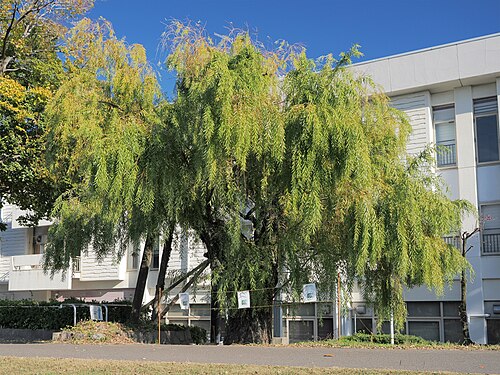
Weeping Willow (Salix babylonica) · 81 years · Motomachi
Three hundred and seventy metres. That is the whole of what makes this willow remarkable, and it is enough: no registered survivor in Hiroshima stood closer to the point the bomb went off. It is the first entry on the city's list, N03a1-01, and the code itself carries the facts. N for north of the hypocentre, 03 for the three hundred metre band, a for never transplanted. It is standing where it stood. A weeping willow is not a strong tree. It is fast, soft-wooded and short-lived, the sort of thing a city plants along a river because it grows quickly and looks well over water, and at this distance the heat and the blast took everything above ground. What survived was underground. The willow came back from its own roots, which is how most of the trees on this register survived, and the trunk you stand in front of grew after 1945 from a root system that did not. Nobody has published its age. The register does not carry one, because the register was built to record a distance rather than a life. It stands in the Chuo Park green space west of the Youth Centre, on ground that is now grass and paths and was, for a while after 1945, expected to grow nothing at all.
Camphor Tree (Cinnamomum camphora) · 81 years · Nakamachi
Shirakami Shrine sits on a rock. Before Hiroshima was built out across its delta the sea came up to this point, and the outcrop the shrine stands on was a landmark for boats, which is why there is a shrine here at all and why the ground was never levelled. Three camphors grow in the courtyard, 490 metres from the hypocentre, and the city registers all three as A-bombed trees under one code, S04a4-01 to 03. The a in that code matters: none of them has been moved. They are the closest camphors on the register, and camphor is the tree that does best on this list, with more entries than almost any other species, because a mature camphor carries an enormous root system and a thick corky bark that a flash of heat scorches rather than kills. The shrine itself burned. The trees held. Stand in the courtyard now and the odd thing is how ordinary it looks: a small shrine wedged between office blocks a few minutes from Peace Boulevard, with three big trees in it and traffic on both sides. No age is recorded for any of the three. They were grown trees in 1945, which puts a floor under them and nothing more.
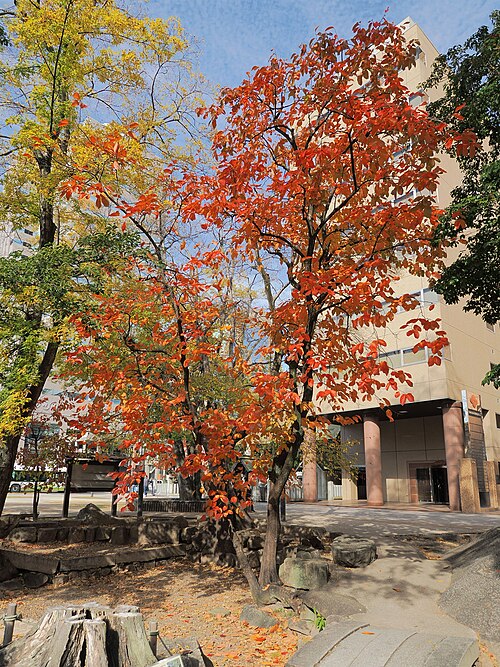
Japanese Persimmon (Diospyros kaki) · 81 years · Komachi
There is a persimmon tree on Peace Boulevard that was 530 metres from the bomb and still fruits. It stands in the strip of planting outside Shirakami Shrine, one tree among a group the city registers together at that distance: two hackberries, two muku trees, five kurogane hollies, a bead tree and this persimmon, S05a6-11. A persimmon is an orchard tree, not a monument. It was somebody's fruit tree in a garden in a neighbourhood that no longer exists, and the boulevard it now stands on was cut through the burnt ground afterwards as a firebreak a hundred metres wide. Persimmons ripen hard and orange in late autumn and hang on the bare branches into December, and the fruit of this one is edible in the ordinary way, which is a strange thing to know while standing half a kilometre from the hypocentre. The city does not record its age and nothing about it is signposted as spectacular. It is on the list because it was here, and because it went on doing the only thing a fruit tree does.
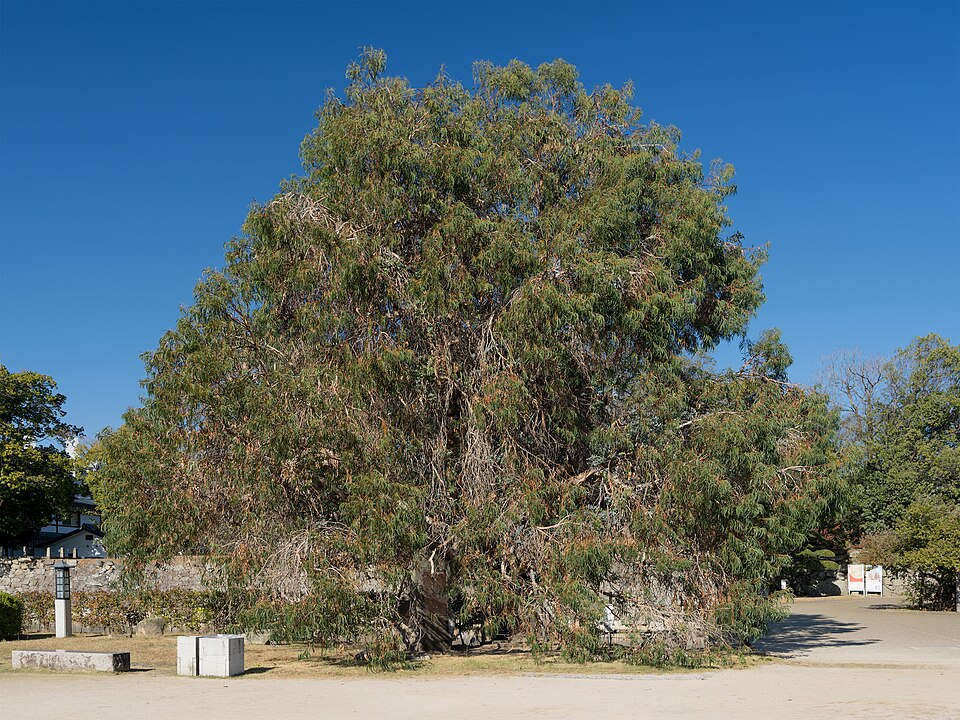
Eucalyptus (Eucalyptus globulus subsp. bicostata) · 81 years · Motomachi
An Australian tree survived the bomb in the grounds of a Japanese castle. The eucalyptus in the ninomaru at Hiroshima Castle stood 740 metres from the hypocentre and is registered as N07a7-01, never moved. Everything around it went. Hiroshima Castle had stood since the 1590s and was one of the few original keeps left in Japan; it came down in the blast and what stands there now was rebuilt in concrete in 1958. The castle grounds were not a park in 1945. They held the headquarters of the Second General Army, which is part of why the city was a target, and the ninomaru where this tree grows was inside a working military compound. Beside it on the same register entry is a giant pussy willow at the same distance. How a eucalyptus came to be planted here is not recorded on the city's list, though the species was widely brought into Japan from the late nineteenth century for its speed. It has a habit that suits this ground: eucalypts carry dormant buds under the bark along the whole trunk, which is exactly the equipment a tree needs to come back after fire.
Chinese Parasol Tree (Firmiana simplex) · 81 years · Nakajima-cho
Four of these grew in the courtyard of the Hiroshima Telecommunications Bureau, 1,300 metres east of the hypocentre, and nothing stood between them and the flash. One burned. Three did not, and the following spring they put out buds, in a city where the working assumption was that nothing would grow for seventy years. That fact travelled further than the trees did. In 1973, when the postal bureau rebuilt, the survivors were lifted and moved into Peace Memorial Park, where two of them stand now on the north side of the museum's east building, trunks hollowed out on the side that faced the blast and closed over with new growth on the other. The third died in 1996, and one of the remaining two was blown over by a typhoon in 2004 and put back up by the city. Seeds off them are sent all over the world as second-generation aogiri; one is growing in the garden of the Truman Presidential Library, planted by Harry Truman's grandson. In 2001 a nine year old girl from a Hiroshima primary school wrote a song about the tree that won the city's millennium competition, and Hiroshima put it into the public domain so anyone could sing it. They flower yellow in June and July.
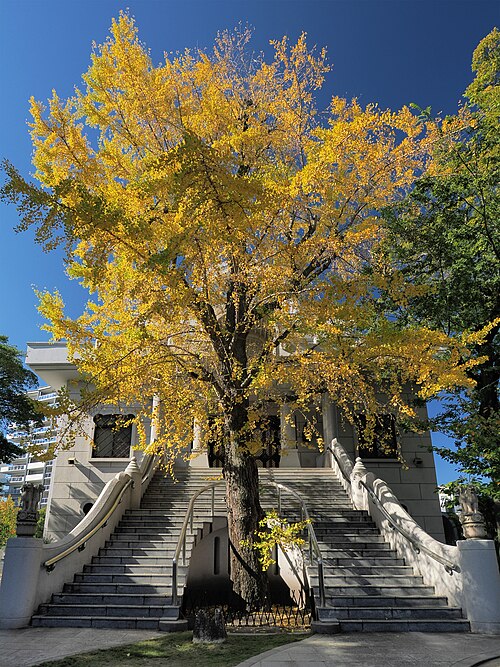
Ginkgo (Ginkgo biloba) · 81 years · Teramachi
Teramachi means temple town, and it is a single street of them, laid out when the Asano lords moved Hiroshima's temples together in the seventeenth century so they would form a defensive line along the river. On 6 August 1945 that put a dozen temples in a row 1,100 metres from the hypocentre. The ginkgo at Hosenbo is the one that is still there, registered as N11a19-01 and never moved. Ginkgo is the species most associated with surviving the bomb, and the reason is not sentimental. It carries an enormous amount of water in a thick, spongy bark, it sprouts readily from the base and from dormant buds on old wood, and it is fire-resistant enough that Japanese temples have planted it against fire for centuries, which is why so many of the trees standing near the hypocentre in 1945 were ginkgoes in the first place. The temples along this street burned. Walk it now and it is quiet, narrow, entirely rebuilt, with old trees in the gaps between new buildings. No age is recorded for this one.
Ginkgo (Ginkgo biloba) · 81 years · Kaminobori-cho
Shukkeien was made in 1620, the year after Asano Nagaakira came to Hiroshima, as the lord's garden beside his castle. It is a shrunk-down landscape, which is what the name means, with a pond standing in for a famous Chinese lake and a bridge over it, and it was designed by a tea master rather than a gardener. On 6 August 1945 it was 1,370 metres from the hypocentre. The garden burned and its buildings went, and people who had run from the city centre came here and died in the grounds; the garden was closed for six years and reopened in 1951. Three of its trees are on the city's register and have never been moved: this ginkgo, a muku and a black pine, all under the code E13a25. They are the oldest things on this page in all likelihood, because they were mature garden trees in a garden already three centuries old, though nobody has published a number for any of them. The ginkgo goes yellow in the second half of November, at the same time as the maples the garden is visited for.
Ginkgo (Ginkgo biloba) · 81 years · Ushita
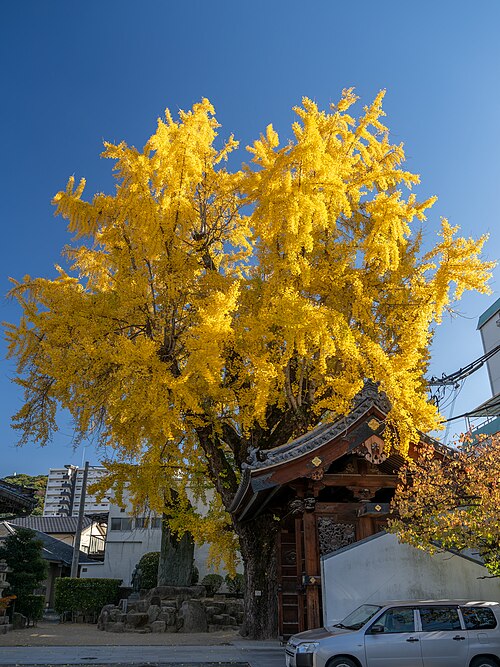
In 1990 this temple built a new gate and cut a hole in the roof so the tree could carry on through it. The ginkgo at Anrakuji was 2,160 metres from the hypocentre, the farthest tree on this page, and distance did not spare it: it burned down to the trunk and put out shoots from a branch the following year. The temple's main hall came through the fire as a skeleton, and the accounts credit the neighbours who fought the fire and the big ginkgo in the grounds with slowing it. When the temple came to rebuild its gate beside the tree, the decision recorded is blunt and not sentimental: the tree would not be cut. So the roof was designed with an opening and the ginkgo grows up through it. The gate was repaired in 1994 and still leans north, which is the direction the blast came from, and it is on the city's register of A-bombed buildings in its own right. The tree is 20 metres tall with a trunk 4.55 metres round, the only one on this page for which anybody has published a measurement.
Camphor Tree (Cinnamomum camphora) · Oomiya, Nishi-ku
Nobody at this shrine calls this tree by its species. It is the husband, Otoko-gusu, and the camphor standing beside it is the wife.
The two were a landmark for anyone leaving Hiroshima on the road north towards Kabe, a pair of crowns you steered by. This is the larger one. The national giant-tree register measured it in 2000 at 6.4 metres round and 35 metres tall, and recorded its health as good. The prefecture's own encyclopedia of Hiroshima publishes 6.5 metres, close enough to be the same tape read twice.
The camphors and the grove around them carry a natural monument designation, and the paperwork behind it does not agree with itself. The encyclopedia calls it prefectural. The national register's own code reads municipal. Both are recorded here as they stand.
The shrine keeps a harder record than either. Its main hall sits 2.9 kilometres from the hypocentre and is on the city of Hiroshima's list of structures that survived the atomic bomb.
Nobody has dated the camphor. The register's age band is blank, and camphor growth varies too much between sites to run an age backwards off a trunk. If you know when this one went in, tell us.
It is a separate errand from the downtown trees, about two and a half kilometres north and five minutes on foot from the Oshibacho bus stop.
Camphor Tree (Cinnamomum camphora) · Oomiya, Nishi-ku
Every published account of these two camphors calls them a matched pair, both around 30 metres tall. The people who came with a tape found something else.
Surveying the trees one by one in 2000, the national giant-tree register put the husband at 35 metres and this tree, Onna-gusu, the wife, at 23. The girths run the same way: 5.4 metres here against 6.4 next door. The prefecture's encyclopedia of Hiroshima publishes 5.5 metres for this trunk, close enough to be the same measurement in a different hand, but the heights have never been reconciled and both sets of figures stand.
None of that makes it a small tree. The same survey recorded its health as good, and a 5.4 metre trunk holds its own beside anything else in the grove. The two camphors and the grove around them are a designated natural monument, prefectural by the encyclopedia's account and municipal by the code on the national register.
The ground it stands on carries a formal record of its own. The shrine's main hall is 2.9 kilometres from the hypocentre and appears on Hiroshima's official list of hibaku kenzobutsu, the buildings left standing after the atomic bomb.
The age of this camphor has never been established and the register leaves the field blank. If somebody has a planting date, or a shrine record that gives one, we would like to hear it.
Chinese Hackberry (Celtis sinensis) · Oomiya, Nishi-ku
The national register that catalogues this tree keeps a field for a local nickname. Beside the two camphors on the same grounds it is filled in. Beside this one it reads: none.
That is the only modest thing about it. The 2000 giant-tree survey recorded an enoki, the Chinese hackberry, with a trunk 4.82 metres round and a crown at 26 metres, health good. By the register's own figures that puts it three metres above the celebrated wife camphor on the same grounds, and nobody has ever given it a name for the trouble.
It is part of the shrine's wood rather than a specimen planted in front of it. The prefecture's encyclopedia of Hiroshima, describing that wood, lists enoki among its broadleaves alongside zelkova, mukunoki and mukuroji, though it names no individual tree and publishes no measurements. Two sources for the species and the grove, then, and one for the tape.
The wood grows on ground the city has formally recorded: the shrine's main hall, 2.9 kilometres from the hypocentre, is one of Hiroshima's listed hibaku kenzobutsu, the buildings that were still standing after the atomic bomb.
The hackberry's age has never been documented. The register left the band empty and no second source fills it, so if you know anything about when it went in, tell us.
Camphor Tree (Cinnamomum camphora) · Motoujina (Ujina Island), Minami-ku
Two accounts of this camphor disagree about its age by more than a century and a half. One puts it at roughly 300 years. Another says only that it is over 135. Neither number is tied to a planting record, so the honest answer is that nobody has dated this tree. What has been measured is the trunk: the national giant-tree survey taped it at 5.6 metres round in 2000, and other sources give 5.5 and 5.9, which is the ordinary spread you get when people measure a fluted camphor at slightly different heights on different days. It stands at the foot of the Ujina Lighthouse in Motoujina Park, on the water at the southern edge of Minami-ku, inside the Seto Inland Sea National Park. Under either reading of its age it was already growing here when the lighthouse was built in 1950, and the two of them are now the ward's own set piece: the guided walks are advertised as the large camphor tree and the Motoujina lighthouse, in that order. Hiroshima's own ward page keeps the description short, a thick trunk and a spreading crown at the foot of the light, and confirms the coastal promenade past it is open to walkers, typhoon closures aside. The pin marks the lighthouse rather than the trunk, which puts you within a few steps. If you know when this one went in, tell us.
Japanese Black Pine (Pinus thunbergii) · 390 years · Nagatsuka, Asaminami-ku
Nine metres tall and twenty-six metres wide, this pine is close to three times broader than it is high, and twenty-four wooden posts hold it that way. The branches are trained out almost horizontally, and the shape they make gave the tree its name: Rengematsu, the lotus pine, an open flower. By temple tradition it went in when Renkoji moved to this site in Kan'ei 7, which is 1630, though one account of the move dates it to 1624 instead. The information board beside the tree is careful with its wording, saying the pine is said to have been planted then rather than recorded as such, and the national giant-tree survey is vaguer still: 300 years or more. Edo-period Hiroshima thought enough of it to give it two further names. The Asano lord is said to have rated it against the famous pine of Karasaki on Lake Biwa, after which it was known as the Karasaki pine that would flee barefoot. The other name is the reclining dragon. Hiroshima Prefecture made it a Natural Monument on 23 April 1954. The trunk measures 3.2 metres round on the temple's own board and 3.5 in the national survey, an ordinary disagreement for a trunk trained this hard. The grounds are free and open, and the temple's Edo-period gate and Kannon hall stand beside it, both of which came through the 1945 bombing.
Ginkgo (Ginkgo biloba) · 225-325 years · Kabe-minami, Asakita-ku
The 1943 flood carried off the shrine's torii gate. The ginkgo standing behind it did not move, and the gate took sixty-nine years to come back: the replacement went up only in 2012.
Tomohiro Shrine sits on low ground in Nakajima, boxed in by the Ota, Nenotani and Misasa rivers, in an area with a long history of flooding. The Chugoku Shimbun, Hiroshima's own paper, went out to profile the tree for coming through that one intact. The city counts it among Hiroshima's three major ginkgo trees and made it a designated natural monument in April 1995.
The measurements disagree slightly, and the reason is mundane: the city records a girth of 415cm at chest height, the Environment Ministry's giant-tree register 419cm, taken on a different day by different hands. Both put it around 25 metres tall, with limbs reaching almost ten metres out to the north. The register's 2000 survey placed it in the 200 to 299 year band, which makes it somewhere between 225 and 325 years old now.
It is a male tree, so late November brings the gold without the fallen fruit that gives ginkgo pavements their reputation. Eight minutes on foot from Nakashima Station, and the gate you walk under is younger than almost everyone walking under it.
Japanese Cedar (Cryptomeria japonica) · 200-400 years · Yuki-cho Ege, Saeki-ku (Mount Togo)
About three or four metres up, this cedar stops being one tree. The trunk divides into four stems, each more than a metre thick, which is where the name comes from: Shihon-sugi, the four-trunk cedar. Japanese accounts describe it as four cedars fused into one, presenting a different silhouette from every angle you walk it from.
The Forestry Agency named it one of the 100 Giant Trees of Japan in 2000. After that the sources stop agreeing. The Kinki-Chugoku forest office, which manages the tree, measured 11.5 metres of girth in 2002 and gives the height as 46 metres and the age as 190 years. The Environment Ministry's register, surveying in 1988, recorded 9.9 metres round and no age at all. A hiking page puts the chest-height girth at 14 metres, and one tree-hunter's site matches the register's girth while claiming 30 metres of height and 400 years of age. Somewhere inside that spread stands a very large cedar, and nobody has settled which figures are right.
Getting to it is the price of admission. The tree is on national forest land on Mount Togo, up a forest road to a trailhead roughly half an hour's drive from Yuki, then sixty to ninety minutes on foot with a steep finish. Hikers logged the trail as recently as 2022. Wear proper boots, and expect to hunt: it stands on the descent path rather than at any address.
Japanese Cedar (Cryptomeria japonica) · 600 years · Ayagaya, Kabe-cho, Asakita-ku (Mount Fukuo)
Five cedars were planted on this hillside in 1391. Three are still alive. The temple keeps the details: the year was Meitoku 3, the Takeda clan paid for the work, the priest Ryokai was rebuilding the main hall at the time, and the trees went in alongside it. The Edo-period gazetteer Geihan Tsushi records them as well, and the city lists them as a natural monument. Their name is Tomyo-sugi, the Lantern Cedars, and it comes from an epidemic. People from the district climbed up here and lit lanterns in front of the trees in prayer, and by local telling the sickness went away. The losses have been recent rather than medieval. One cedar was felled in 1982 because it looked ready to come down, and another died and was cut back to a stump 2.2 metres high in 2004. What remains stands about 37 metres tall, and the thickest trunk measured 5.15 metres round in a national survey in 2000. That survey guessed the trees at only 200 to 300 years old, which sits badly against a planting recorded by date in 1391; the dated record is the better evidence, but the disagreement is worth knowing about. They are the first thing past the Niomon gate, up 53 stone steps, on a mountain people here call Aki no Koyasan. The last half hour from the bus stop is uphill on foot.
Ginkgo (Ginkgo biloba) · 1,500 years · Kawachi-nukui, Asaminami-ku
This ginkgo grows roots out of its own branches. They hang down through the crown in pale columns, a habit that only turns up on very old trees of this species, and it is where the neighbourhood name comes from: Chichisagari Icho, the milk-drop ginkgo. Hiroshima's heritage record designated it in 1979 and put its age at about 1,500 years. That number is the designation's own account rather than a ring count or a documented planting, so it is a broad guess and should be read as one: somewhere in the range of 1,200 to 1,600 years, with nobody having cored the tree to check. The trunk is either 5.25 metres round or 4.18, depending on which survey you take. The heritage record gives the larger figure, the Environment Ministry's giant-tree register gives the smaller one from its visit in 2000, and the gap is most likely the height at which each of them ran the tape, or the twenty years between the two measurements. It stands 24 metres tall, with limbs reaching nine and a half metres from east to west. The shrine sits in Kawachi, on the flat ground between the Ota and the Furukawa, two rivers with a long history of putting this district under water. Grounds are free and open in daylight. No station is within walking distance, so it is a local bus toward Kawachi or a car.
Japanese Bay Tree (Machilus thunbergii) · Numata-cho Ato, Asaminami-ku
Somebody measured this tree twice, twenty six years apart, and in between it had put on eleven centimetres. The first figure, 3.62 metres round, sits in the 1974 papers that made the grove at Ato Myojin Shrine a Hiroshima City natural monument. That listing covers the whole stand rather than any single trunk, and names this laurel in its description as the representative large tree of the area. The second figure, 3.73 metres, comes from the Environment Ministry's national survey of giant trees, which reached the precinct in 2000 and recorded it in good health.
It is a tabunoki, the broad evergreen laurel that fills the warm coastal forests of western Japan and turns up on shrine ground all over the region, keeping its gloss through the winter. It has a cedar of almost exactly its own size for company a few steps away, and two smaller umbrella pines behind that. Shrine tradition puts the foundation at 852 and records a reorganisation in 1837, when the old Ato Myojin was merged with a Hachiman shrine.
What nobody has recorded is the tree's age. Various trees here are said to have gone in around that 1837 rebuilding, but no source ties this one to it, so the honest answer is that we do not know. The registers give its waist and its health and stop. If you know when it went in, tell us.
Japanese Cedar (Cryptomeria japonica) · Numata-cho Ato, Asaminami-ku
In 1974 the cedar at Ato Myojin Shrine measured 3.41 metres round. In 2000 the Environment Ministry's giant-tree surveyors put a tape around it and got 4.10 metres. Sixty nine centimetres in twenty six years, while the evergreen laurel standing a few steps away in the same grove managed eleven.
Cryptomeria japonica does that. It is the tree Japan has planted for timber and for shrines for more than a thousand years, straight, fast and fibrously red-barked, and a shrine cedar left standing rather than cut is a cedar allowed to show what the species can do. This one was recorded in good health.
The grove around it is what the city actually protected, listed as a natural monument in February 1974, up in the hills of Numata-cho well outside central Hiroshima. Shrine tradition dates the foundation to 852 and a reorganisation to 1837. Several trees here are said to have been planted around that rebuilding, but no source ties this cedar to that date or to any other, so its age is genuinely open.
One loose end we would rather state than hide: a local account refers to a giant cedar at this shrine that is no longer there. We have not been able to read it, and it may well describe a different tree, since the surviving cedar is the one both the 1974 and the 2000 records measure. If you have walked up recently, tell us what is standing.
Japanese Cedar (Cryptomeria japonica) · Kuchita-minami-cho, Asakita-ku (Mount Matsukasa)
There is no road to this one. The inner sanctuary of Matsukasa Kannon sits near the summit of Mount Matsukasa, 374 metres above northern Hiroshima, and the way up is a marked hiking trail from JR Tosaka station. What is waiting at the top is a Japanese cedar 4.80 metres round, measured by the Environment Ministry's giant-tree surveyors in 2000 and recorded in good health.
The temple is Shingon and dates its founding to 1530. Its main hall is down in Tosaka, in Higashi-ku, while the oku-no-in, the inner sanctuary, stays up here, an arrangement common enough in Japanese mountain temples: the older and quieter half of a place is often the half you have to climb to. Walkers who have made the trip recently describe a well used path with a landslide detour in place since 2018, a Kobo Daishi well, a Shaka hall and a Mizuko Kannon. A second registered tree stands on the same ground, an oak of 3.10 metres that nobody has named.
The cedar has no recorded age. No second source describes it at all, which is the ordinary fate of a tree only walkers ever see: the register measured it, and everything written about this mountain is about the temple rather than what grows beside it.
If you have climbed up and know more, or have dated it, tell us and we will put it on the page.
Muku Tree (Aphananthe aspera) · Nakano-higashi, Aki-ku
The famous tree at Kirihata Shrine is not this one. That is the great zelkova, 5.6 metres round and 28 metres tall, protected as a Hiroshima City natural monument since February 1974 together with the evergreen shii forest on the slope behind. This is the muku, three metres round, listed in the Environment Ministry's national survey of giant trees and named by nobody else at all.
Aphananthe aspera is worth knowing about anyway. Its leaves dry so rough that woodworkers once used them as sandpaper on wood and horn, and it carries small dark fruit in autumn that the birds strip. It seeds easily and grows fast on good ground, which is why it ends up standing on shrine land: that is where the ground stops being turned over.
Kirihata sits on a hillside about a hundred metres east of Route 2, between Seno and Nakano-higashi stations on the Sanyo main line, ten or fifteen minutes' walk from either. A giant-tree cataloguer who visited in 2017 described ordinary shrine access, which is what it is. Gate, steps, trees, no ticket, and the dark evergreen hill rising behind.
The muku's age is recorded nowhere we can find. The 2000 survey took its girth and left the health column blank, and no source since has said a word about it. If you can date it, or have put a tape round it lately, we would like to hear from you.
Japanese Cedar (Cryptomeria japonica) · 300 years · Yuki-cho Fushidani, Saeki-ku
The Environment Ministry's surveyors reached this shrine in 1988, put a tape round the cedar at chest height and got 5.80 metres. Then they did something the register rarely does: they gave the tree an age. Over three hundred years.
That figure is the register's own rather than ours, and it is a band rather than a date. Take it at face value and this cedar was already standing in the late 1600s, stood through the rest of the Edo period, and was standing in August 1945, an hour of mountain road west of what happened to the city. Yuki-cho is deep in Saeki-ku, and the distance is the whole of the reason.
Omori Hachiman is a small shrine at Fushidani, two minutes from the Omori bus stop and roughly fifty minutes from central Hiroshima. The old Saeki-gun gazetteer traces its founding to a transfer from Usa Hachimangu in the Yomei era, which is the lineage most Hachiman shrines in western Japan claim and few can document. The cedar was recorded in good health. A daimyo oak of 3.30 metres stands on the same ground, and the register gives that one the same three hundred years.
What no source gives is a planting date, or any story attached to this particular trunk. Somebody in Omori almost certainly knows one. If that is you, tell us.
Daimyo Oak (Quercus dentata) · 300 years · Yuki-cho Fushidani, Saeki-ku
A daimyo oak this size is unusual enough to be the whole point. Quercus dentata is a slow, often stunted tree of poor ground and cold slopes, and it rarely puts on real bulk. The Environment Ministry's surveyors measured this one at 3.30 metres round in 1988, in good health, at a small Hachiman shrine in the mountains of Yuki-cho, and gave it the same age band as the great cedar standing with it: over three hundred years.
Its leaves are the reason most people in Japan know this species without knowing they do. Kashiwa is the oak whose broad leaves wrap the rice cakes eaten at Children's Day, chosen because the old leaves stay on the branch all winter and let go only when the new buds push them off, which was read as a family line that does not break. On a tree of this age the effect runs for months. Brown leaves hanging into spring, on a crown that has not looked bare since the last time somebody was watching.
The shrine sits at Fushidani, two minutes from the Omori bus stop, about fifty minutes out of central Hiroshima. Beyond the register, no source names this oak at all, so the three hundred years is as close to an age as anyone has published. If you know better, we would like to be corrected.
Hinoki Cypress (Chamaecyparis obtusa) · Yuki-cho Yunoyama, Saeki-ku
The tree stands next to a bathhouse. Yunoyama Myojin's torii sits beside the Yunoyama Onsen-kan, in an old hot spring settlement in the mountains of Yuki-cho, about fifty minutes by road from central Hiroshima, and the shrine's hinoki cypress was measured at 3.40 metres round by the Environment Ministry's giant-tree surveyors in 1988. Health, that year: good.
Hinoki is the most valued softwood in Japan. It is the timber that rebuilds the Ise shrines every twenty years, the wood of temple pillars and bath tubs, and the smell people mean when they say a Japanese bath smells of wood. A working forest does not produce a cypress of this girth, because a working forest fells them long before. The big ones are almost all standing on shrine and temple ground, which is the polite way of saying somebody decided they were not for cutting.
What we have on this one is thin, and it is better said plainly than dressed up. The national register carries it, with species, girth and a health note, and beyond that we have found only general confirmation that the shrine and its torii stand where the register puts them, beside the bathhouse. No age has ever been published. Nothing we can find has been written about the tree itself.
If you have soaked at Yunoyama and looked up on the way out, tell us what is there.
Chinese Hackberry (Celtis sinensis) · Ato-cho Kunikusa, Aki-ku
As far as we can establish, one document in the world records this tree. The Environment Ministry's national survey of giant trees sent somebody to Ato Kojin Shrine in the year 2000 to measure a Chinese hackberry at 3.80 metres round and note that it was in good health. Two searches for anything else at all about this shrine came back with nothing.
That is not unusual for a Kojin shrine. They are the small ones, the local ones, dedicated to the rough deity of the hearth and the fire, and there are a great many of them in this part of Japan. They tend to sit at the edge of a hamlet with a few big trees and no visitors, which is precisely the arrangement that produces a hackberry of this size.
Celtis sinensis is a workhorse of a tree: fast, tolerant, hard to kill, planted at road junctions and field corners all over the country, with small dark fruit in autumn that the birds take. Getting to nearly four metres round means it has been left alone for a very long time by people who had no particular reason to leave it.
How long, we cannot tell you. There is no age on the record and no second document to check one against. If you live in Kunikusa and know this tree, that is a gap you could close for us.
Saw-leaf Zelkova (Zelkova serrata) · Ato-cho Masukoshi, Aki-ku
The health column for this tree does not say good. It says partly withered: some of the crown is dead, the tree is not. That was the Environment Ministry surveyor's verdict in the year 2000, and it remains the only assessment anybody has published of the zelkova at Masukoshi Shrine, a tree 3.29 metres round on shrine ground in Ato-cho, out in the rural east of Aki-ku.
Dieback in an old zelkova is ordinary rather than terminal. The species is the great vase-shaped broadleaf of Japanese towns and shrine approaches, the one that makes a tunnel of leaves over a road, and the timber temple carpenters want for beams and drum makers want for bodies. A veteran tends to lose the top of its crown limb by limb across decades while the rest of it carries on underneath.
So what a visitor is likely to meet is a big tree with gaps in it, which is what an old tree looks like when it is being honest. We have not found one other source that mentions this shrine by name, which means no age, no history and no second opinion on its condition in the twenty six years since that survey.
If you have stood under it lately, we would genuinely like to know how the crown looks now.
Muku Tree (Aphananthe aspera) · Kabe-cho Katsugi Nakagouchi, Asakita-ku
There is a bus stop called Furosaki Jinja-mae, meaning in front of Furosaki Shrine, and it puts you on the doorstep. Hiroshima Kotsu runs it. That is a piece of luck for a tree this undocumented: a muku of 3.39 metres round on ordinary shrine ground in Kabe-cho, up in the Asakita hills, measured by the Environment Ministry in 2000 and never mentioned in print by anything else we can find.
Muku, Aphananthe aspera, is a tree half of Japan has walked past and few can name. It carries small dark fruit in autumn that are sweet enough to eat, and leaves so rough when dried that woodworkers once used them to smooth wood and horn. It seeds easily and grows fast, and it ends up old on shrine ground for the same reason most trees do: nobody there had a reason to cut it.
The surveyors left the health column blank on this one, so we cannot honestly tell you what condition it was in even at the turn of the century, and no age has ever been published for it. What we can tell you is that it is over three metres round, and that the bus stops outside.
If you get off there, tell us what you find. On this tree, a reader standing in front of it knows more than the record does.
Ginkgo (Ginkgo biloba) · Kabe-cho Katsugi, Asakita-ku
Hiroshima's famous ginkgos are the ones near the hypocentre that came back into leaf the spring after 1945. This is not one of them. It stands well north of the centre, in the hills of Kabe-cho on the grounds of Tamanawa Shrine, and its claim is a quieter one: 3.27 metres round, in good health, recorded by the Environment Ministry's giant-tree survey in the year 2000 and by nothing else we have been able to find.
Ginkgo biloba is the last species of the last family of an order that otherwise stopped existing. Its nearest living relatives are the conifers, at a distance of a couple of hundred million years, and it survived to the present largely because monks and priests in China and Japan kept planting it on temple and shrine ground long before any European had seen one. Old ginkgos in Japan stand almost exclusively where this one stands: on sacred ground, near a hall, because somebody wanted it there.
Nobody wrote down when. Two searches for Tamanawa Shrine produced postal listings and nothing else, so the tree's age is simply unknown, and so is whatever history the shrine has with it. If you know either, tell us.
What is not in doubt is November. A ginkgo does not colour gradually. It holds green, turns the whole crown at once, and drops the lot within days, and for the week before that it is unmistakable from halfway down the valley.
Japanese Nutmeg-yew (Torreya nucifera) · Shiraki-cho Odera, Asakita-ku
A go board cut from a single block of this species can cost more than a car. Kaya is the wood every serious go and shogi player wants, pale gold, faintly resinous, very slightly springy under the stone, and it is expensive for the reason that matters here: Torreya nucifera grows extremely slowly, so a board-grade trunk represents centuries rather than decades. Japan has been cutting the good ones out of its forests for four hundred years.
This one is 3.24 metres round and it is still standing, on the grounds of Shiraki Kojin Shrine in the hills of Asakita-ku, which is where the big ones tend to be left. The Environment Ministry's surveyors measured it in the year 2000 and marked its health as partly withered: dieback in the crown, a living tree underneath it.
The rest is blank. Two searches for this shrine by name returned the district's own hiking and sightseeing pages and nothing whatever about the site, so no age has ever been published and nobody has checked on the tree since that survey. Shiraki is walking country below its own mountain, and the shrine sits at Odera.
If you pass it, look up and tell us what state the crown is in. On a tree recorded with dieback twenty six years ago, that is the one thing worth knowing and the one thing we do not have.
Japanese Bay Tree (Machilus thunbergii) · Asa-cho Tsutsuse, Asakita-ku
Most Japanese incense is held together by this species. Powdered tabunoki bark is the standard binder in a joss stick: mix it with water and it turns to a paste that takes the scent and holds the shape, which is how an unshowy evergreen laurel came to be quietly commercial for centuries.
The one at Tsutsuse Hachiman Shrine has clearly not been put to that use. It measures 3.10 metres round and the Environment Ministry recorded it in good health in the year 2000, on shrine ground in Asa-cho, in the northern hills of Asakita-ku. Beyond that, nothing. An exact-phrase search for the shrine's name returns no article, no photograph, no local history page. As far as the written record goes, this tree exists in one document.
Machilus thunbergii is a warm-country tree, the backbone of the evergreen laurel forest that once covered lowland western Japan before people cleared it for fields. The patches that survived are mostly shrine groves, so a tabunoki of this size is less an ornament than a piece of the forest that used to be here, kept by accident of who owned the ground.
Its age has never been published and nobody has written the shrine up. If you know Tsutsuse, you know more about this tree than the internet does, and we would like you to tell us.
Japanese Bay Tree (Machilus thunbergii) · Kabe-cho Katsugi, Asakita-ku
Three trees at this shrine were large enough for the national register. There is a black pine of 3.80 metres and a ginkgo of 3.07, and then there is this one: a tabunoki, 4.60 metres round, the biggest thing standing at Ono Hachiman.
All three were measured by the Environment Ministry's giant-tree surveyors in the year 2000. On this one they left the health column empty, which is the register's way of saying nobody filled it in rather than a verdict either way. The shrine sits in Kabe-cho Katsugi, in the hills of Asakita-ku north of the city, and two searches for anything written about it came back with nothing at all, which is the ordinary condition of a rural Hachiman shrine here: known to its hamlet, recorded by the state, invisible to everybody else.
A tabunoki at this girth is a serious tree. The species is a broad, dense, evergreen laurel of the warm coastal belt, and a trunk of 4.6 metres carries a crown wide enough to shade most of a small precinct. Its one flamboyant moment comes in spring, when the new growth opens bronze and red before settling to dark green.
No age has been published for it and no second source describes it. If you know the shrine, help us out and we will put what you know on the page.
Saw-leaf Zelkova (Zelkova serrata) · Asa-cho Miyano, Asakita-ku
Practically the only thing anybody has published about Miyano Hachiman Shrine is its postal code, and two of its trees are on a national register. The zelkova measures 4.57 metres round, the hackberry beside it 4.40, and both were taken down by the Environment Ministry's surveyors when they worked through Asa-cho in the year 2000. At those sizes they are a pair rather than a specimen and an also-ran.
The zelkova's health was recorded as partly withered, the register's term for dieback in the crown of a tree that is otherwise alive. In an old keyaki that is close to standard. The species throws up a huge vase of a crown and then spends its last century or two shedding the top of it while the lower limbs carry on. It is Japan's great shrine and street tree, the one that roofs an approach road in leaf, and the timber temple carpenters ask for when they need a beam.
Everything else is missing. Two searches turned up those postal listings and no history, so there is no age for the zelkova, and nobody has looked at its condition in the twenty six years since the survey.
It stands at Miyano, near the community hall. If you go, tell us what the crown looks like now, because on this one the record has nothing more to give.
Japanese Bay Tree (Machilus thunbergii) · Asa-cho Nokanmuri, Asakita-ku
Five metres and twenty eight centimetres round, at a shrine in a hamlet too small to place reliably on a map. Nokanmuri sits in Asa-cho, in the far north of Hiroshima's Asakita ward, inside the wider Kuji area, and the tabunoki on its ground is the sort of trunk most oaks never reach. The Environment Ministry measured it in the year 2000 and recorded its health as good. A second tabunoki at the same shrine, 3.31 metres, stands as its junior by a clear two metres of girth.
Machilus thunbergii does not usually get this far. It is an evergreen laurel of the warm coastal belt, dense and broad and unhurried once it is up, and a specimen over five metres round is the kind of thing that survives because the ground under it was never ploughed, never built on and never sold. Shrine ground, in other words.
What is missing is everything else. Two searches for the shrine by name found no history, no photograph, no dating, not even a tourism listing. Even the position is an estimate taken from the surrounding district rather than a pin somebody set at the trunk, which is why this page calls the location approximate and means it.
If you know Nokanmuri you can settle both questions for us: where exactly it stands, and how old anyone there believes it to be.