The Siebold Zelkova
NetherlandsLeidenAcademiewijk
You need a ticket to see this treePaid entry to the Hortus Botanicus (Rapenburg 73): adults 14 euros at the desk, 13.50 online; open daily 9:00 to 18:00 from 21 March to 20 September and 10:00 to 17:00 from 21 September to 20 March; closed 3 October and 25 December to 1 January.
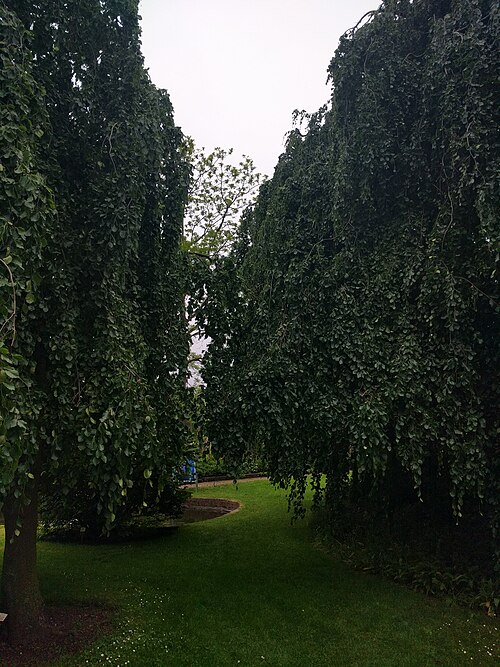
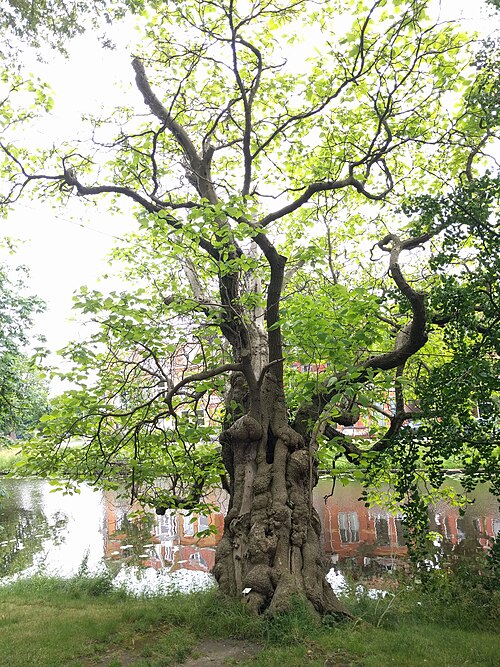
These are the first zelkovas that ever left Japan. Philipp Franz von Siebold, the physician who spent the 1820s on the Dutch trading post at Deshima and sent home more Japanese plants than any European before him, brought zelkovas out with him in 1830. Two of them ended up here. One grew as a single trunk and stands at the centre of the Japanese garden; this one came up with five stems, so the register measures its girth on the thickest of them, about two metres, which undersells the mass of the thing considerably. The dating needs stating plainly, because the register disagrees with itself. Its planting band puts the tree between 1800 and 1850, while its own note says the two Leiden zelkovas went into the ground in 1858 and 1860. Take the age as somewhere between 165 and 225 years, and if you know which is right, tell us. Zelkova serrata is a relative of the elm that turned out to be largely resistant to Dutch elm disease, which is a good part of why it appeared on European planting lists after the 1970s, when the elms were dying in every city on the continent. This tree predates that fashion by more than a century, and it got here because one man wanted Japan in a Dutch garden.
Hortus Botanicus Leiden, in the Japanese gardenYou can recognise it by its five stems rising from one base, unlike its single-trunked companion at the centre of the Japanese garden. Its thickest stem measures about two metres round.
15 minute walk from Leiden Centraal station
Sources
Where the facts on this page come from.
- In the official register: Landelijk Register Monumentale Bomen (Bomenstichting), no. 1690080
- bomenstichting.nl
- services-eu1.arcgis.com
- hortusleiden.nl