Two National Natural Monuments stand 3.6 kilometres apart in Minami-Alps City, Yamanashi. Four Chinese junipers planted around 1316 at the four corners of a Zen temple courtyard, said to represent the Four Heavenly Kings, and the Great Zelkova of Mitsue, over 1,000 years old and ranked one of the Three Great Zelkovas of Japan. Both are free to visit and both survived recent storm damage under active municipal care.
0 of 2 visited in Minami-Alps
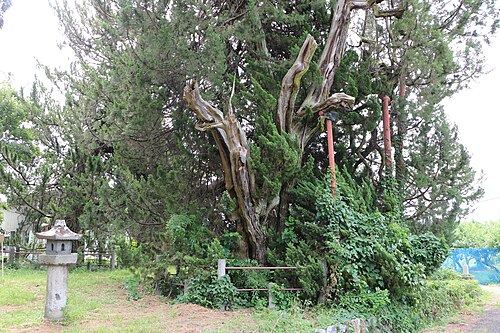
Chinese Juniper (Juniperus chinensis) · 700 years · Ayusawa, Minami-Alps City
There are four of them, one at each corner of the courtyard, and the tradition holds that they stand for the Four Heavenly Kings.
Kochozenji is a Rinzai Zen temple founded in 1316 by Muso Kokushi, and the planting of these Chinese junipers is attributed to him at that founding. That is where the figure of about 700 years comes from: a date on the temple, carried across to the trees, rather than anything measured in the wood. Locals call them the Yotsu-byakushin, the four byakushin. They sit roughly ten metres apart around the front court of what used to be the guest hall, and the state lists them as one thing, a single National Natural Monument since 14 November 1953.
They are not matching specimens. Girth at 1.5 metres runs from 2.00 to 3.90 metres across the four, and height from 11.20 to 17.70 metres, so the corners of the courtyard are visibly unequal.
The temple was the family temple of Oi-fujin, mother of Takeda Shingen, the warlord whose cavalry decided the shape of this province in the sixteenth century. If the founding tradition holds, the junipers were already two centuries into their growth when she came here to pray.
The courtyard is open nine to five, every day of the year. There is nothing to pay and nobody to ask.
Photo: さかおり (CC BY-SA 4.0)
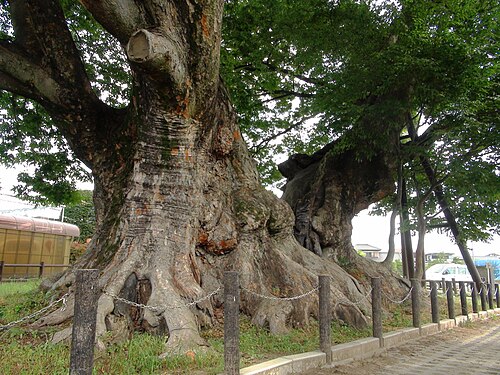
Saw-leaf Zelkova (Zelkova serrata) · 1,000 years · Terabe, Minami-Alps City
It looks like two trees leaning together. It is one, and the space between them is where lightning burned out its heart.
The Great Zelkova of Mitsue is counted among the Three Great Zelkovas of Japan, with Haramachi's in Gunma and Higashine's in Yamagata. A lightning fire hollowed and destroyed the central core long ago, leaving a trunk that reads as a pair from any distance; the base settles it as one tree. Around that trunk at chest height the national heritage database and the city's own page both give about 14.2 to 14.35 metres. An older source says 14.7. At the roots it swells to roughly 17.28 metres. Height is 20 metres in some accounts and 25 in the city's, and nobody has reconciled the two.
It was designated a National Natural Monument on 30 November 1928, one of the earliest listings in the country, on size alone. Its age is given as over a thousand years, and neither official source narrows that, so neither will we.
In October 2019 Typhoon Hagibis snapped a major limb off the north side. The city dressed and disinfected the wound and braced what was left on cables, finishing the work in February 2020, by which point the tree was already throwing new shoots from the base.
A shrine stood here once. It has gone; the tree outlasted it. The lane in is narrow and residential, so come quietly.
Photo: Sakaori (talk) (CC BY-SA 3.0)