Hokuto's hero tree is Jindai-zakura, by tradition the oldest cherry in Japan at up to 2,000 years, a National Natural Monument since 1922. A second cherry once told farmers when to plant a rice paddy 7.5km away. A third is a designated azalea hiding among a larger undesignated bloom on Mt Utsukushimori. A fourth stop is two ten-metre zelkovas flanking Negoya Shrine.
0 of 4 visited in Hokuto
Higan Cherry (Prunus subhirtella var. ascendens) · ~1900 years · Yamataka, Hokuto
In October 1922 Japan named its first National Natural Monuments. Five single trees were on that list, and this cherry was one of them. It is also counted among the Three Great Cherry Trees of Japan, with Miharu Takizakura in Fukushima and Usuzumi-zakura in Gifu, both designated on the very same day.
The age usually given is 1,800 to 2,000 years, tied to a legend that the warrior prince Yamato Takeru planted it. Treat that as a tradition rather than a finding. The prefecture's tourism board, the city of Hokuto and a government cultural publication all repeat the figure and none cites a dating method, and the trunk is too hollow and knotted to read reliably. What can be measured is the base: a root flare given as 11.8 metres round by the prefecture and 13.5 by other listings, under a tree only about 10 metres tall. It grows outward rather than up.
It is an Edo-higan, the long-lived species behind many of Japan's oldest cherries, and the blossom is pale and drooping in early April. Bloom forecasters still track this individual tree season by season, which is how we know it is alive and watched. Seeds from it have reportedly been flown into space and grown on around the world.
Jisso-ji charges around 500 yen during blossom season. Without a car it is a taxi from Hinoharu or Kobuchizawa.
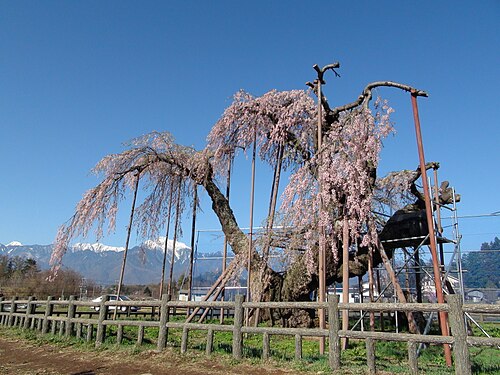
Weeping Higan Cherry (Prunus subhirtella var. pendula) · 400 years · Kobuchisawa, Hokuto, about 7.5km from Jindai-zakura
Before calendars told Kobuchisawa's farmers when to plant rice, this cherry did. Tradition holds it was planted as a goshinboku, a sacred tree, on the paddy-field ridge that once grew rice offered to a shrine, and its bloom timing served as the signal to begin planting season.
It stands alone at the edge of a working rice paddy at about 820 metres elevation, the kind of solitary specimen that gets used for film and tourism location scouting rather than crowded up by other trees. A weeping form of the Edo Higan cherry, it is thought to have taken root around the shift from the Sengoku era to the Edo period, putting it at roughly 400 years old, a figure that lines up with what a tree this size should be.
Sources differ slightly on the trunk: the city gives 8 metres round, the tourism board a more precise 7.5. The smaller figure is used here.
It was designated a Yamanashi Prefecture Natural Monument in 1959, prefectural rather than national. Free parking for about 30 cars and 5 buses sits nearby. Close approach has been temporarily restricted in places while the soil and roots recover from foot traffic, though the tree stays visible from the paddy edge and the parking area throughout.
Photo: Sakaori (talk) (CC BY-SA 3.0)
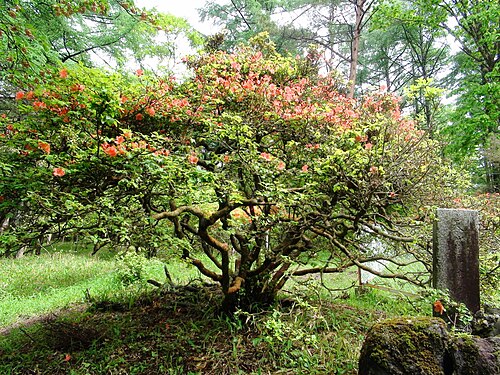
Japanese Azalea (Rhododendron kaempferi) · Utsukushimori, Kiyosato, Oizumi-cho, Hokuto
The famous thing on this hill is not the protected thing. Mt Utsukushimori, 1,542 metres on the southern foot of Yatsugatake, carries something like a thousand rengetsutsuji that colour the whole slope in June and fill everyone's photographs. Those are a different species and none of them is designated. The National Natural Monument here is one azalea, listed on 7 June 1935, and most people walk straight past it.
The 1935 text tells you what to look for: a plant that divides at ground level into more than a dozen stems off a single root crown, those stems measuring about 2.7 metres round taken together, throwing a crown roughly six metres east to west and five and a half north to south. The 2.7 is a sum, not a trunk, which is worth knowing before you go up expecting something thick.
Nobody recorded an age in 1935 and nobody has since, so there is no age to give. Its current vigour is a fair question too: one unverified summary says the plant has been in decline, and no source we could check repeats it. Yamanashi Prefecture still listed it as a standing monument in April 2025.
It is a fifteen-minute walk up from the car park at the base, where there is a visitor centre and room for fifty cars. If you get up there and photograph the designated one rather than the hillside, send it to us.
Photo: Sakaori (talk) (CC BY-SA 3.0)
Saw-leaf Zelkova (Zelkova serrata) · 800-1,000 years · Egusa, Sutama-cho, Hokuto City, Yamanashi Prefecture
Two zelkovas flank the path to Negoya Shrine, Tagi on the rice-field side and Hatagi on the dry-field side, and Hokuto's farmers still read their spring in the order the pair comes into leaf: Hatagi first favours a good year for the dry fields, Tagi first favours the rice. Both trunks run past ten metres round, among the largest zelkovas recorded anywhere in Japan, though the two sources that measured them disagree by close to two metres and neither figure is picked as the winner here.
Takeda Shingen, the Sengoku-period warlord whose clan held a castle nearby, is said to have passed between the pair about five hundred years ago on his way to pray at the shrine, when they were already old. A 1968 fire hollowed both trunks and snapped a bole; tree surgery roughly a decade ago brought them back from it, and a scatter of ancient boulders at the base of each marks the ground as sacred well before either the fire or the shrine.
The prefecture's own record gives no age at all. Tourist pages and a 2025 visitor's account put it somewhere between eight hundred and a thousand years, which is tradition rather than measurement, and worth taking as such.