Every year on 1 November, workers in Kenrokuen put a pole up beside one particular pine and run ropes from its tip down to the branches, then do the same at eight hundred more places before the snow comes. That is the tree most people come for. The two the state protects are elsewhere and free: a pair of chinquapins flanking the door of the old prefectural office, and a mountain cherry that samurai lowered their spears to pass under. Kanazawa was never bombed, which is why its old wood is still standing.
0 of 7 visited in Kanazawa
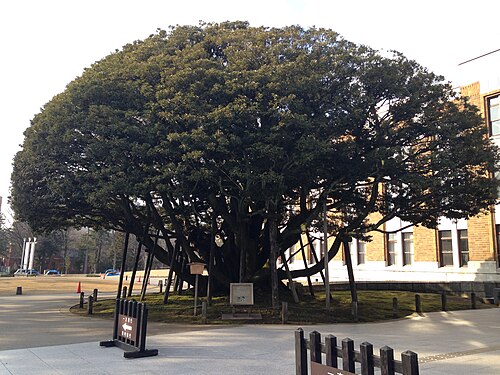
Japanese Chinquapin (Castanopsis sieboldii) · Hirosaka
Two of them stand either side of a doorway, and they do not so much stand as sit. These are broad, low, heavily built chinquapins flanking the front entrance of the old Ishikawa prefectural office below the castle, and the state made the pair a National Natural Monument in August 1943. The signboard gives the right-hand tree 7.4 metres round and 12 metres tall and the left one 5.2 metres and 13, though anyone looking at the two of them would put them closer to equal. Both carry dead wood in the crown and neither has a hole in its shape. The name Dogata is older than the building. In the Maeda period there was an archery range on this spot built in imitation of the toshiya at Kyoto's Sanjusangendo, where archers shot the length of a long veranda, and it was known as the Dogata. The range went, rice warehouses replaced it, and the name stayed on the ground while everything on it changed twice. Nobody has published an age for either tree. If you know of one, tell us: the state protected them in wartime without recording how old they were.
Photo: そらみみ (CC BY-SA 4.0)
Japanese Mountain Cherry (Prunus jamasakura) · 125-250 years · Teramachi
Samurai lowered their spears to pass under this tree. The cherry grew inside Komatsu Castle, where Maeda Toshitsune had retired, and he gave it to the abbot of Shogetsuji; through the Tokugawa period a spear carried upright had to be dropped level as its bearer went beneath the branches, as a mark of respect to a tree that had come from a lord. It still leans out over the temple's earth wall into the street, which is where the custom would have applied. Very little of what you see is old. The trunk is the only ancient part, so weathered that it is hard to tell rock from bark, and almost every branch above it is new growth. It is a mountain cherry rather than one of the garden hybrids, and Kodansha's survey notes it as a form with unusually large flowers, four to five centimetres across, white washed with red, on a tree whose young leaves come out red as well. The state made it a National Natural Monument in August 1943, the same day as the chinquapins at Hirosaka. The Environment Agency once recorded its girth as 7.81 metres, which is not possible for this trunk; the figure to trust is 3.5.
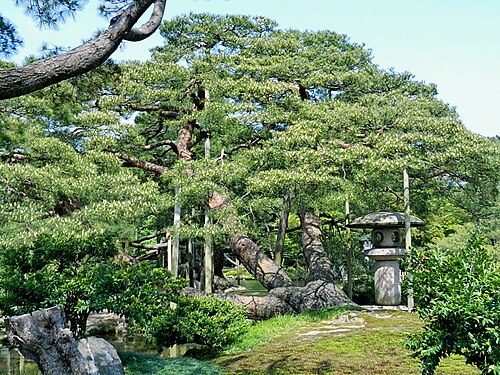
Japanese Black Pine (Pinus thunbergii) · Kenrokumachi
On the first of November every year, this is the tree they do first. Kanazawa gets heavy wet snow off the Sea of Japan and it breaks pine branches, so the garden's answer is the yukitsuri: a pole set upright at the centre of the tree and ropes fanned out from its tip down to every major limb, holding them up from above. The method is called ringo-tsuri, apple hanging. Kenrokuen puts it up at more than eight hundred places between 1 November and the middle of December and takes it down in March, and the Karasaki pine is always the opening job, which means the picture of Kanazawa in winter that everybody has seen is usually this tree. It is a black pine grown from seed, and the seed was fetched. The thirteenth Maeda lord, Nariyasu, sent for it from the famous pine at Karasaki on the shore of Lake Biwa, one of the eight classic views of Omi, and raised this one from it on the edge of Kasumigaike pond, where the branches now run out low and wide over the water. Kenrokuen was closed to ordinary people until 1874.
Photo: lienyuan lee (CC BY 3.0)
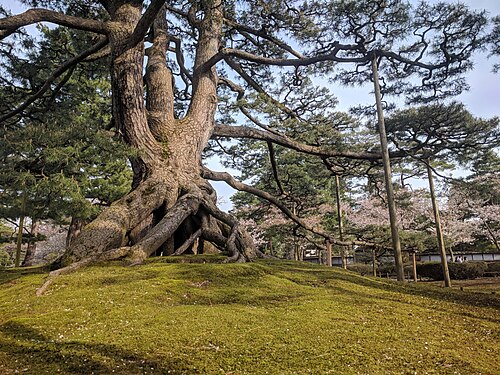
Japanese Black Pine (Pinus thunbergii) · 150 years · Kenrokumachi
Forty-odd roots stand two metres clear of the ground before they meet the trunk. The story told about it is that the thirteenth Maeda lord, Nariyasu, planted a young pine on a heaped mound of earth with his own hands and then had the soil taken away a little at a time over years, leaving the root system exposed in the air as the tree grew into it. If that is right, the tree dates from his lifetime, 1822 to 1866, which puts it at somewhere around 150 years and makes it the youngest tree on this page by centuries. Above the roots the trunk gathers into one, then splits into three, and the crown it carries is unhurried and wide. It stands where the Tatsumi canal, which brings water into the garden from an intake 8.5 kilometres up the Saigawa, swings through a deep bend. Kenrokuen has an area of about 11.5 hectares and its name was chosen for it: the twelfth lord asked Matsudaira Sadanobu to name the garden and he took it from a Song dynasty account of the famous gardens of Luoyang, meaning a garden that combines six qualities at once, spaciousness and seclusion, artifice and antiquity, water and a view. The whole garden was made a Special Place of Scenic Beauty in March 1985.
Photo: SOHAFun (CC BY-SA 4.0)
Saw-leaf Zelkova (Zelkova serrata) · 1,000 years · Nomachi
A poem about a circus came out of this shrine yard. Nakahara Chuya spent part of his childhood in Kanazawa, and the acrobats he watched in the precinct here are said to be behind Sakasu, one of the best known poems in modern Japanese; Muro Saisei played on the same ground. The shrine was important to the Maeda lords and ordinary people called it Oshinme-san. The zelkova in the yard is 33 metres tall on a trunk 7.8 metres round, which makes it the thickest of its species in Ishikawa alongside one at Nanao, and it is somehow missing from the Environment Ministry's national database of giant trees altogether. It looks in places like two trees fused, though nobody has established whether it is. The thousand years on the board belongs to the shrine's account of itself rather than to any measurement of the tree, and the honest position is that the tree is very large and undated. Zelkova is the wood Japanese temples are built from, straight-grained and hard, which is one reason so few of this size survived anywhere. This one is a few minutes over the Saigawa bridge from the busiest crossing in the city.
Japanese Bay Tree (Machilus thunbergii) · Nomachi
It is in the graveyard, behind the hall, and it is 8.4 metres round. The tabunoki at Hongakuji is the biggest tree in this quarter of Kanazawa and one of the least visited, because nothing about the approach suggests there is anything back there. It divides into several trunks partway up and gathers again at the base, and the largest single stem is 6.18 metres on its own by the Environment Ministry's measurement. Standing next to it, the fact that this is the middle of a city stops being obvious. Tabunoki is an evergreen of the laurel family and a coastal tree, common along the warm shores of western Japan and nothing like this size inland; its bark was ground to make the binder in incense sticks. The temple was founded to hold a portion of the ashes and the mortuary tablet of Maeda Toshinaga, the second lord of Kaga, and it shared duty as a sect head temple with Honchoji in rotation. Nobody has published an age for the tree, and it carries no national or prefectural designation; the temple's whole grove is a Kanazawa protected woodland.
Saw-leaf Zelkova (Zelkova serrata) · Kita-Yasue
This shrine was once called the shrine of the great tree, and the great tree is gone. A stone in the precinct dates the founding to 727, and the shrine appears in the tenth century Engishiki register under a different name, Michi; two old mirrors bearing that name are still kept here. Ishikawa's own shrine authority records that until the Kan'ei years, some time before 1644, a huge zelkova stood in the grounds and people called the place Taiboku no Miya, the shrine of the big tree. Nobody knows what happened to it. Zelkovas have been growing here ever since, which may be deliberate and may just be what grows on this ground, and the largest of them is the sacred tree, on the left once you are through the entrance torii. It is 5 metres round and 16 metres tall, leaning hard, with hollows where heavy limbs were taken off, and by every visible sign it is in good health and still going. It has no designation and no recorded age. The whole grove is a protected woodland of Kanazawa city. Give it two or three more centuries and the old name might fit again.