Most people picture a camellia as a shrub in a pot.
Common Camellia
Camellia japonica
A camellia is supposed to drop its flower whole, head and all, which is why samurai were said to dislike them. We map 6 of them, in 5 cities.
The four hundred year old tree at Byakugo-ji in Nara does not: it sheds petal by petal, and it opens red, white, peach, striped and variegated blossoms on the same plant. Japan's thickest wild camellia stands in a village burial ground at the end of a dead-end valley in Himi, three trunks grown back into each other and 3.89 metres round; its age is put at 500 years by the city and 700 to 800 by an older survey. Portugal is the other home of old camellias. The mild wet north suited Camellia japonica so well that Portuguese growers ended up exporting it back to the rest of Europe, and the pair in front of the church at Paranhos in Porto are six and a half metres tall.
Porto
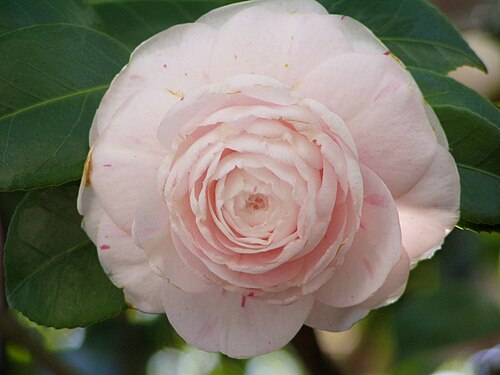
The Camellias of Casa TaitEnsemble
Porto calls itself the City of Camellias, and the oldest proof of that claim is a set of hedges, not a single tree.
Photo: Paulo V. Araujo, Dias com Arvores
Guimaraes
Eighteen camellias planted across two garden terraces here have outlived the building's most fashionable era by more than a century.
Dresden
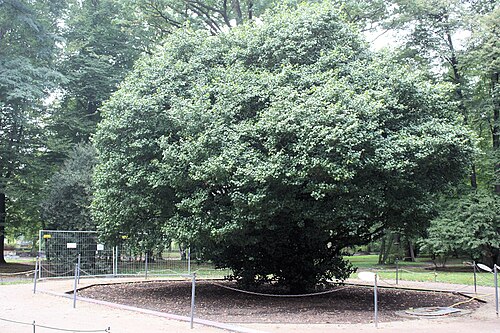
In January 1905 this camellia's winter house burned down at about minus 20 degrees, and the water from the fire hoses froze around the plant in a shell of ice.
Photo: Dguendel (CC BY 3.0)
Nara
One tree, five colours, and it does not drop its flowers the way a camellia is supposed to.
Himi
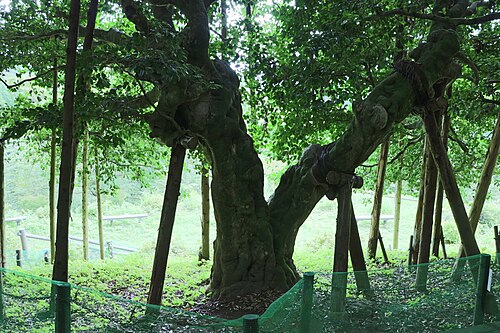
Japan's thickest wild camellia stands in a village burial ground at the end of a dead-end valley.
Photo: さかおり (CC BY-SA 4.0)
Explore by city: Porto · Guimaraes · Dresden · Nara · Himi · Prague · Brussels · Brisbane · every city · or browse all species.