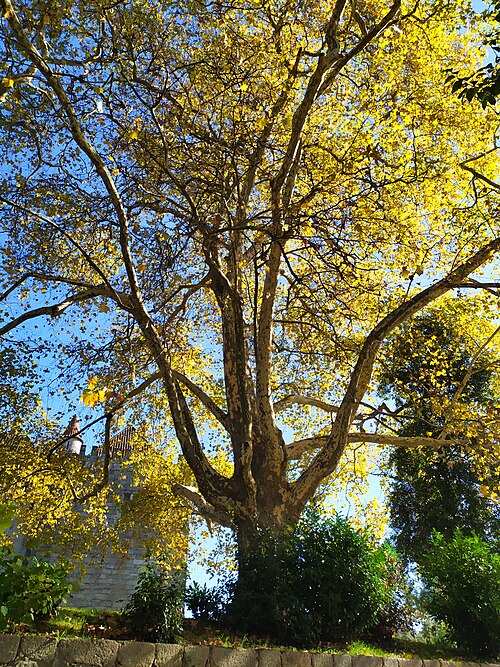
Eighteen camellias planted across two garden terraces here have outlived the building's most fashionable era by more than a century. The register puts them at around 195 years, planted in the 1830s, decades before the palace itself was extended into the grand house whose halls now show contemporary art. Camellia japonica arrived in Europe from East Asia in the eighteenth century as a hothouse curiosity for the wealthy; by the time these were planted it had become the flower a family used to say a garden mattered. Guimaraes and the wider Minho region took to it harder than most of Portugal, which is why the area still markets itself, without much exaggeration, along a Camellia Route. The eighteen trees here split into two groups on the lower and upper parterres of a three-terrace baroque garden, laid out with box hedges, stone fountains and a view back over the city; the garden won a national landscape architecture award in 2006. Camellias flower through the coldest months, January into March, when almost nothing else in a Portuguese garden is doing anything at all, which is presumably part of why a family planted eighteen of them and not one.
From people who stood here
No notes yet
Did you visit the tree? Leave a note for the next visitor.
Getting there
Jardins do Palacio Vila Flor, Av. D. Afonso Henriques 701, 4810-431 Guimaraes
You can recognise it by its winter flowers, blooming January into March when little else in the garden does. It stands among eighteen camellias split across the lower and upper terraces of the Palacio Vila Flor's baroque garden.
Free, public garden, Monday to Saturday 09:00-13:00 and 14:30-20:00, Sunday 10:00-13:00 and 15:00-19:00
About 10 min walk from the historic centre, on Av. D. Afonso Henriques
In bloom
January to March, when the camellias flower and little else in the garden does
The line is our estimate of how much there is to see, not a measurement. Typical for this species where this tree stands; exact weeks shift with the year.
Sources
Where the facts on this page come from. The story was written with AI from these sources, and readers who know the tree correct it.
- In the official register: Arvoredo de Interesse Público (ICNF), no. KNJ3/072
- si.icnf.pt
- visitguimaraes.travel
- pt.wikipedia.org