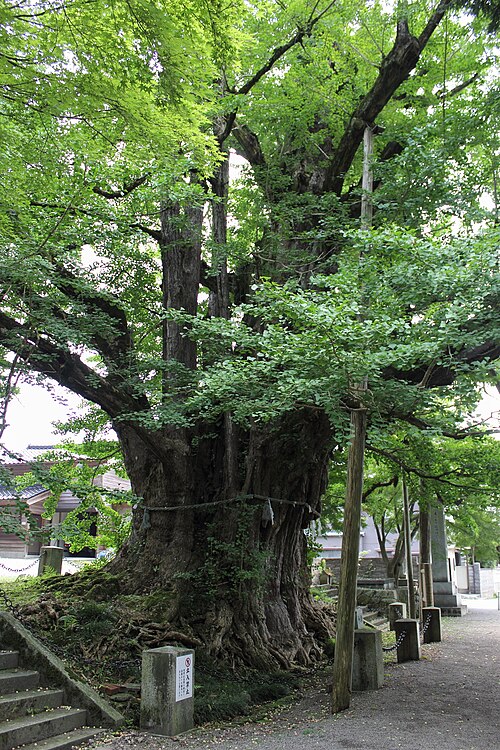
Japan's thickest wild camellia stands in a village burial ground at the end of a dead-end valley. The Oidani camellia is ordinary yabu-tsubaki, Camellia japonica as it grows in the hills without anyone's help, and the surveyor Miyake Kazuyoshi ranked it first in the country for the species. It measures 3.89 metres round and 7.5 metres tall, spreading 7.9 metres east to west and 11 north to south. Its age is disputed and we are not going to settle it. Himi City's own cultural-properties page says about 500 years. A 1998 published survey of Japan's giant trees says 700 to 800 instead. Neither explains how it got to its number. The shape is what people come up here for. It splits into three thick trunks less than a metre off the ground, and their branches have grown back into each other into a tangle solid enough at around two and a half metres up to sit on. Locally it is the Sasumata Camellia, after the Y-shaped pole once used to pin a man against a wall. The graveyard has a story attached. A samurai of Ikeda Castle executed on a false charge; his widow turned away by her own family and dead of grief; the two buried on the hill facing the castle, with a camellia planted where a stone should have gone. Toyama Prefecture designated the tree in 1965. It opens deep red for about a month from early April.
From people who stood here
No notes yet
Did you visit the tree? Leave a note for the next visitor.
Getting there
Oidani 1249, Himi City, Toyama Prefecture, Japan; in a small hillside graveyard at the innermost end of the Oidani hamlet
You can recognise it by splitting into three thick trunks less than a metre up, their branches tangled back together into a mass solid enough to sit on. It stands in a hillside graveyard at the end of Oidani hamlet.
Free, no ticket. Stands inside a small community hillside graveyard at the far end of Oidani hamlet, an ordinary open village burial ground rather than anyone's private garden; both government sources give a plain address and neither mentions a gate, fee or restriction. Very remote: about 18km from Himi's city centre, close to the Ishikawa Prefecture border, up a side valley off the Oidani river.
From JR Himi Line's Himi Station: taxi about 35 minutes, or Kaetsunou bus to the Shimo-Iwase stop then about 30 minutes on foot.
In bloom
April, when it carries deep red flowers for about a month
The line is our estimate of how much there is to see, not a measurement. Typical for this species where this tree stands; exact weeks shift with the year.
Sources
Where the facts on this page come from. The story was written with AI from these sources, and readers who know the tree correct it.