Chiang Kai-shek planted these two junipers himself, on Arbor Day, 12 March 1962.
Chinese Juniper
Juniperus chinensis
The Chinese juniper is best known in the West as a bonsai subject, trained small in a tray. We map 7 of them, in 7 cities.
Left alone for centuries beside a temple or a palace, it does the opposite: it grows into a slow, twisting giant whose bark spirals hard enough that people read dragons into it. Court records describe the coiled eastern branch at Seoul's Changdeokgung as a dragon ascending to heaven, and Beijing's Nine Dragon Cypress is a juniper misnamed by generations who never doubted the resemblance. The oldest, in Nanjing, is reckoned at about 1,500 years and is still called a pine. Kamakura's pair at Kenchoji have stood since the temple's founding in 1253, on a site once known as Hell Valley. Courts and monasteries protected what everyone else would have shaped smaller, which is why the old ones are almost all on sacred or royal ground.
Taipei
Seoul
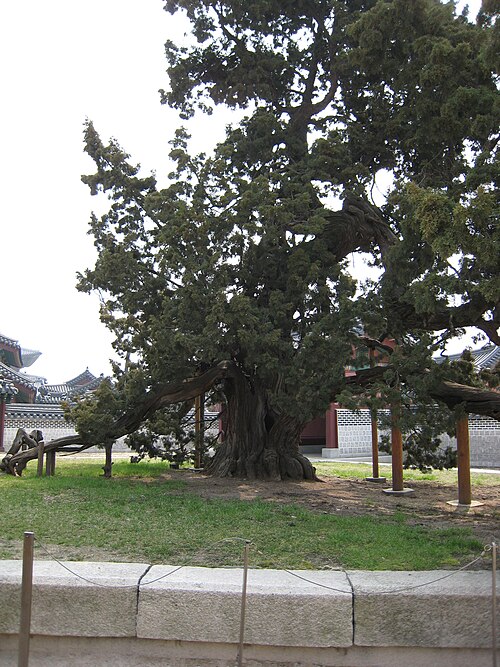
Look up and this Chinese juniper does not read as a tree so much as a gesture: a trunk that twists and climbs, missing one whole limb, shaped by more history than Changdeokgung Palace itself has st...
Photo: karendotcom127 (CC BY 2.0)
Beijing
The bark on this juniper twists hard enough that people counted nine dragons in it.
Kamakura
Before the temple there was an execution ground here, and the valley was called Hell Valley.
Atami
A juniper this old should stand straight, and this one does the opposite: its trunk twists into a spiral and leans hard to the south, a shape recorded as far back as a 1938 government survey.
Minami-Alps
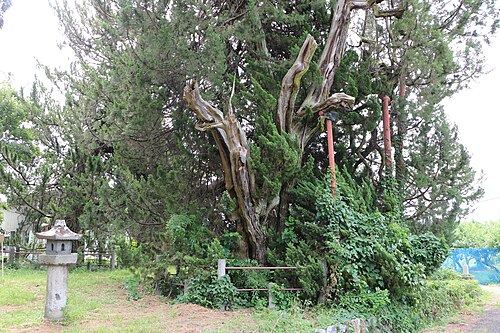
There are four of them, one at each corner of the courtyard, and the tradition holds that they stand for the Four Heavenly Kings.
Photo: さかおり (CC BY-SA 4.0)
Nanjing
Nanjing calls this tree a pine, and it has been a juniper for about 1,500 years.
Explore by city: Taipei · Seoul · Beijing · Leiden · Brussels · Brisbane · Munich · Lisbon · every city · or browse all species.