Beijing's oldest trees grew up with its temples and imperial rites: cypresses planted for an altar, a scholar tree Qianlong liked well enough to build a pavilion just to look at, ginkgos that queue photographers every November, and a scholar tree marking the spot where the last Ming emperor died. The city has graded its ancient trees by class since the imperial era and named ten ancient tree kings in 2018; five of that shortlist make this list. Most stand behind a park or temple gate rather than a house door, and one, at Bolin Temple, costs nothing at all.
0 of 7 visited in Beijing
Chinese Juniper (Juniperus chinensis) · 600 years · Temple of Heaven Park
The bark on this juniper twists hard enough that people counted nine dragons in it. Hence the name, and the older epithet Nine Dragons Greeting the Sage, earned because emperors passed the tree on their way to the Circular Mound Altar for the winter solstice sacrifice. In 2018 the city government named it one of Beijing's ten most beautiful ancient tree kings.
It is not a big tree. The municipal register gives a trunk 3.68 metres round, a height of 11.5 metres and a canopy only 6.7 metres across: dense and knotted rather than towering. It is graded one, the class reserved for trees over three hundred years old. Tradition puts the planting in 1420, the eighteenth year of the Yongle reign, and that is where the round figure of six hundred years comes from, an official date repeated down the centuries rather than a ring count. Read it as a wide band, not a birthday.
The tree stands northwest of the Echo Wall, inside the Temple of Heaven's inner enclosure, which needs a second ticket on top of the park entry. Our pin marks the park rather than the trunk: the sources agree on the direction and none of them gives a coordinate. They also both trace back to the same 2018 municipal survey, so the figures come from one count rather than two.
Chinese Arborvitae (Platycladus orientalis) · 400-500 years · Ditan Park (Temple of Earth)
Three cypresses around the Fangze Altar hold military ranks. The Great General stands south of the altar's south gate, 5.15 metres round and still vigorous. The Old General is west of it at 4.8 metres. The One-Armed General, outside the west perimeter wall, has lost every major limb but one and is still alive.
Tradition dates the trio to 1530, when the Jiajing Emperor raised the Temple of Earth's altar here. A Shaanxi official is said to have sent the saplings, invoking the cypress the Yellow Emperor supposedly planted. Their official tags read about four hundred years, but a 2026 investigation by the city paper argues the trees predate the altar and may be Yuan or early Ming work, which is why the age band here is broad rather than exact. The same piece dismantles a local tradition that Sun Yat-sen named them; the records suggest he never planted anything on this ground.
The species is contested too. Older park sources call all three Chinese arborvitae; the 2026 article reclassifies two of them as junipers. Nobody disputes that they are old, and all three were described as green and standing in that same report.
Entry to Ditan Park costs two yuan, a formality rather than a fee. Walk to the altar and they are around you, in three directions.
Japanese Pagoda Tree (Styphnolobium japonicum) · 250 years · Bolin Temple (Yonghegong area)
A scholar tree's leaf usually runs to a dozen or more leaflets. This one carries seven, small and loosely hung, and in wind the whole crown moves like a cloud of butterflies. That is where the name comes from: the butterfly scholar tree, a rare cultivar of which only two or three others are known anywhere in Beijing, at Guangji Temple and Jingshan Park. This is the oldest and largest of Bolin Temple's scholar trees.
It went in during the renovation of Bolin Temple in 1758, the twenty-third year of the Qianlong reign, which puts it at roughly 250 years. Fifteen metres tall, 1.8 metres round. The temple around it is older still, founded in 1347, and takes its name from its trees: Bolin means cypress forest. Old cypresses, pines and a ginkgo share the grounds with it, and the tree stands in the Weimo Pavilion courtyard rather than out front.
Entry is free and the gates are open through the middle of the day. The temple has been a nationally protected relic since 2006, which is some reassurance, because there is a gap in what we know: we found no dated sighting of this particular tree after 2020. If you get there and it is standing in its sevens, tell us. The pin marks the temple building, not the courtyard within it.
Ginkgo (Ginkgo biloba) · 600 years · Wuta Temple (Five Pagoda Temple)
Two female ginkgos stand either side of the Diamond Throne pagoda, and every November people queue to photograph them. A 2026 city paper feature described visitors waiting their turn at the best spots while the gold came down on the carved stone.
The pair went in when the temple, then called Zhenjue, was built in the Yongle era of the Ming dynasty, which gives them roughly six hundred years. They are not identical. The east tree stands about 17 metres; the west one reaches about 20 and is the stouter, with a trunk near five metres round. The Qing poet Hong Liangji wrote a line about the pair that still reads accurately: two trees stand strange by Wuta's gate. That is six centuries of somebody bothering to write them down.
The pagoda between them gives the place its common name, five stone spires on one carved base, and the site now doubles as the Beijing Stone Carving Art Museum. Twenty yuan gets you in, free for the first two hundred visitors each Wednesday, closed Mondays.
Our pin marks the temple grounds rather than the trees, which stand at the pagoda itself. In the second half of November that hardly matters. The trees are the loudest thing on the site, and the cameras will show you where to stand.
Chinese Arborvitae (Platycladus orientalis) · 1,000 years · Zhongshan Park
The altar came second. Seven cypresses stand outside the south gate of the Sheji Altar, and local tradition holds them to be survivors of the Liao-dynasty Xinguo Temple that occupied this ground before the Ming laid out the altar in 1420. That would put them past a thousand years. It is a temple-succession story rather than a dated planting, so read the figure as the tradition it is and not as a measurement.
The thickest of the seven runs close to six metres round, which the local description puts at four adults with arms outstretched, only just meeting. Another divides into nine major limbs that then divide again, and the comparison people reach for is a thousand-armed Guanyin. The city keeps a file on each tree in the grove and monitors them individually; recent reporting describes all seven as thriving.
A few steps away is the thing most visitors photograph: a scholar tree over two hundred years old growing out of a split in one of the cypresses, known locally as the cypress and scholar tree embrace.
The ground is Zhongshan Park now, beside the Forbidden City, three yuan to enter. Ming and Qing emperors made their offerings for land and grain here. Our pin marks the park rather than the grove, because no source gives a coordinate for the trees themselves.
Japanese Pagoda Tree (Styphnolobium japonicum) · 1,200 years · Beihai Park
The Qianlong Emperor built a pavilion so he could sit and look at this tree, then named the courtyard after it: Guke Ting, the Court of the Ancient Bole. A rockery went in beside it at the same time, partly to protect the tree. Not many trees anywhere have had that much imperial attention paid to their comfort.
It is a scholar tree, traditionally dated to the Tang dynasty, which is where the figure of roughly 1,200 years comes from. That is a registered and long-repeated age rather than a fresh count, so the band around it is wide. What the municipal survey does measure is concrete enough: a trunk 5.96 metres round, 13 metres of height, a canopy nine metres across, grade one on the ancient-tree register, and a place on the city's 2018 list of its ten most beautiful ancient tree kings.
The shape is the real distinction. Beijing's own description calls it a massive potted landscape, which is fair. Centuries of training have left something deliberately sculpted rather than wild, and the whole frame of it reads most clearly in winter once the leaves are down.
It stands in the northwest quadrant of Beihai Park, beside the Huafangzhai pavilion, and our pin marks the park rather than the courtyard, so allow yourself a walk. The newest record we found of the tree is that 2018 survey.
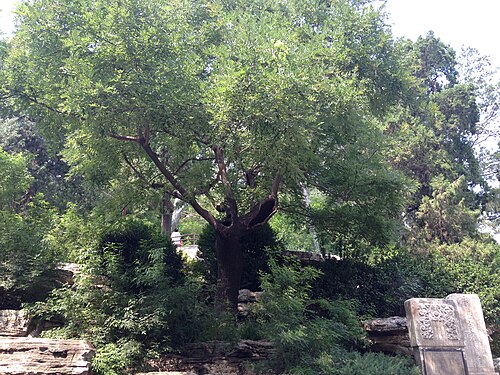
Japanese Pagoda Tree (Styphnolobium japonicum) · 180 years · Jingshan Park
Three trees have stood on this exact spot, and none of them is the one everybody comes to see. On 25 April 1644, as the rebel general Li Zicheng's army broke into Beijing, the last Ming emperor, Chongzhen, climbed Jingshan hill and hanged himself from a scholar tree at its eastern foot rather than be captured. Qing soldiers are said to have punished the tree afterward, binding it in an iron chain and cangue, the same restraint used on a condemned criminal, giving rise to a couplet still quoted today: the sovereign was guilty and nobody asked, the old scholar tree, guiltless, wears the lock.
That original tree is long gone. It was felled in the early 1970s during the Cultural Revolution as one of the Four Olds, replaced with a sapling in 1981, then replaced again in 1996 with a mature Japanese pagoda tree, already about 150 years old, transplanted whole from a courtyard on Beishuncheng Street across the city. The tree standing on the spot today, marked by a stele reading roughly Site Where the Chongzhen Emperor Died for the Country, is that third tree: genuinely old in its own right, roughly 180 years now, but with no physical continuity to 1644. The legend belongs to the site and the story it tells, not to any single trunk.
Photo: そらみみ (CC BY-SA 4.0)