Bamberg's protected trees are not headline giants: five of the six carry no measured age at all, and the registers describe most in a single line. What they have is genuine public ground: a spring path above Wildensorg, a roadside lane, a demolished manor's site, a riverbank downstream, a road junction in Schesslitz to the north where an oak the district bothered to name stands, and further out toward Teuchatz, a lime thick enough that people once thought it was three trees fused together. If you carry a tape measure, we would like to hear from you.
0 of 6 visited in Bamberg
Small-leaved Lime (Tilia cordata) · Wildensorg
Two trees, one monument. Bamberg's natural monument register lists number three as "2 Linden am Ottobrunnen", a pair of small-leaved limes on the wooded hillside above Wildensorg, and protects them as a single entry rather than as two trees that happen to stand together. They face the Ottobrunnen, a spring on the Bamberger Weg, the footpath that climbs out of the city into the Berggebiet. The well carries the name of Otto of Bamberg, the bishop who died in 1139. That name belongs to the water and to the ground around it, and nothing on record attaches these two limes to him, so the story stops where the sources do.
A lime beside a well is one of the older arrangements in German village life, the tree marking the water and the meeting place at once. Whether that is why this pair is here, nobody wrote down. What is written down is the protection: both fall under the city ordinance of November 1995, amended in 2007, which means neither can be felled or cut back at anyone's convenience.
Go for the walk rather than for the trees alone. The path is wooded, the climb is short, and the pair stands at the top of it with the spring opposite.
Neither lime has been dated and neither trunk has been measured. If you get up there with a tape, tell us what they come to.
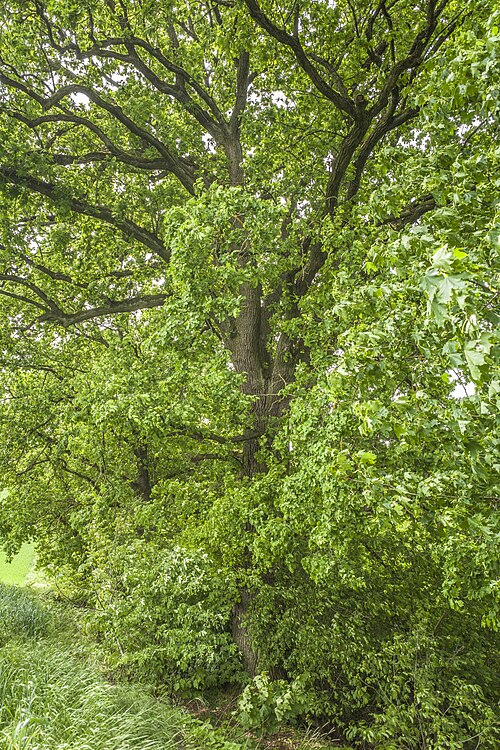
Pedunculate Oak (Quercus robur) · Wildensorg
The address is the Devil's Ditch. Teufelsgraben is a lane running down the Wildensorg hillside southwest of the Kaiser-Heinrich-Gymnasium, and the oak stands on the verge of it, in the open, with nothing between it and the lane. It is not a school tree. The register places it southwest of the building rather than on the site, and you reach it without passing a gate or asking anyone.
Worth knowing before you go: a second protected oak stands close by, and that one is inside a garden plot, which the register says in as many words. The tree on this page is the one out on the bank above the lane, standing alone.
It is a pedunculate oak, the species that hangs its acorns on long stalks and holds its leaves almost stalkless against the twig, which is the reverse of the sessile oak it gets confused with. Bamberg protects it as natural monument 5, under the ordinance the city passed in November 1995 and amended in 2007, so it cannot be felled or cut back at anyone's convenience.
The rest of the hillside is worth the climb with it. The Ottobrunnen limes and the lime at the old Rothof are both within a couple of kilometres on foot.
What nobody has recorded is how old this oak is or how thick. Oaks carry centuries without advertising them. If you have measured it, tell us.
Photo: Stephan van Helden (CC BY-SA 4.0)
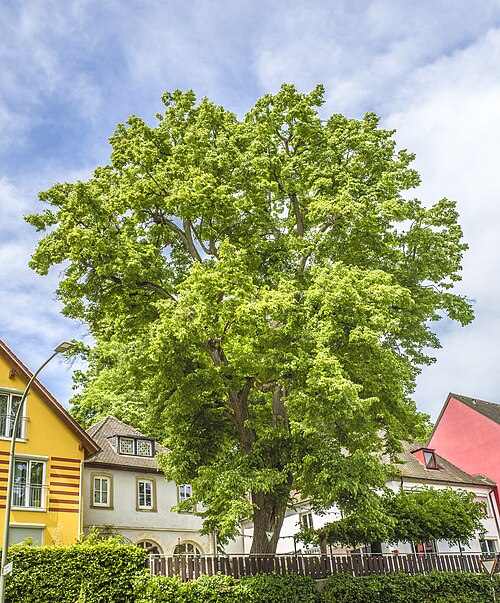
Small-leaved Lime (Tilia cordata) · Bug
Its official name is a house number. Bamberg's register of natural monuments lists entry 10 as "1 Linde am Regnitzufer 1", and the address it is named after is the Buger Hof, a hotel and restaurant on the riverbank in Bug, the village district a few kilometres upstream of the cathedral. The tree is a small-leaved lime and it stands at the edge of that ground, where the garden meets the Regnitz.
So the access is an open question and it is better said than glossed over. The lime is in full view from the public path along the river, the one walkers and cyclists use to get out of Bamberg southwards, and that view is free to anyone. Whether the last few metres underneath it are open to a passer-by or belong to the terrace is something we have not been able to settle. Look from the path. Ask inside if you want to stand under the crown.
Riverbank suits a lime better than almost anywhere else in a city: water at the root, open light on the water side, and no pavement compacting the ground over it. The city has protected this one since the ordinance of November 1995.
No age is recorded for it and no one has put a tape around the trunk. If you know either number, or whether the ground beneath it is open, tell us.
Photo: Stephan van Helden (CC BY-SA 4.0)
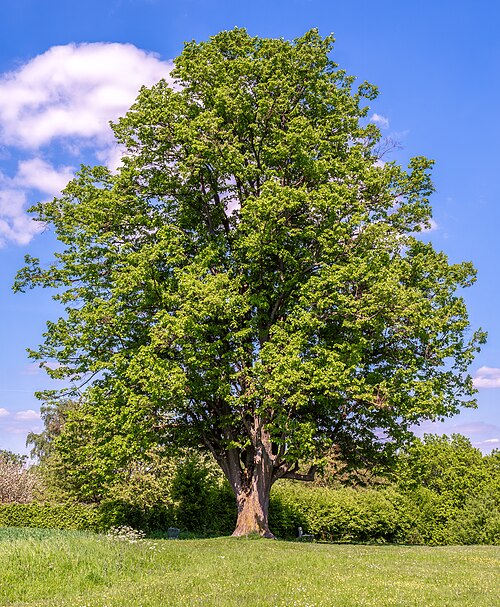
Small-leaved Lime (Tilia cordata) · Wildensorg
The estate this tree is named after was pulled down in the middle of the 1960s. The Rothof stood on the Wildensorger Straße, up on the hillside west of Bamberg; the buildings went, and the ground eventually went to the city's drinking water, which is what the site holds now. The lime is still there, on what the register calls the northern boundary of the property. A boundary line with nothing left to divide.
That whole history is in the register's own wording. Natural monument 6, protected under the city ordinance of November 1995: "1 Linde am ehemaligen Rothof, nördliche Grundstücksgrenze". One lime at the former Rothof, northern property line. The farm is described in the past tense and the tree is not.
It is a small-leaved lime and it stands by the road, which is the useful part for anyone walking up: no gate, no garden, no permission. The hillside route that takes in the Teufelsgraben oak and the pair of limes at the Ottobrunnen passes within about a kilometre and a half of it, so all three fit into one afternoon on foot.
How much of the Rothof this lime actually saw is the open question. Nobody has dated it and nobody has measured the trunk. If you have, tell us.
Photo: Reinhold Möller (CC BY-SA 4.0)
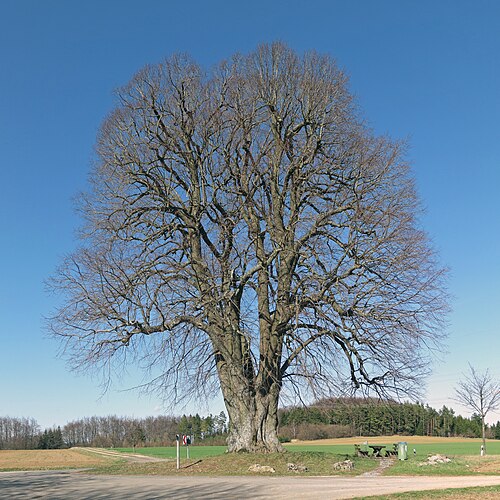
Large-leaved Lime (Tilia platyphyllos) · 350-400 years · Teuchatz
Local legend ties this lime to the Thirty Years' War: soldiers from the Swedish army, the story goes, were buried here in the 1630s and the tree grew from their graves. Nobody can prove the burial, but the tree's girth roughly fits that timeline, tracked at 770 centimetres round in 1990 and 822 centimetres in 2008, which is honest grounds for guessing it is nearing four centuries old if the legend holds and nothing more precise if it does not.
The trunk is thick enough that a separate story grew up around it too, that it is really three trees fused into one. Look closely and the case falls apart. Dendrologists who have studied the tree describe a single continuous trunk, heavily buttressed and studded with burls at the base rather than three obvious stems. What has needed real intervention is the crown, cut back hard in recent years and now held together with steel cables above the point, about four metres up, where it forks into several broad limbs. It once spread 26 metres wide.
Teuchatz has no railway; the branch line that served it closed in 1968, and no confirmed bus makes the trip either. Getting here from Bamberg means a car and about 25 minutes on quiet roads, at the end of which the tree stands directly on the roadside with nothing between the pavement and the trunk. A war grave for a legend and a trunk that still argues about how many trees it started as.
A day trip away
Schesslitz, 14 km north-east
Oak (Quercus sp.) · Schesslitz
Most protected trees in the Bamberg district get a number. This one got a name. The district's 2009 ordinance lists natural monument 61 as the Kilianseiche, Kilian's oak, standing where the Hauptstrasse in Schesslitz turns off toward the cemetery. A plain oak a few hundred metres away, number 62, is listed simply as an oak.
The name is nearly all the register gives. It records no species, no girth, no height and no age, so even calling this an oak rests on the name rather than on a survey. Which oak it is, and how old, are questions this page cannot answer yet.
The name does point somewhere. The parish church in Schesslitz is dedicated to Saint Kilian, and the bus from Bamberg stops at a halt called Kilianskirche. Whether the tree was named for the church, or for some older reason, no source we have found says, so we will not invent a story for it.
Then the caveat that matters most. The only photograph of the tree we can find is an old upload to the Panoramio photo site, taken sixteen metres from the register's point, and there is nothing recent. The ordinance still protects it, but we cannot show you dated proof that it stands.
Schesslitz is about fifteen kilometres north of Bamberg, roughly twenty-five minutes on the regional bus. If you make the trip, tell us whether Kilian's oak is still at its junction, and if you know your oaks, which kind it is.