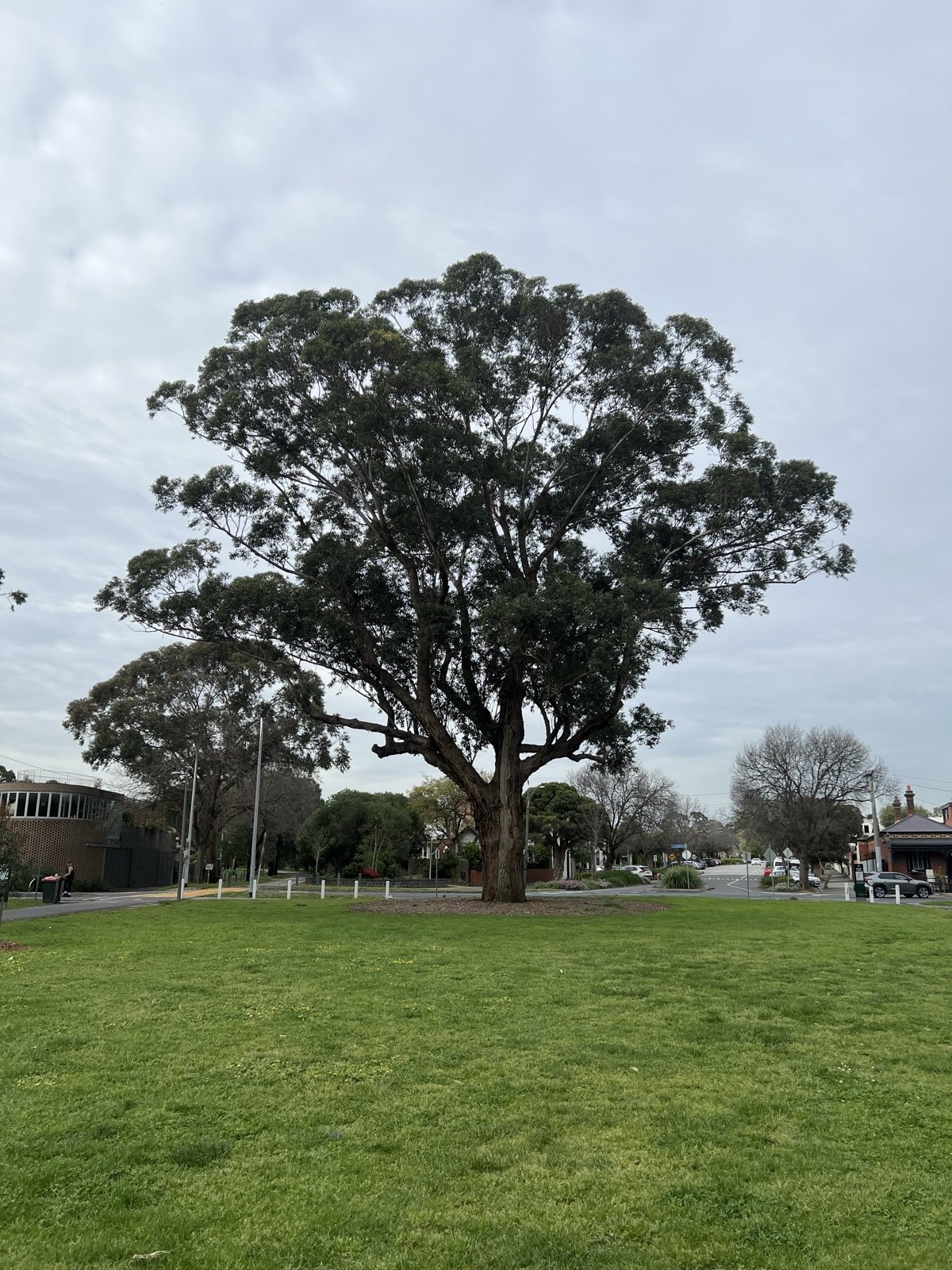
The Holm Oak of Darling Gardens
Darling Gardens has two trees on the National Trust's register. This is the other one. The Trust names a holm oak of regional significance alongside the elm, and it is much the smaller of the pair: 84 centimetres of diameter at breast height in the City of Yarra's survey, roughly 2.64 metres of girth once converted from the width across the trunk that the register publishes, against the elm's 4.84. It stands 16 metres tall about ninety metres from the elm, nearer the middle of the park than the Gold Street corner. Size is plainly not why it is listed. Quercus ilex is the evergreen oak of the Mediterranean, dark, leathery and dense enough that little grows under it, and it holds its canopy through the entire year. In a Melbourne February that is the difference between shade and no shade, and in July, when the elms around it are bare, it is still in full leaf. Spain and Portugal have grazed pigs on the acorns of this species for centuries, which is the other reason it travelled as far as it did. The age on file is the register's blunt band, over a hundred years at the 2012 survey, with no year and no independent date behind it. If you know when Darling Gardens' oak went in, tell us.
The line is our estimate of how much there is to see, not a measurement. Typical for this species where this tree stands; exact weeks shift with the year.
Darling Gardens, off Gold Street, Clifton Hill VIC 3068You can recognise it by its dark, dense, evergreen canopy, still in full leaf when the nearby elms are bare. It stands about ninety metres from Darling Gardens' registered elm, off Gold Street.
Free, always open. Public City of Yarra park.
Clifton Hill railway station (Hurstbridge/Mernda lines) is about a 6 minute walk; tram route 86 on Queens Parade is about a 6 minute walk (24-Gold St/Queens Pde stop).
Sources
Where the facts on this page come from.
- In the official register: City of Yarra Significant Trees register, no. 2
- City of Yarra Significant Trees register (, ref 2)
- National Trust of Australia (Vic) Significant Tree Register, cited via search snippet: 'Darling Gardens has two trees on the register: a holm oak (…