Giessen's veteran trees are scattered rather than gathered: a soaring oak pair called Adam and Eve in the Badenburger Wald, an early-protected oak and a Schiller memorial lime paired four hundred metres apart in Rödgen, and a storm-and-fire-scarred group of limes at a spring source in Lützellinden, nine kilometres from the oaks. Four trees, three separate outings rather than one walk, each protected as a Naturdenkmal, and none of them padded to look like more than it is.
0 of 4 visited in Giessen
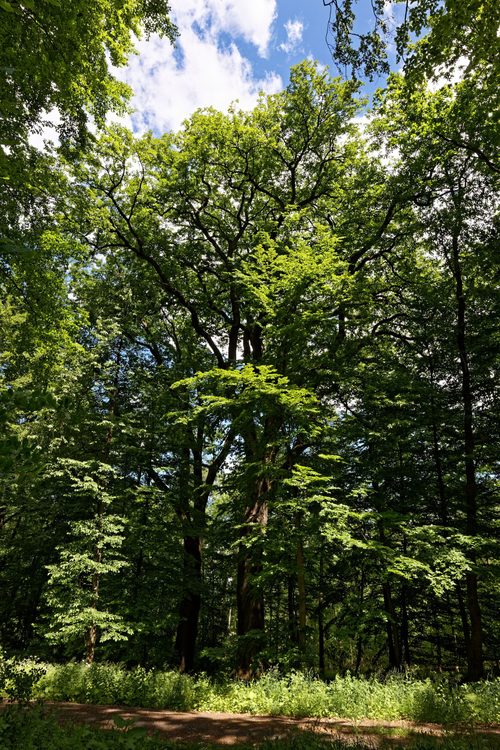
Sessile Oak (Quercus petraea) · 300-330 years · Wieseck
They count as one monument and there are two of them. Adam und Eva are a pair of sessile oaks in the Badenburger Wald on the Wieseck side of Giessen, registered together as a single Naturdenkmal, and the larger of the pair runs more than ten metres of unbranched trunk before it lets the first limb out. Straight oak of that length is rare, and from directly underneath it reads as a column rather than a tree.
The measurements depend on who took them and when. The city's Naturdenkmal register puts the two at roughly 4.20 and 5.20 metres round, 25 and 30 metres tall. Figures published in 2020 by monumentale-eichen and baumkunde give 4.42 and 5.95 metres, with 33 metres for the taller. Neither set is a mistake, so the range rather than any single number is the honest answer.
The pair are estimated at 300 to 330 years old, from their structure and growth rather than from any planting record, and they were documented by Hans Joachim Froehlich in his 1990 survey of Germany's historic trees.
The forest is public and free to walk. It sits on the northeastern edge of Giessen, and the city's other veteran trees are in other districts several kilometres away, so this one is a trip of its own rather than a stop on a walk.
Photo: Rainer Lippert
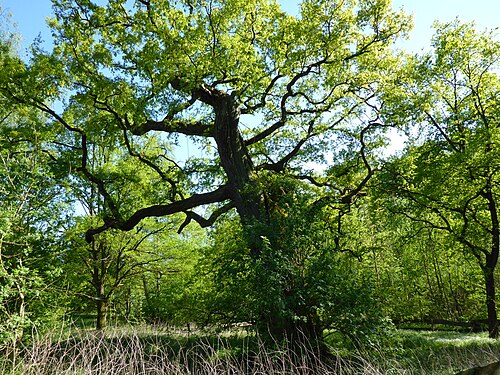
Pedunculate Oak (Quercus robur) · 275-350 years · Rödgen
A steel grating covers the triangular hole in this oak's trunk, one heavy horizontal branch rests on two steel tubes, and the bark has gone from the far side. Surveyors still describe it as vital overall. That is what an old oak looks like when a town has decided to keep it.
It has stood under protection since 3 September 1906, one of the earliest protection dates on Giessen's Naturdenkmal register and older than both world wars. The setting is modest: a former forest picnic clearing at the corner of Geiselweg and Seeweg, on the Rödgen side of the city.
Its age and size are on record twice and the two records do not match. The city register gives roughly 275 to 300 years, 16 metres tall, 6.10 metres round. Monumentale-eichen, measuring in 2018, gives about 350 years, 15 metres and 6.29 metres. Neither is careless. An oak's age is estimated from girth and structure rather than counted, and two estimates from different decades will differ, so the honest span here is 275 to 350 years.
The clearing is free and open. The Schillerlinde is about 400 metres away, so those two make a short walk together; Giessen's other veterans are kilometres off in other districts and are separate outings.
Photo: B!G!1851 (CC BY-SA 4.0)
Small-leaved Lime (Tilia cordata) · 167 years · Rödgen
Nobody has to estimate this tree's age. It was planted on 11 November 1859 for the hundredth birthday of Friedrich von Schiller, which makes it exactly 167 years old and the rare tree that arrives with a date rather than a range.
It was one of hundreds. Towns across the German states marked the Schiller centenary that year by putting a lime in the ground, and Rödgen planted its own on the Geiselstrauchkopf at the edge of the village, by what is now the sports field. It has since been designated a Naturdenkmal.
It is not a giant and there is no sense pretending otherwise: just under two metres round the trunk, which is modest for 167 years. A memorial tree is a different object from a veteran oak. This one was planted as public memory, on a date somebody wrote down, and it is still doing that job.
One local account ties it to Rödgen's Grenzgang, the traditional walking of the village boundary. That page could not be reached to check, so it stays lore here rather than fact. If you know the story, tell us.
The Alte Eiche stands about 400 metres away, an easy walk from this one.
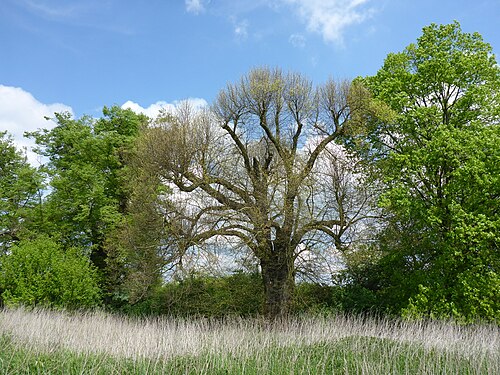
Small-leaved Lime (Tilia cordata) · 200-400 years · Lützellinden
The oldest of these limes has been through fire twice, taken lightning and repeated storm damage, and a survey in February 2021 still described it as vital, if partly hollow. Trees standing at the head of a spring lead exposed lives.
There were three. One came down in a storm and two remain, joined by a young lime that NABU planted after the spring area was returned to a more natural state. The names line up neatly: the Lindbach rises at the foot of the lindens, in the district of Lützellinden on the southwestern edge of Giessen. The group is a designated Naturdenkmal, listed as landscape-defining, which is a rare thing for a register to say about three trees and a stream source.
Nobody has dated the survivors precisely. Both sources give the same wide band, 200 to 400 years, estimated from size and structure with no planting record to narrow it, and the band is left wide here for that reason. The larger of the pair was measured in May 2020 at 5.79 metres round and 15 metres tall.
The spring is public and free. It lies about nine kilometres from the oaks in the Badenburger Wald on the far side of the city, so it is a visit in its own right and not a stop on a walk.
Photo: B!G!1851 (CC BY-SA 4.0)