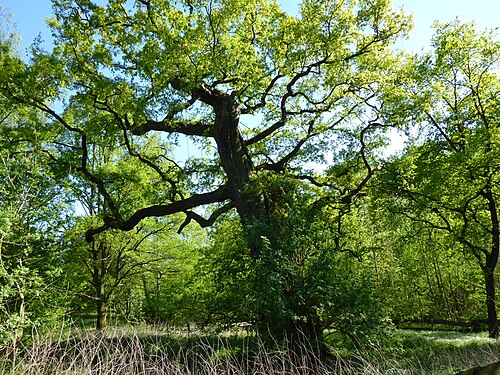
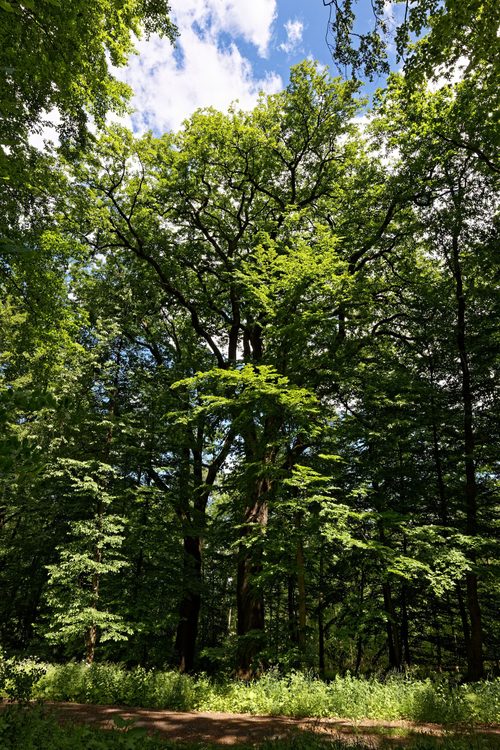
Lindengruppe an der Lindbachquelle
The oldest of these limes has been through fire twice, taken lightning and repeated storm damage, and a survey in February 2021 still described it as vital, if partly hollow. Trees standing at the head of a spring lead exposed lives. There were three. One came down in a storm and two remain, joined by a young lime that NABU planted after the spring area was returned to a more natural state. The names line up neatly: the Lindbach rises at the foot of the lindens, in the district of Lützellinden on the southwestern edge of Giessen. The group is a designated Naturdenkmal, listed as landscape-defining, which is a rare thing for a register to say about three trees and a stream source. Nobody has dated the survivors precisely. Both sources give the same wide band, 200 to 400 years, estimated from size and structure with no planting record to narrow it, and the band is left wide here for that reason. The larger of the pair was measured in May 2020 at 5.79 metres round and 15 metres tall. The spring is public and free. It lies about nine kilometres from the oaks in the Badenburger Wald on the far side of the city, so it is a visit in its own right and not a stop on a walk.
In bloom
June to July, when it flowers
The line is our estimate of how much there is to see, not a measurement. Typical for this species where this tree stands; exact weeks shift with the year.
At the Lindbach spring source, Lützellinden, GießenYou can recognise them as the two old, partly hollow limes standing with a younger, newly planted one beside them. They stand at the Lindbach spring source, in Lützellinden.
Free, public spring/parkland site in Lützellinden; no restriction found.
Not verified; no confirmed nearby stop. Lützellinden is a district on Giessen's southwest edge, reachable by car or bicycle from the city centre.
Sources
Where the facts on this page come from.