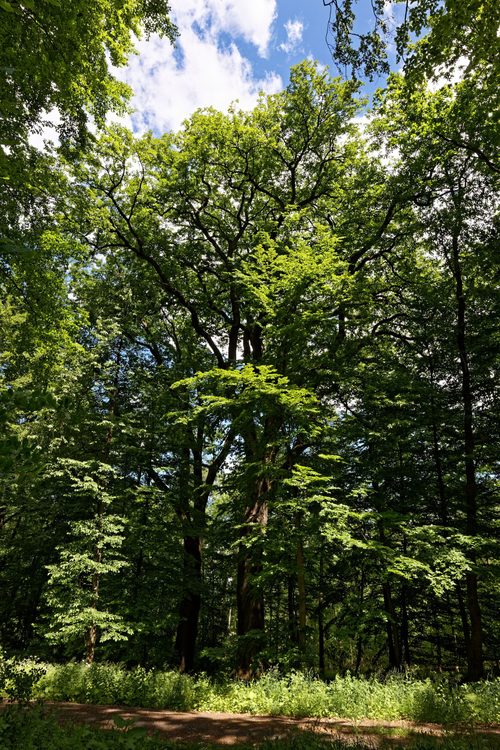
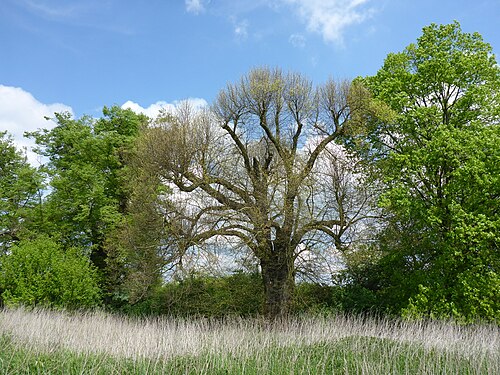
A steel grating covers the triangular hole in this oak's trunk, one heavy horizontal branch rests on two steel tubes, and the bark has gone from the far side. Surveyors still describe it as vital overall. That is what an old oak looks like when a town has decided to keep it. It has stood under protection since 3 September 1906, one of the earliest protection dates on Giessen's Naturdenkmal register and older than both world wars. The setting is modest: a former forest picnic clearing at the corner of Geiselweg and Seeweg, on the Rödgen side of the city. Its age and size are on record twice and the two records do not match. The city register gives roughly 275 to 300 years, 16 metres tall, 6.10 metres round. Monumentale-eichen, measuring in 2018, gives about 350 years, 15 metres and 6.29 metres. Neither is careless. An oak's age is estimated from girth and structure rather than counted, and two estimates from different decades will differ, so the honest span here is 275 to 350 years. The clearing is free and open. The Schillerlinde is about 400 metres away, so those two make a short walk together; Giessen's other veterans are kilometres off in other districts and are separate outings.
In fruit
September to October: acorns drop, and a good mast year buries the ground in them
The line is our estimate of how much there is to see, not a measurement. Typical for this species where this tree stands; exact weeks shift with the year.
Corner of Geiselweg/Seeweg, Rödgen, Gießen, on a former forest picnic clearingYou can recognise it by the steel grating over a hole in its trunk and a heavy branch propped on steel tubes. It stands at the corner of Geiselweg and Seeweg, in Rödgen.
Free, public clearing off Seeweg; no restriction found.
Not verified; no confirmed nearby stop. Rödgen is a district on Giessen's south edge, reachable by car or bicycle from the city centre.
Sources
Where the facts on this page come from.