Sixteen cedar seedlings came from Kew in 1818 and two are still standing in front of the palace, the larger of them the thickest of its kind in Germany. The Schlosspark is thirteen hectares of English landscape garden on ground that has been garden since 1441, and it holds six big trunks, five of them five metres round or more within a few hundred metres of each other. Free to walk through, twenty-five minutes from Frankfurt.
0 of 6 visited in Bad Homburg
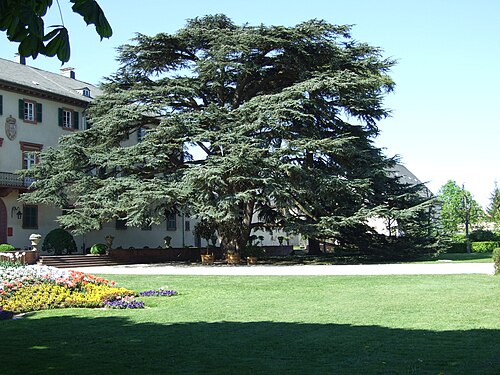
Cedar (Cedrus libani per baumkunde.de, Cedrus atlantica per the city of Bad Homburg; disputed, see notes) · ~210 years · Schlosspark, beside the palace
Sixteen cedar seedlings came from Kew and two of them are still standing here. They arrived through Princess Elizabeth of Great Britain, who married Landgrave Friedrich VI Joseph in 1818, brought her own interest in botany with her and kept her English contacts. The pair went into the ground in front of the palace's royal wing in 1822 and have grown side by side ever since.
The larger one is the point. It is 6.40 metres round, 21 metres tall, and the city calls it both the thickest and the oldest of its kind in Germany. Its reach is the part that does not photograph: by 2011 the crown measured more than 35 metres from east to west, so the tree is far wider than it is high, with limbs that run out nearly horizontally and then turn up at the ends.
Two hundred years is young for a cedar. The species can pass 800, which means this one is barely a quarter through and still thickening. Sources disagree about which cedar it actually is: the city says Atlas cedar, the German tree register says cedar of Lebanon. If you know your cedars, we would like to hear which.
Photo: dontworry, via Wikimedia Commons, CC BY-SA 3.0 (CC BY-SA 3.0)
Dawn Redwood (Metasequoia glyptostroboides) · 70 years · Schlosspark, southern end
This species was known only from fossils until 1944. A Chinese forester found living dawn redwoods in Hubei, seed went round the world's botanic gardens from 1948, and almost every large specimen in Europe is one of that first generation. This one is about 70 years old, which for a tree on this site makes it among the youngest here and by some distance the fastest.
In seventy years it has put on 5.8 metres of girth and 28 metres of height, which is more than the cedar managed in two hundred. The base is the part worth walking to: it flares out into deep vertical folds and buttresses, gnarled in a way that reads as far older than the tree is, and the bark runs in long fibrous strips up a trunk that tapers hard.
It is a conifer that drops its needles, so it turns foxy orange in November and stands bare through winter. Come in autumn and it is the brightest thing at the south end of the park.
Pedunculate Oak (Quercus robur) · Schlosspark, north end of the pond
Nobody has dated this oak, and it is probably the oldest thing in the park. It is 5.39 metres round and 25 metres tall, measured in the autumn of 2021 by the dendrologist who catalogued this park's big trees, and that girth puts it well past the cedars that have a planting date on them.
It stands just left of the bridge at the north end of the pond, on ground that has been garden since at least 1441, when a garden is first recorded beside the castle here. The park was laid out as a baroque garden from 1680 under Landgrave Friedrich II and remade as an English landscape park from the later eighteenth century, which is the style it still wears: grass, water, and single large trees given room. An oak this wide was either kept through one of those remakings or planted at one of them.
We would like to know which, and so would anyone standing under it. If you have a source for its age, a plaque, a park survey, a local record, tell us and we will put it on the page.
Pedunculate Oak (Quercus robur) · Schlosspark, south-west of the lake
This pedunculate oak is 4.94 metres round, measured in August 2021, and it stands about thirty metres south-west of the lake rather than on its bank, which is where our map first put it. A reader who knows this park tree by tree told us so, and the survey that measured it says the same.
It is one of three big oaks in the Schlosspark and the easiest to walk past. The largest, 5.39 metres, stands at the bridge two hundred metres north; a third, which locals call the Schöne Eiche, grows on the far side of the big meadow from the plane, towards the gate into the old town. This one has no name, no plaque and no path leading to it. It simply stands back from the water, broad and low-limbed, where the grass runs under the crown.
It is the common oak of German parkland, and at this girth almost certainly older than the cedars by the palace that carry a planting year. Nobody has dated it. The park was laid out as a baroque garden from 1680 and remade as an English landscape park a century later, and a trunk this wide was either kept through one of those remakings or planted at one of them. No source says which.
Plane (Platanus sp.) · Schlosspark, north end of the pond
At 5.66 metres round, this is the thickest trunk anyone has measured in the park, wider than the famous cedars and wider than the big oak thirty metres away. It has no name, no plaque and no entry in any register. It turned up in a dendrologist's survey of the park in 2021 and that is the whole of its paper trail.
It stands about ten metres east of the second of the park's wingnuts, near the north end of the pond. Planes are easy to pick out once the eye knows them: bark that flakes off in irregular plates and leaves the trunk patched in olive, cream and grey, a pattern that keeps changing as the tree sheds, and seed balls that hang on bare branches through the winter like small brown lanterns.
We have not established which plane it is. The London plane is the usual one in a park of this date, but nobody has said so in print about this tree, so we have not written it down as fact. If you can tell an oriental plane from a London plane by the leaf lobes or the seed balls, stand under it and tell us.
Pedunculate Oak (Quercus robur) · Schlosspark, towards the Altstadt gate
This oak has no plaque, no register entry and no date, and it may be the finest tree in the park. It is about five metres round and, by the estimate of the reader who knows this park trunk by trunk, around 36 metres tall, which would make it the tallest tree measured anywhere in the Schlosspark. He calls it the Schöne Eiche, the beautiful oak, and the name is about the crown rather than the girth: huge, whole and unusually vigorous, without the dead limbs and storm scars that most old oaks carry.
It is the third of the park's big pedunculate oaks. The widest, 5.39 metres, stands at the bridge; a second of 4.94 metres stands back from the lake in the south. This one grows on the far side of the big meadow from the plane, towards the gate into the old town, so the walk between the plane and the gate passes straight under it.
Nobody has dated it. The ground has been garden since 1441, baroque from 1680 and an English landscape park a century after that, and an oak of this size was either spared through one of those remakings or planted in one. No source says which, and neither do we. If you have a tape measure and a free afternoon, the girth is the number we would most like to have confirmed.