Fujikawaguchiko maps five trees, all kept alive by sacred ground rather than a park department. Shoji no Osugi is Suwa Shrine's guardian cedar by Lake Shoji, roughly 1,200 years old. A short drive south stand three of Japan's seven nationally protected Ohatsuki ginkgos, a leaf-seed mutation: one flattened by a 2018 typhoon and still fruiting. In Fujiyoshida, a wild wisteria at Yama-jinja gives its name to the fifth. Five trees so far, each verified on its own merits.
0 of 5 visited in Fujikawaguchiko
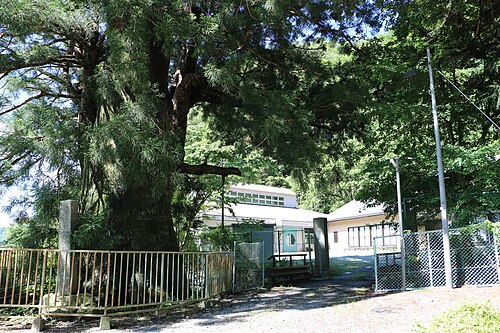
Japanese Cedar (Cryptomeria japonica) · 1,200 years · Shoji (Lake Shoji area, Fuji Five Lakes)
Twelve metres round the trunk and forty metres tall, this is one of the largest cedars in Yamanashi, and it stands in a shrine yard rather than deep forest. Suwa Shrine keeps it as its goshinboku, the sacred tree of the place. Shrine trees get left alone, which is how a cedar reaches this size in a valley people have lived in for centuries.
Locally it goes by Sennen-sugi, the Thousand-Year Cedar. The estimate behind that name is roughly 1,200 years, a broad figure arrived at from the tree's size rather than from anything counted, so treat the nickname as the rounder version of an already round number. On 31 January 1928 the state made the protection official and designated it a National Natural Monument.
The setting is the other half of the appeal. Shoji is one of the Fuji Five Lakes, so the tree stands inside one of the most photographed landscapes in Japan while the mountain takes the attention. The shrine grounds are open and free, and there is nothing between a visitor and the trunk.
No recent assessment of its health turned up in the sources we reached, and nothing in them points to decline. If you have been there lately, tell us how it looked.
Photo: さかおり (CC BY-SA 4.0)
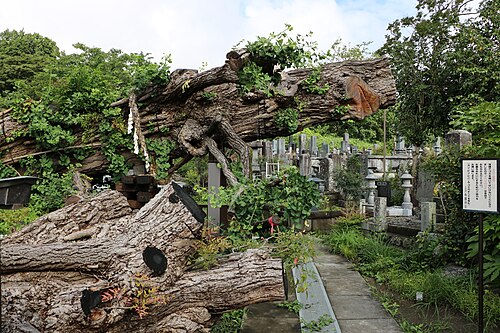
Ohatsuki Ginkgo (Ginkgo biloba var. epiphylla) · 750 years · Shimoyama, Minobu-cho (about 17 km south of Fujikawaguchiko, within day-trip distance)
On the night of 30 September 2018, Typhoon Trami snapped this ginkgo off near its base and laid the whole tree flat on the ground at Jotakuji Temple. The temple left it exactly where it fell rather than clearing it away, and within a year new shoots were pushing out of the fallen trunk. It has fruited from the ground every autumn since. Locals now call it Yokobushi no Oh-Icho, the great fallen ginkgo, and the town still tracks its condition on its own website today.
This is not an ordinary ginkgo. It is an Ohatsuki variant, in which roughly a third of the seeds grow fused to the edge of a leaf instead of hanging free, a mutation first described to Japanese science from this exact tree in 1891. Only seven trees of this kind carry national Natural Monument status, designated in 1929, and three of the seven stand within a couple of kilometres of each other in this one district of Minobu.
Local legend explains the ground rather than the species: a Nichiren-sect priest is said to have planted his teacher's walking staff, cut from ginkgo wood, over the grave of a dog that once took poison meant for him, and the staff took root. Whatever actually planted it, something here has kept it fruiting for roughly 750 years, upright for most of them and, since 2018, flat on its side.
Photo: さかおり (CC BY-SA 4.0)
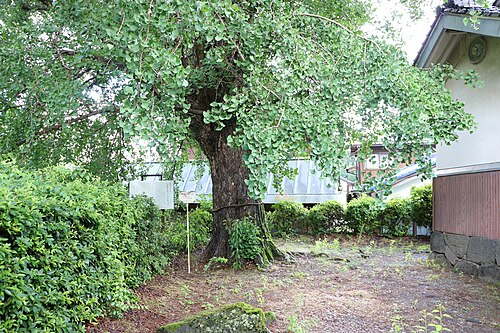
Ohatsuki Ginkgo (Ginkgo biloba var. epiphylla) · 200 years · Kamiyagisawa, Minobu-cho, about 17 km south of Fujikawaguchiko's centre and about 1.7 km from fjk_002 (the Ohatsuki Ginkgo of Jotakuji Temple), in the same Shimoyama-area cluster of nationally designated Ohatsuki ginkgos
In the autumn of 2011 a male tree produced roughly forty seeds. They hung eight to ten metres up, on one branch of a ginkgo that had never fruited in its recorded history, because that single limb had quietly reversed sex on its own. Researchers took grafting and seedling permits at the University of Tokyo's botanical garden between 2015 and 2017 to work out what had happened, and that remains the freshest confirmation on record that the tree is alive and being watched.
It was already odd before that. Ohatsuki ginkgos carry their seeds on the leaf blade itself instead of on a stalk, a mutation rare enough that Japan has given the status of National Natural Monument to only seven of them. This one, on the grounds of Yamajinja shrine in Kamiyagisawa, is the only male of the seven, protected since July 1940. Botanists first described it in 1891, though the town's own page has also put that at 1896.
Nobody has ever dated it properly. Local tradition called it about 180 years old at the time of the 2011 fruiting, which puts it near two centuries now, and that is tradition rather than measurement. The trunk measures 3 metres round at chest height, 3.94 at the base, under 25 metres of crown. Another of the seven stands less than two kilometres away, at Jotakuji temple.
Photo: さかおり (CC BY-SA 4.0)
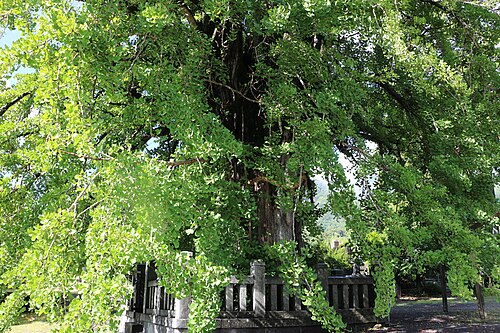
Ohatsuki Ginkgo (Ginkgo biloba var. epiphylla) · 700 years · Shimoyama, Minobu, about 750 metres from fjk_002 (Jotakuji) and 1.65 km from fjk_003 (Yagisawa), the same Shimoyama-area cluster of nationally designated Ohatsuki ginkgos
Legend says the monk Nichiren planted this ginkgo himself during an overnight stay in 1282, on his way through the valley that now bears his sect's temples across Minobu. That would put the tree near 750 years old, and it is tradition rather than a planting record, so the age here stays a broad estimate rather than a precise one.
What is measured is the mutation. Most ginkgos carry their seeds on a stalk; this one, like only six others in all of Japan, grows them straight out of the leaf blade itself. Botanists first wrote the trait up in July 1891, and the government made the protection official in April 1929. Three of the seven nationally designated Ohatsuki ginkgos in the country stand within two kilometres of each other here in Minobu, an odd concentration nobody has fully explained.
The trunk runs 5.4 metres round at chest height and 6.42 at the base, rising to a 24-metre crown with comparatively few of the milky, nipple-like growths that mark many old ginkgos. It stands between the guardian gate and the main hall of Hongokuji Temple, directly on the Nichiren pilgrim route, with its two Ohatsuki siblings close enough to visit in the same afternoon: one 750 metres north at Jotakuji, the other a further kilometre on at a shrine in Yagisawa.
Photo: さかおり (CC BY-SA 4.0)
Japanese Wisteria (Wisteria floribunda) · Fujiyoshida, about 20 km from Fujikawaguchiko's other trees, connected by the local Fujikyuko rail and bus network
Two wild wisteria vines grow in the grounds of a shrine named for them: Yama-jinja, whose fuller name, Yamanokami no Fuji, means the wisteria of the mountain god. Unlike most shrine wisterias here, planted as a cultivar and trained onto a frame, these two seeded themselves and climbed on their own.
The state designated the site a National Natural Monument on 31 January 1928, one of only eight climbing plants in the country with that status. The vine nearer the shrine building once measured 3.1 metres round at the root, until a typhoon damaged it badly enough that it now leans on a support structure. Its companion grows tangled into a Japanese maple on the shrine's north side and is otherwise undescribed in any source reached.
Nobody has dated either vine. Wisterias do not date reliably by girth the way trees do, and no planting record survives, so the age here stays an open question rather than a guess. If you know, tell us.
It is still flowering. A flower-tracking report placed it past peak bloom by 8 May 2026, recent, dated evidence that both vines are alive and doing what they have done since before anyone thought to measure them.