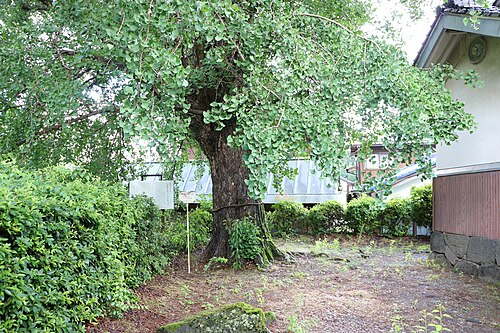
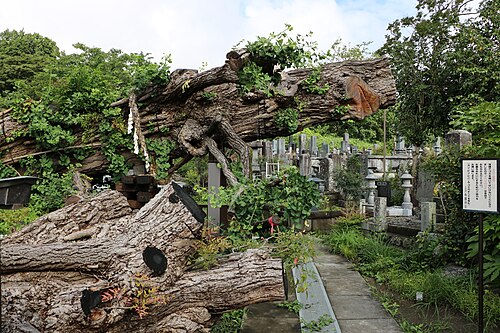
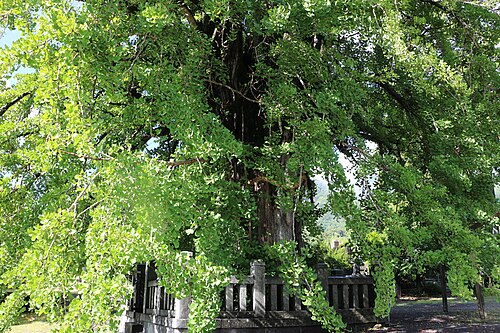
Twelve metres round the trunk and forty metres tall, this is one of the largest cedars in Yamanashi, and it stands in a shrine yard rather than deep forest. Suwa Shrine keeps it as its goshinboku, the sacred tree of the place. Shrine trees get left alone, which is how a cedar reaches this size in a valley people have lived in for centuries. Locally it goes by Sennen-sugi, the Thousand-Year Cedar. The estimate behind that name is roughly 1,200 years, a broad figure arrived at from the tree's size rather than from anything counted, so treat the nickname as the rounder version of an already round number. On 31 January 1928 the state made the protection official and designated it a National Natural Monument. The setting is the other half of the appeal. Shoji is one of the Fuji Five Lakes, so the tree stands inside one of the most photographed landscapes in Japan while the mountain takes the attention. The shrine grounds are open and free, and there is nothing between a visitor and the trunk. No recent assessment of its health turned up in the sources we reached, and nothing in them points to decline. If you have been there lately, tell us how it looked.
Suwa Shrine, Shoji, Fujikawaguchiko, Minamitsuru District, Yamanashi PrefectureYou can recognise it by its huge trunk, twelve metres round, towering over the shrine yard. It stands in the grounds of Suwa Shrine, in Shoji.
Free. Stands within the grounds of Suwa Shrine, open to the public.
In the Shoji district by Lake Shoji, one of the Fuji Five Lakes; reached by car or local bus from Kawaguchiko or Fujinomiya.
Sources
Where the facts on this page come from.