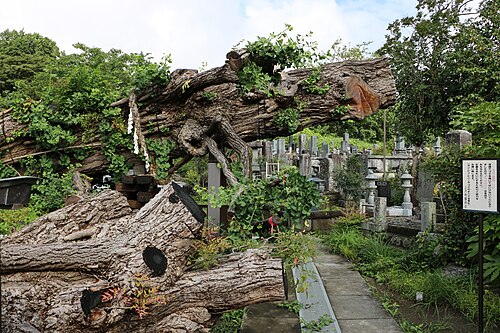
On the night of 30 September 2018, Typhoon Trami snapped this ginkgo off near its base and laid the whole tree flat on the ground at Jotakuji Temple.
Photo: さかおり (CC BY-SA 4.0)
Ginkgo biloba var. epiphylla
Most ginkgos hang their seeds on a stalk, apart from the branch. We map 6 of them, in 4 cities.
This mutation grows them straight out of the leaf blade itself, first described to Japanese science in July 1891 from a specimen in Minobu, Yamanashi. Only seven trees of the kind hold National Natural Monument status, and an unexplained three of them stand within two kilometres of each other in that one district: one toppled by Typhoon Trami in 2018 and still fruiting from its fallen trunk, another the sole male of the seven, its single fertile branch discovered only in 2011 after decades of nothing, and a third that local legend has the monk Nichiren planting himself in 1282. None has a documented planting date; all three ages here stay broad estimates rather than measurements.
On the night of 30 September 2018, Typhoon Trami snapped this ginkgo off near its base and laid the whole tree flat on the ground at Jotakuji Temple.
Photo: さかおり (CC BY-SA 4.0)
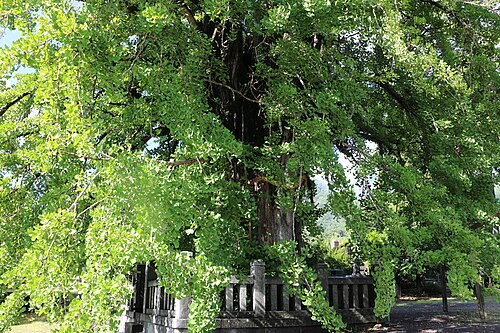
Legend says the monk Nichiren planted this ginkgo himself during an overnight stay in 1282, on his way through the valley that now bears his sect's temples across Minobu.
Photo: さかおり (CC BY-SA 4.0)
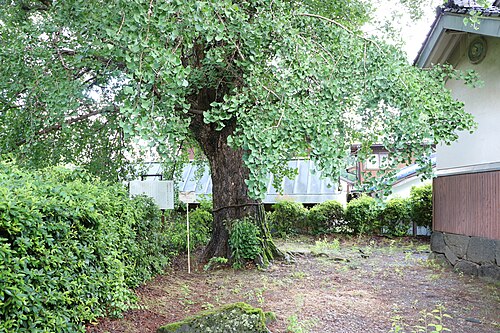
In the autumn of 2011 a male tree produced roughly forty seeds.
Photo: さかおり (CC BY-SA 4.0)
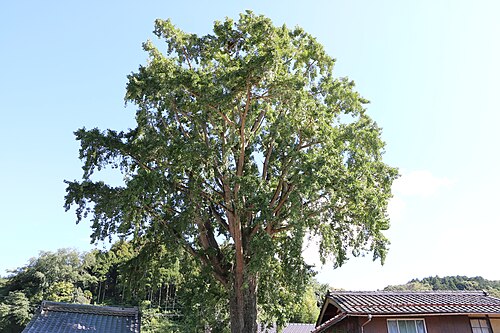
This ginkgo grows its seeds on the edges of its leaves, which is not how ginkgos work.
Photo: さかおり (CC BY-SA 4.0)
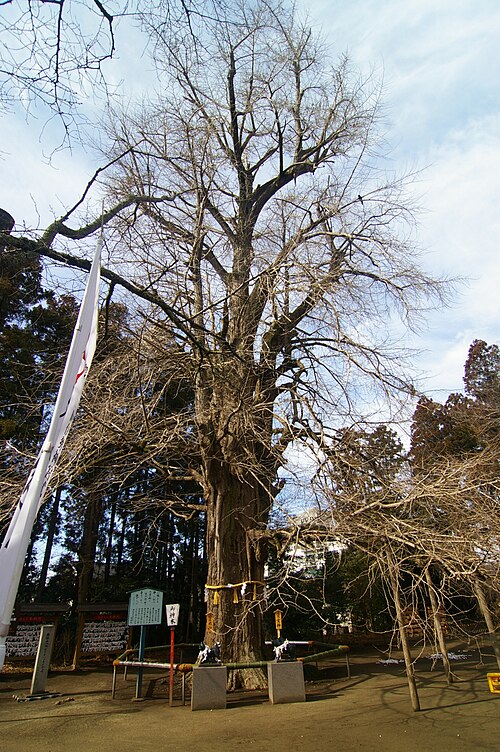
There are perhaps twenty leaf-seed ginkgos known anywhere in the world, and this is the largest of them.
Photo: DrTerraKhan (CC BY-SA 3.0)
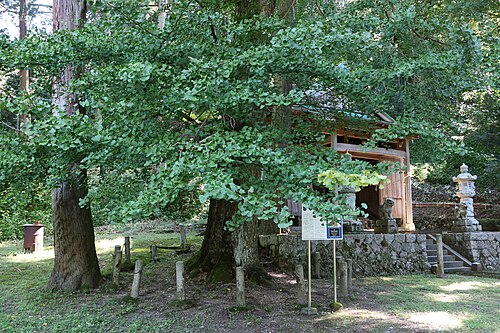
These two ginkgos grow their seeds on the edges of their leaves.
Photo: さかおり (CC BY-SA 4.0)
Explore by city: Fujikawaguchiko · Prague · Brussels · Seville · Munich · Porto · Brisbane · Lisbon · every city · or browse all species.