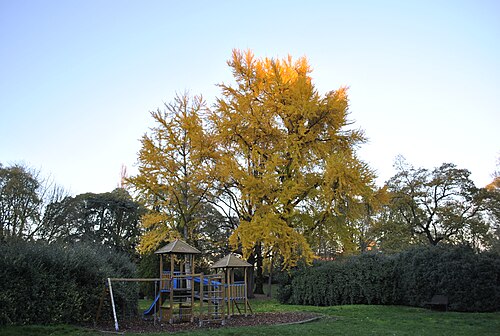
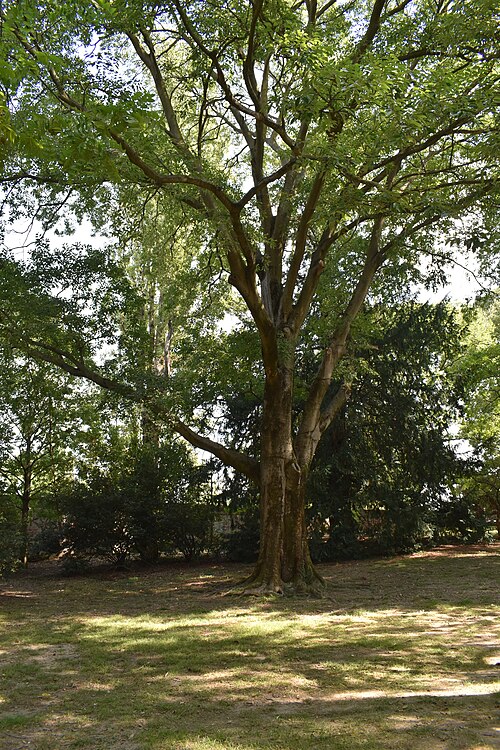
The first written record of this tree dates to 1890, and it did not start out in a library garden. It is a survivor of the University of Ferrara's old botanical garden, once kept in the courtyard of Palazzo Paradiso, the building that now houses the Biblioteca Ariostea, the city's historic public library. When the university's collection moved on, this ginkgo did not go with it. At 4.65 metres round and about 20 metres tall, with a canopy wide enough to fill the courtyard it stands in, it is a male tree, which means it never produces the strong-smelling fruit that gives female ginkgos their bad reputation, only the fan-shaped leaves that turn a uniform gold every autumn and draw crowds specifically to photograph it. Local papers cover the display most years, treating a single tree changing colour as news, which is a fair measure of how much the city has come to value it. Ginkgo biloba's lineage runs back some 250 million years, effectively unchanged, a genuine living fossil rather than a marketing phrase. A specimen first recorded in a 19th century university garden and still standing in the 21st is, by the standards of its own family tree, barely middle-aged.
Autumn colour
late November into early December, when the canopy turns gold and draws crowds to photograph it
The line is our estimate of how much there is to see, not a measurement. Typical for this species where this tree stands; exact weeks shift with the year.
Biblioteca Comunale Ariostea, Via delle Scienze 17, 44121 FerraraThe wide-canopied ginkgo filling the library's courtyard garden at Via delle Scienze 17, unmistakable in November when it turns gold.
Free, in the library's public courtyard garden, open during library hours
About a 10 minute walk south of Ferrara Castello Estense
Sources
Where the facts on this page come from.
- In the official register: Elenco degli alberi monumentali d'Italia (MASAF), no. 01/D548/FE/08
- masaf.gov.it
- museoferrara.it
- estense.com
- MASAF, Elenco degli alberi monumentali d'Italia (Italy's national register of monumental trees), no. 01/D548/FE/08