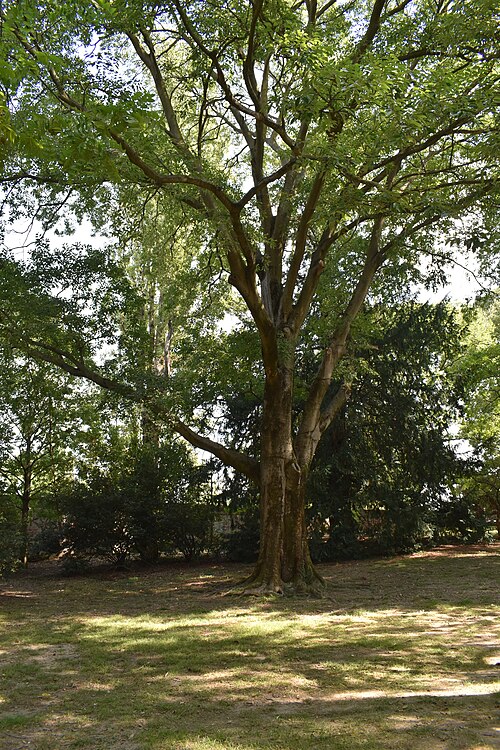
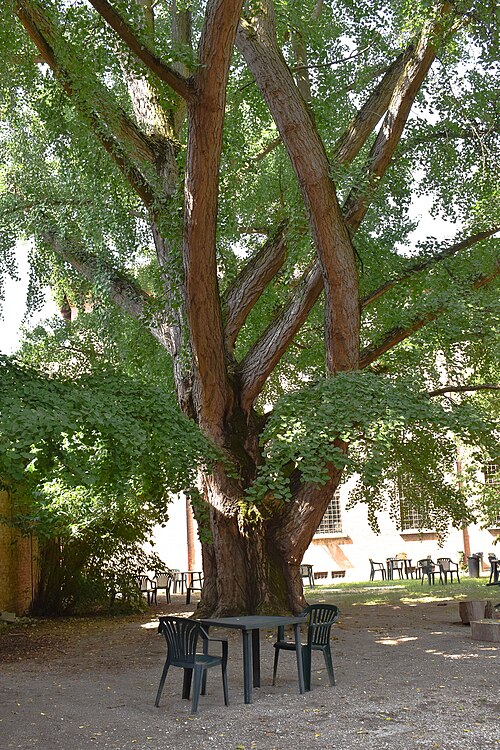
Parco Massari's plant list runs long, planes, paulownias, horse chestnuts, magnolias, birches, limes, firs, pines, acacias, but the ginkgo is the one tree in it whose lineage predates the flowering plants surrounding it by tens of millions of years. This specimen, 3.80 metres round and 25 metres tall, grows among the park's other monumental trees, the three cedars of Lebanon and the bagolaro that made Italy's first official protected-tree list together. Ginkgo biloba is the last living species of an order that once grew across the northern hemisphere and had been reduced, by the time European botanists took an interest, to a handful of cultivated groves in China. It survives poor soil, pollution and pests that would finish off almost anything else, and it turns a hard, uniform gold in autumn rather than the mixed colours most deciduous trees show. The park itself was laid out in 1780 for a marchese, remade as an English landscape garden by the Massari family in the 19th century, and sold to the city of Ferrara in 1936, so this tree has spent at least part of its life under each of those owners.
Autumn colour
November, when the fan-shaped leaves turn a uniform hard gold
The line is our estimate of how much there is to see, not a measurement. Typical for this species where this tree stands; exact weeks shift with the year.
Parco Massari, Corso Porta Mare, 44121 FerraraThe ginkgo among Parco Massari's collection of monumental trees, its fan-shaped leaves and pale gray trunk unlike anything else nearby.
Free, public park, open daily
About a 15 minute walk north-east of Ferrara railway station
Sources
Where the facts on this page come from.
- In the official register: Elenco degli alberi monumentali d'Italia (MASAF), no. 17/D548/FE/08
- masaf.gov.it
- storiedipianura.it
- MASAF, Elenco degli alberi monumentali d'Italia (Italy's national register of monumental trees), no. 17/D548/FE/08