Cagliari's biggest tree stands outside the central railway station: a Moreton Bay fig twelve metres round, fenced at the base. A second fig, 9.8 metres round, holds the corner where Via Roma meets the waterfront. The Giardini Pubblici, Sardinia's oldest park, adds twinned figs, a honey locust and a jacaranda, and the botanical garden nearby holds a third fig, an ombu, a dragon tree and an argan, the only one in an Italian garden. Further out: a Pirri cypress, two Dolianova pines, and a blue gum and lime above Sinnai. Ten of fourteen stand within a kilometre and a half.
0 of 14 visited in Cagliari
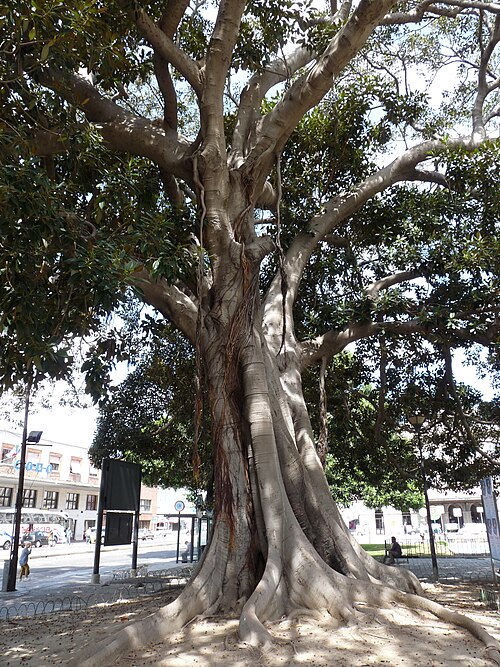
Moreton Bay Fig (Ficus macrophylla) · 140-150 years · Marina, opposite the port and central station
Twelve metres around the trunk. That is the largest girth Italy's national register of monumental trees records for any tree in Cagliari, and it belongs to a fig from the far side of the world standing on the square outside the central railway station.
Ficus macrophylla comes from the coastal forests of eastern Australia, and at this size it stops behaving like a street tree. Aerial roots come down from the limbs, thicken where they meet the ground and fuse into a base with no clean edge to put a tape around. Local reporting puts the tree at 140 to 150 years old.
The fence is the first thing a visitor notices. The city ringed the ground under the canopy in November 2025 as a precaution against branch drop, so you can stand beside the tree but not walk under it. It is not a sign of decline. A University of Sassari team assessed the trunk in January 2025 with a dendrodensimeter, an instrument that reads the density of the wood as it drills, and reported no risk of structural collapse and no damage from the building works going on in the piazza. In April 2026 the councillor responsible for the city's green spaces said the same thing plainly: the tree is healthy, and has been under continuous technical management since 2019.
Photo: Smiley.toerist (CC BY-SA 4.0)
Moreton Bay Fig (Ficus macrophylla) · 140 years · Marina, Via Roma waterfront
Local press calls this the fig that survived the bombs. Cagliari was hit hard from the air in 1943 and the Moreton Bay fig on the corner where Via Roma meets Via Regina Margherita came through it, which is a large part of why the city is fond of it.
CagliariNews dates the planting to about 1883, when the harbour front was being laid out as the Parterre della Darsena, so the tree is over 140 years old. Italy's national register of monumental trees measures the trunk at 9.8 metres round, second in the city only to the fig outside the railway station, five minutes west along the same waterfront.
Sardinia added it to the regional list of monumental trees on 21 January 2025, on the same day as the cypress in the Pirri cemetery. The case local reporting made for it was not only age. A canopy this size over one of Cagliari's busiest junctions cools the air under it, takes in what the traffic puts out, and holds resident and migrating birds through the year. It is a working tree in a place that badly needs one, and the fact that it is Australian, like every other big fig in this city, has stopped being remarkable to anybody who lives here.
Moreton Bay Fig (Ficus macrophylla) · 140-195 years · Giardini Pubblici, between Castello and La Vega
The national register does not measure these two figs separately. It files them as an insieme omogeneo, a homogeneous group, which is how they read from the path: two Moreton Bay figs of much the same size and age, standing together on the avenue near the main entrance of the Giardini Pubblici.
They are the quieter half of Cagliari's fig story. The park opened between 1866 and 1873 on ground the city had used for its bastion and its lazzaretto, which makes it the oldest public park in Sardinia, and these two went in early enough that published estimates of their age start at 140 years and run as far as 195. Nobody has narrowed that. The city's own pages and the local press cite different figures and neither has been withdrawn.
In November 2021 the council put three of the park's trees onto the Sardinian regional list of monumental trees: this pair and the honey locust a short walk away. Regional money followed, earmarked for maintenance on the park's protected trees. What that buys is time. A Ficus macrophylla at this size carries limbs longer than most trees are tall, drops aerial roots from them and thickens the ones that reach soil into props, and keeping that structure standing over a public path is the whole job.
Honey Locust (Gleditsia triacanthos) · 120-150 years · Giardini Pubblici, between Castello and La Vega
Italians call this species spino di Giuda, Judas's thorn, and the local name for this particular tree sometimes adds inerme: thornless. That is the joke of it. A wild Gleditsia triacanthos defends itself with branched spines that grow in bunches straight out of the trunk, long enough to go through a boot. The form planted in parks has had them bred out.
It is the third of the three Giardini Pubblici trees Cagliari's council put onto the Sardinian regional list of monumental trees in November 2021, alongside the pair of Moreton Bay figs a short walk away, and by some distance the least obvious of them. The national register measured its trunk at 2.94 metres round in 2020 and nobody has taped it since. No source gives it a documented age; the figures that circulate for the park's protected trees put it somewhere over a century, and that is as close as the record comes.
Honey locust is a tree of central North America and it does not look like the figs at all. The leaves are pinnate and small enough to read as ferns from underneath, they come late and go early, and the seed pods are long, dark and twisted, hanging in the crown well after the leaves have gone.
Blue Jacaranda (Jacaranda mimosifolia) · 100-150 years · Giardini Pubblici, between Castello and La Vega
For a few weeks each May this tree stops being green. Jacaranda mimosifolia flowers in violet-blue trumpets across the entire crown, and what falls carpets the ground beneath it in the same colour, which is why the species has been planted in warm cities from Pretoria to Lisbon to Sydney.
It is the odd one out among the Giardini Pubblici's protected trees, and much the smallest: Italy's national register of monumental trees gives it 1.74 metres round and 16 metres tall, against figs that go to twelve. Its record is also the thinnest here. That register is the only source that has measured this tree on its own, and when regional funding for maintenance of the park's monumental trees came round in 2025 the coverage named the jacaranda without adding an age or a condition report specific to it. So the century or more given on this page is an estimate in line with the trees standing around it, not a dated figure, and it should be read that way.
The species comes from the dry forests of northwestern Argentina and Bolivia. It flowers on bare or barely-leafed branches, which is what produces the effect: no green to dilute it, just the whole shape of the tree in one colour for a fortnight.
Prosopis torquata · 165-200 years · central Cagliari, near Via Sonnino
This tree has no English name. Sardinians call it the tintitaco, the Italian tree registry that keeps the fullest record of it translates that as the Admiral's Tree, and Prosopis torquata, a thorny mesquite from the dry country of northwestern Argentina, is otherwise close to unknown in European parks.
The name points at the story local sources tell. An English naval commander, a ship that put into Cagliari to sit out a storm with a cargo of exotic plants, and this one left behind as a gift to the city. It is repeated in several places and documented in none, so read it as the city's own account rather than as a record.
The measurements come with the same caution. The national register lists the trunk at 3 metres round; the Italian tree registry gives 5.7 metres, taken at ground level because the trunk divides low, at about 1.3 metres. Both are right at the height they were measured. Age splits the same way: roughly 166 years on the registry's most recent update, around 200 in local reporting, and no figure at all on the national sheet.
The state of it is not in dispute. One heavy limb rests on scaffolding and a metal cage holds the trunk on one side. It is alive, protected under Sardinian law, and very obviously being kept that way.
Mediterranean Cypress (Cupressus sempervirens) · 200 years · Pirri
The cemetery came second. Pirri's burial ground was consecrated on 8 November 1913 and this cypress was already standing on the site, more than two hundred years old by the reckoning of the Sardinian press that covered its protection in 2025.
That makes it, on the published figures, the oldest tree on this page. It is also improbably heavy for its species. Italy's national register of monumental trees puts the trunk at 6.3 metres round, where a Mediterranean cypress normally goes up as a narrow dark column and stays that way for centuries.
Cupressus sempervirens has been the tree of Mediterranean burial grounds since long before this one was planted: evergreen, so it never looks dead, and slow enough to outlast everyone buried beneath it. The unusual part here is the order of events. This tree did not arrive to mark the graves, the graves arrived around the tree, and generations of Pirri residents have used it as a landmark rather than a monument.
Sardinia added it to the regional list of monumental trees on 21 January 2025, the same day as the fig on Via Roma. Pirri is a district about four kilometres out from the old centre, on a city bus route, and this is a working cemetery rather than a garden: visiting hours, quiet, and people there with a reason.
Moreton Bay Fig (Ficus macrophylla) · ~150 years · Stampace, Valle di Palabanda
Cagliari's botanical garden was laid out in a valley the Romans had already used, on the site of an amphitheatre and a run of Punic and Roman cisterns, and it opened on 15 November 1866. This fig is one of the trees that went in at the start.
The date comes from the garden itself. Its account of its notable trees says they are the oldest specimens on the ground because they were planted during the founding phase, and it names this Ficus macrophylla in that list, alongside the ombu and the dragon tree. Allow the founding planting a decade or two beyond the opening and the fig comes out somewhere around 140 to 160 years old. Nobody has put a tape around it, so there is no girth to quote.
Cagliari's other Moreton Bay figs are public property in every sense: the giant on Piazza Matteotti outside the railway station, fenced off as a precaution and argued over in the local press, and the pair on the avenue in the Giardini Pubblici. This one has had the quieter life. It grew up inside a working university collection, on five hectares designed by the architect Gaetano Cima for the garden's first director Patrizio Gennari, among people whose job is to notice what trees do. Four euros gets you in, Monday to Saturday.
Ombu (Phytolacca dioica) · ~150 years · Stampace, Valle di Palabanda
The ombu is not built like a tree. Phytolacca dioica is a pachycaul, a plant that puts its bulk into a broad soft water-holding stem instead of into hard timber, which is how a South American relative of pokeweed ends up thickening at the base in a way no timber tree does.
Cagliari's grows along the main avenue of the botanical garden, past the bald cypresses and short of the Pampanini fountain, which is where the garden's own visitor route places it. Both the Italian parks and gardens association and the Italian Botanical Heritage survey list it among the garden's significant specimens, which is good company for a species most visitors would walk past without a second look.
Its age comes from the garden's own account, which says the notable trees are the oldest on the ground because they were planted during the founding phase, and names the Phytolacca dioica among them. The garden opened on 15 November 1866, so the ombu is up to about 160 years old, give or take however long that first planting ran on. What nobody has published is a girth, and on a trunk of this shape that is the measurement worth having. If you have stood beside it with a tape, tell us.
Dragon Tree (Dracaena draco) · ~150 years · Stampace, Valle di Palabanda
Cut a dragon tree and it bleeds. The red resin that runs out is what gave Dracaena draco its name and what made the species worth shipping off the Canary Islands for centuries, as a dye, a varnish and a medicine.
This one stands near the Department of Botanical Sciences building at the top of Cagliari's botanical garden, and it is an odd thing to meet in Sardinia. Not a conifer and not a palm: a succulent that has worked out the shape of a tree, thickening slowly and dividing its crown into fistfuls of stiff sword-shaped leaves. The older it gets, the more branched and the more particular that crown becomes.
Dating one is hard, because a dragon tree lays down none of the annual rings you can count in an oak, and its age is usually read from how often the crown has forked. Here the figure comes from the garden instead. Its own account of its notable trees says they are the oldest specimens on the ground because they were planted during the founding phase, and it names the Dracaena draco in that list beside the ombu and the Moreton Bay fig. The garden opened on 15 November 1866 in the Valle di Palabanda, above Roman cisterns and the site of an amphitheatre, so this dragon tree has had up to about 160 years to build the head it carries now. Nobody has measured its trunk.
Argan (Argania sideroxylon, syn. Argania spinosa) · Stampace, Valle di Palabanda
Italy has exactly one argan tree in a botanical garden, and it grows in Cagliari.
Argania sideroxylon is endemic to the semi-arid south of Morocco and is planted almost nowhere in Europe. The Italian parks and gardens association lists this specimen as the only one in any Italian botanical garden. The Italian Botanical Heritage survey goes a step further and calls it probably the only one in any European botanical garden. A University of Bari research record on the species, written about something else entirely, agrees that the Cagliari tree is the only documented argan in the country.
So the reason to walk to this one is not age or size. It is that the species has no business being here at all. Argan is the tree behind argan oil, pressed from the kernels inside its fruit, and in its home range goats climb into the branches after them. Everything about it is built for drought: small leathery grey-green leaves, thorny branches, a crown that holds on through months without rain. Cagliari, hot and dry by the standards of anywhere north of it, is close enough to Morocco in climate to keep the tree alive.
The garden around it opened on 15 November 1866, on five hectares in the Valle di Palabanda above Punic and Roman cisterns. Nobody has published a planting date, an age or a girth for the argan itself. If you have measured it, or know when it went in, tell us.
A day trip away
Sinnai, 17 km north-east
Tasmanian Blue Gum (Eucalyptus globulus) · 100 years · Sinnai, Foresta dei Sette Fratelli
Sardinia has almost no native eucalyptus, and that is the point of this one. Eucalyptus globulus, the Tasmanian blue gum, arrived on the island as a reforestation and windbreak species, planted along roads and forest edges rather than admired for its own sake. This one, standing at the edge of the Foresta dei Sette Fratelli near Sinnai, ended up on Italy's national register of monumental trees anyway, one of relatively few eucalyptus to make that list in a country where the species is functionally an immigrant.
The numbers disagree by about six percent, which for a tree this size is not much of an argument: the regional heritage portal measures the trunk at 4.9 metres round, the national register at 5.2, and both put the height at close to 30 metres. Age is recorded only loosely, as over a hundred years, which given how fast blue gums grow in the right climate could mean either a genuinely old specimen or one that simply had good conditions early.
The forest around it is real, a reserve for the Sardinian deer and for mouflon reintroduced here from the 1980s, and the tree stands a fifty metre walk from a car park with full public access and no entrance fee. There is no bus route out here. The road is the only way in, about half an hour from central Cagliari.
Corongiu, 17 km north-east
Common Lime (Tilia x europaea) · 100-175 years · Corongiu, Sinnai
Corongiu is three dams stacked up a valley above Sinnai, built between 1867 and 1922 to give Cagliari its first real water supply, and this lime tree has stood at the site for long enough that nobody now can say whether it predates the dams or came after them. At 2.6 metres round and 18 metres tall, it is the kind of specimen that only grows where a valley holds water and shelter both, which is exactly what an engineer would have looked for in 1867 too.
The reservoirs still work, still supply Cagliari, and the paths around them are now a public walking trail through the hills, popular enough that Legambiente and the water utility Abbanoa run organised visits explaining the site's history. Sardinia's own monumental tree register lists the lime by its measurements alone, no age, no planting story, just the girth and the height and the place name.
What that leaves unsettled is worth saying plainly: reach it on the open trail through the Corongiu valley, and whether that trail runs right up to the tree or past a fenced section of the works has not been confirmed. Anyone who has walked it can tell us, and settle the last honest gap in an otherwise well measured tree.
Dolianova, 18 km north
Aleppo Pine (Pinus halepensis) · 60-95 years · Dolianova
Two Aleppo pines stand at the doorstep of one of Sardinia's most important Romanesque churches, in the small town of Dolianova, about 23 minutes from Cagliari by regional train. The larger, 3.4 metres round and just under 20 metres tall, grows in the open Piazza San Pantaleo, facing the cathedral's stone facade. The second, a metre smaller round, stands inside the sagrato, the walled forecourt where the cathedral keeps its own patch of ground.
The Concattedrale di San Pantaleo behind them was built between the early 1100s and 1289, one of the oldest and most complete Romanesque buildings on the island, its sandstone walls carved with the geometric and animal motifs typical of the period. The pines are far younger: Dolianova's own register puts each at under a century old, but they have grown up in the shadow of a building that predates them by 800 years, and the town has designated both as protected natural landmarks in their own right.
Both stand on open, unticketed ground, which the town's own listing describes in as many words as free and open to everyone. A short detour off any Cagliari itinerary, and a chance to see Italy's national register of monumental trees include something other than a giant.