Sardinia's seven trees are spread across the island and only a car links them. Two stand a few metres apart at Santu Baltolu near Luras in Gallura, and one, S'Ozzastru, is the oldest living tree in Italy. Two more sit around Baunei on the Ogliastra coast, a cedar grows inland at Laconi, and two great oaks stand in the mountains between: the cork oak of Sa Tuppa near Orune, which a Sardinian botanist calls the most imposing on the island, and a downy oak in a wood of two hundred giants at Su Fundale. None of it is an afternoon.
0 of 7 visited in Sardinia
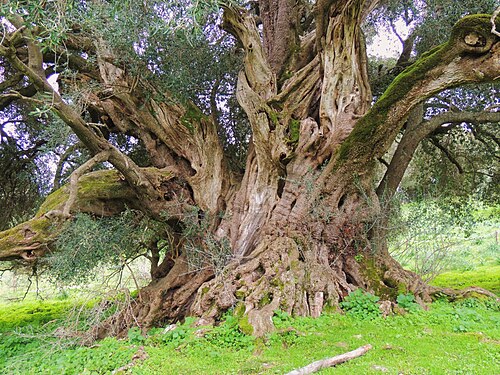
Wild Olive (Olea europaea var. sylvestris) · 3,000-4,000 years · Santu Baltolu di Carana, Gallura
Italy's oldest living tree has an age nobody can pin down within fifteen centuries. S'Ozzastru is a wild olive at Santu Baltolu di Carana, outside Luras in the granite hills of Gallura, and Sardinians call it su babbu mannu, the great father, or the patriarch of all wild olives. The University of Sassari puts it between 2,500 and 4,000 years old. The site that manages it says 3,000 to 4,000. The Piedmontese botanist Bruno Peyronel once suggested more than 5,000, a figure that comes with no scientific data behind it and which he applied to other trees just as freely. All of them are estimates, because an ancient olive hollows out and loses the heartwood any ring count would need, and this trunk is hollow.
The measurements are firmer, and they are what makes the visit. The trunk runs 11.5 metres around, the tree stands 14 metres tall and the crown spreads about 21 metres, which is a wild olive behaving like an oak. Sardinia declared it a national natural monument in 1991.
It is not a tree you stumble on. The grove is a managed site now, with a ticket office, a path and a guide, open from April to early November, and a second ancient olivastro stands a few metres along the same walk.
Photo: Robur.q (CC BY-SA 3.0)
Wild Olive (Olea europaea var. sylvestris) · 2,000 years · Santu Baltolu di Carana, Gallura
This tree has no name of its own, which is the clearest measure of what standing next to S'Ozzastru costs a tree. Almost anywhere else on Sardinia it would be the reason people came. Here it is the one they photograph on the way back to the car. The second olivastro of Santu Baltolu is a wild olive with a trunk 5.4 metres around, less than half its neighbour's 11.5, and that ratio is the only thing that makes it read as small. Italy's national register of monumental trees lists it separately, on its own sheet, and it shares the 1991 natural monument designation that protects the grove.
Its age is the loosest figure on this page. Sardinian sources put it at around 2,000 years and none of them shows any working at all, so read that as a guess in roughly the right neighbourhood rather than a measurement. Nobody has taken a proper dating to it. If you have seen one published, tell us.
What is not in doubt is the species and the setting. Wild olives are what the Mediterranean grew before anyone cultivated anything, and two of them at this size, in the same thin Gallurese soil, on the same short guided walk, is the genuinely rare part.
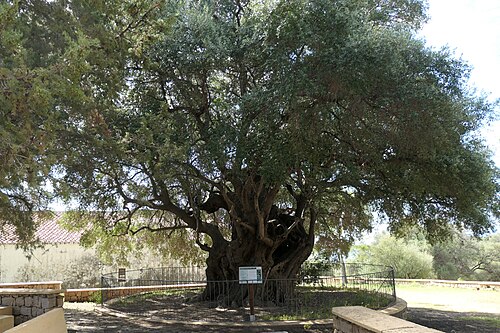
Wild Olive (Olea europaea var. sylvestris) · 1000-2000 years · Santa Maria Navarrese, Baunei, Ogliastra
Somebody tried to burn this tree down in the early 1960s and the fire scars are still on the trunk. The olivastro of Santa Maria Navarrese survived the arson and is still rated in good condition by the region's own foresters, despite a trunk that is partly hollow, which is the usual state of an olive this old.
It stands in the village square beside the church of Santa Maria di Navarra, built in 1502 and, on every estimate anyone has offered, many centuries younger than the tree next to it. Sardinia's forestry agency measures the trunk at 8.40 metres around at 1.3 metres up, with a crown of 9 to 10 metres. The national register gives a slightly larger figure, 9.05 metres, probably taken at a different point on the trunk; nobody has reconciled the two.
The age is stated loosely on purpose. The regional agency calls it millenario, at least a thousand years, and gives no number. Local press quotes botanists at about 2,000. Neither figure comes with any working attached, and no one has published a dating.
The Region declared it a natural monument in January 1994, along with the other old olives, carobs and hackberries in the same square. It is free, in the open, and a short walk up from the harbour.
Photo: Thiotrix (CC BY-SA 4.0)
Wild Olive and Mediterranean Hackberry (Olea europaea var. sylvestris and Celtis australis) · Altopiano del Golgo, Baunei, Ogliastra
Nobody has ever put an age to these trees, and up on the Golgo plateau that feels about right. A small rural church, San Pietro, sits 13 kilometres above Baunei on a lava tableland, and it is flanked by aged wild olives and hackberries. Two of them are registered individually in Italy's national inventory of monumental trees: a wild olive with a trunk 5.68 metres around and a hackberry at 5.25 metres, standing effectively on the same spot. Sardinia's own forestry service describes the church in exactly those words, fiancheggiata da annosi olivastri e bagolari, flanked by aged wild olives and hackberries.
There is no age field anywhere for either of them and no source ventures a guess, so this page does not either. If somebody has measured them, send it to us.
The setting does most of the work. Shepherds' stone huts, the cumbessias, stand alongside the church and still fill for the annual festival, and the Su Sterru sinkhole opens in the ground nearby, which is what brings most people up the road in the first place. The long-distance Selvaggio Blu route passes through. There is no gate and no fee, and the church itself is the place to stand.
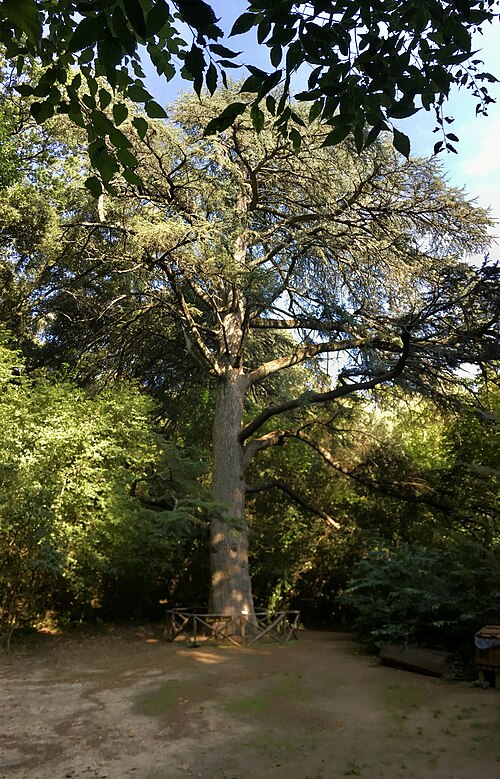
Cedar of Lebanon (Cedrus libani) · 190 years · Parco Aymerich, Laconi, Sarcidano
A Sardinian marquis with a botany habit is said to have planted this cedar in 1835, when it was already six years old, as one of the first Cedars of Lebanon brought into Europe. That account runs consistently through Sardinian sources, but the page citing it most directly is now dead, so treat the date as reported rather than proved. What two official bodies do confirm is the setting. Ignazio Aymerich began laying out this park from 1830 and filled it with rare exotic species, and the regional forestry agency that runs the park today calls the cedar imponente and the oldest of its kind on the island.
Take the 1835 date at face value and the tree is about 190 years old, which by cedar standards is early middle age; the species routinely runs past a thousand in its native Lebanon. The national register measures it at 4.4 metres round and 29 metres tall.
One detail nobody mentions: an oriental plane a few metres away is actually the thicker tree, at 4.5 metres round. The cedar is simply the one everybody comes for. The park is free and open daily under the regional forestry agency, a short walk from Laconi's Piazza Marconi and the Palazzo Aymerich down to the Su Acili entrance.
Photo: Isabetta70 (CC BY-SA 4.0)
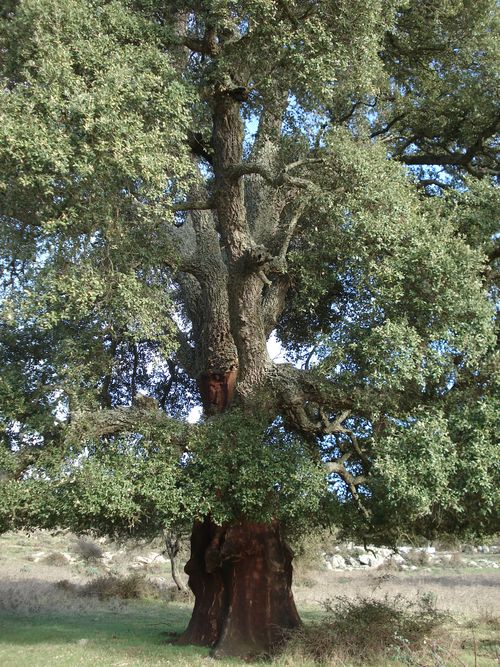
Cork Oak (Quercus suber) · 200-300 years · Sa Tuppa, Orune, Barbagia
This tree is still harvested for its cork, and it has kept its shape anyway. The botanist Ignazio Camarda, who catalogued Sardinia's great trees and old forests in a 2020 book, calls the cork oak of Sa Tuppa the most imposing and best preserved in Sardinia, a tree that could stand as the symbol of its species. The cork comes off regularly, as it does from the working trees around it, and the trunk carries the swellings the cutting leaves behind, yet it has stayed whole and regular.
Camarda measures it at 6.5 metres round at chest height and 9.7 metres at the base, 20 metres tall, and puts its age at 200 to 300 years. Italy's national register of monumental trees lists it too, at 6.2 metres round.
It grows at about 740 metres up, in a clearing kept for free-range grazing, mostly sheep, which sometimes rest in its shade at midday, the spot Sardinians call a meriagu. Branches brought down by wind and snow lie under the crown, but Camarda records the tree as in very good health. Around it the whole Orune plateau is wooded pasture and cork forest, so dense and so full of big trees that he treats the area itself as a monumental cork oak forest.
Photo: Luisa Carta
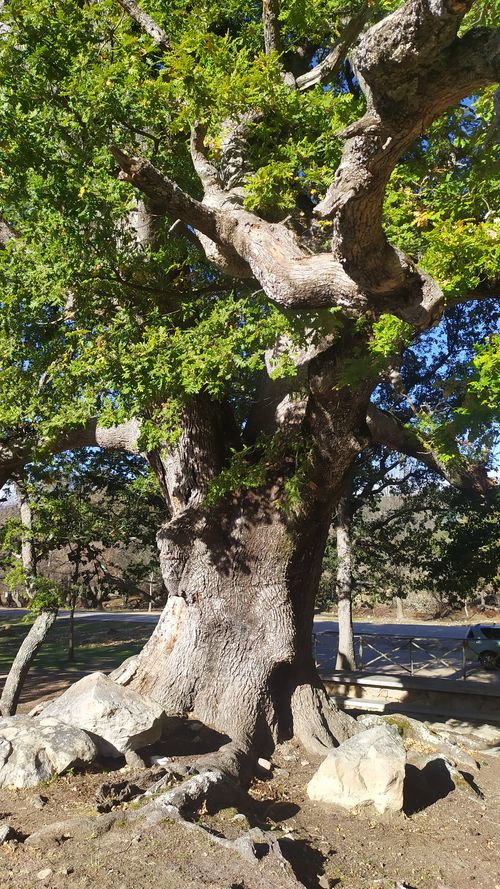
Downy Oak (Quercus pubescens) · 300-400 years · Su Fundale, Talana, Ogliastra
This oak is one of more than two hundred. At Su Fundale, high in the mountains of Ogliastra, a wood of downy oaks runs for 25 to 30 hectares, and every trunk in it is about a metre across or more. The botanist Ignazio Camarda, who catalogued Sardinia's great trees in 2020, calls it an extraordinary sequence of big trees, with unusual bases and roots often half bare above the ground. Many carry the marks of lightning, some have dead tops, others full and healthy crowns.
This is the one Italy's national register of monumental trees lists by itself: 6.4 metres round and 19 metres tall, at about 930 metres up. Camarda puts its age at 300 to 400 years. For the wood as a whole he reads 400 to 500 years from the size of fallen and cut stumps and from growth rings only a few millimetres wide. A holm oak 5.25 metres round, also on the register, stands about 50 metres away.
Holm oak forest closes the wood in to the south and heath to the north, and among the oaks grow wild pear, prickly juniper and the rarer Montpellier maple. The provincial road towards Talana runs straight through the stand, so these trees are a stop on the drive rather than a hike: where the road crosses the wood, the trunks are all around you.
Photo: Luisa Carta