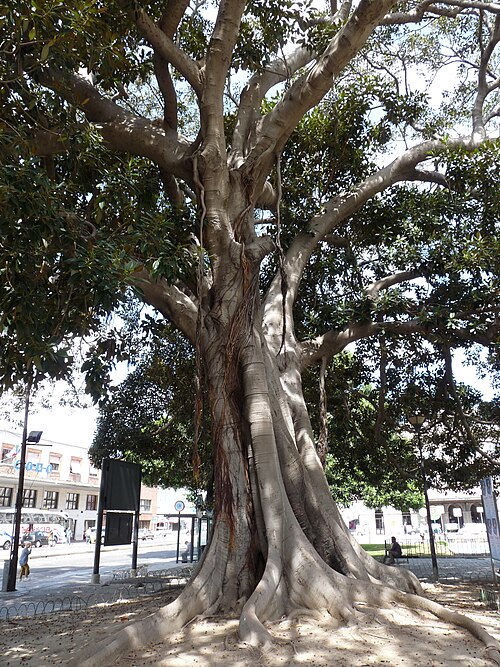
The Ficus of Piazza Ingrao
Local press calls this the fig that survived the bombs. Cagliari was hit hard from the air in 1943 and the Moreton Bay fig on the corner where Via Roma meets Via Regina Margherita came through it, which is a large part of why the city is fond of it. CagliariNews dates the planting to about 1883, when the harbour front was being laid out as the Parterre della Darsena, so the tree is over 140 years old. Italy's national register of monumental trees measures the trunk at 9.8 metres round, second in the city only to the fig outside the railway station, five minutes west along the same waterfront. Sardinia added it to the regional list of monumental trees on 21 January 2025, on the same day as the cypress in the Pirri cemetery. The case local reporting made for it was not only age. A canopy this size over one of Cagliari's busiest junctions cools the air under it, takes in what the traffic puts out, and holds resident and migrating birds through the year. It is a working tree in a place that badly needs one, and the fact that it is Australian, like every other big fig in this city, has stopped being remarkable to anybody who lives here.
This tree looks much the same in every month of the year, so there is no season to chart.
Piazza F.P. Ingrao, at the junction of Via Roma, Via Regina Margherita and Via XX Settembre, CagliariYou can recognise it by the trunk, 9.8 metres round, the city's second largest fig. It stands where Via Roma meets Via Regina Margherita, five minutes from the station fig.
Free, public square on the Via Roma waterfront
5-10 minutes' walk from Piazza Matteotti / the central railway station, along Via Roma
Sources
Where the facts on this page come from.
- In the official register: MASAF, Elenco degli alberi monumentali d'Italia
- cagliarinews.it
- comune.cagliari.it
- MASAF national monumental trees register, sheet 09/B354/CA/20 (italy-masaf)