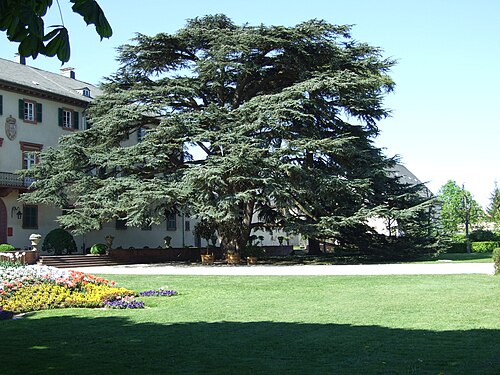
At 5.66 metres round, this is the thickest trunk anyone has measured in the park, wider than the famous cedars and wider than the big oak thirty metres away. It has no name, no plaque and no entry in any register. It turned up in a dendrologist's survey of the park in 2021 and that is the whole of its paper trail. It stands about ten metres east of the second of the park's wingnuts, near the north end of the pond. Planes are easy to pick out once the eye knows them: bark that flakes off in irregular plates and leaves the trunk patched in olive, cream and grey, a pattern that keeps changing as the tree sheds, and seed balls that hang on bare branches through the winter like small brown lanterns. We have not established which plane it is. The London plane is the usual one in a park of this date, but nobody has said so in print about this tree, so we have not written it down as fact. If you can tell an oriental plane from a London plane by the leaf lobes or the seed balls, stand under it and tell us.
From people who stood here
No notes yet
Did you visit the tree? Leave a note for the next visitor.
Getting there
About ten metres east of the second wingnut, Schlosspark, Bad Homburg vor der Hohe, 61348 Hessen, Germany
You can recognise it by bark flaking in irregular plates that leave the trunk patched olive, cream and grey, standing about ten metres east of the second wingnut near the north end of the pond. It is the thickest trunk in the park.
Free. The Schlosspark is a Hessian state park, open to walk through with no gate and no ticket; the palace buildings themselves are ticketed.
Bad Homburg station is roughly 25 minutes from Frankfurt on the S5, and the Schlosspark is about a ten-minute walk from there.
The line is our estimate of how much there is to see, not a measurement. Typical for this species where this tree stands; exact weeks shift with the year.
Sources
Where the facts on this page come from. The story was written with AI from these sources, and readers who know the tree correct it.