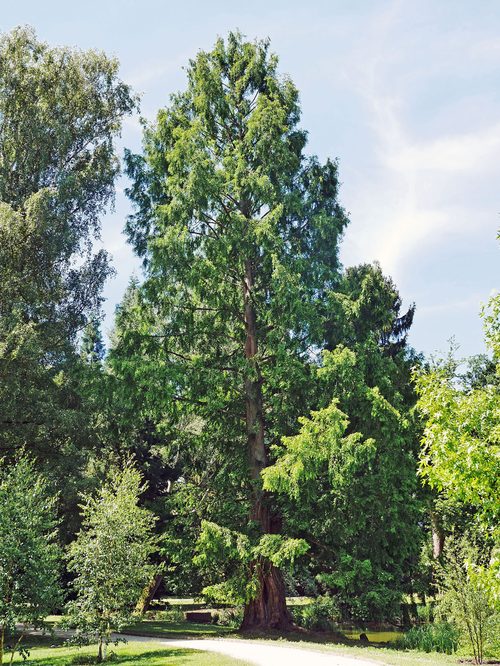
This pedunculate oak is 4.94 metres round, measured in August 2021, and it stands about thirty metres south-west of the lake rather than on its bank, which is where our map first put it. A reader who knows this park tree by tree told us so, and the survey that measured it says the same. It is one of three big oaks in the Schlosspark and the easiest to walk past. The largest, 5.39 metres, stands at the bridge two hundred metres north; a third, which locals call the Schöne Eiche, grows on the far side of the big meadow from the plane, towards the gate into the old town. This one has no name, no plaque and no path leading to it. It simply stands back from the water, broad and low-limbed, where the grass runs under the crown. It is the common oak of German parkland, and at this girth almost certainly older than the cedars by the palace that carry a planting year. Nobody has dated it. The park was laid out as a baroque garden from 1680 and remade as an English landscape park a century later, and a trunk this wide was either kept through one of those remakings or planted at one of them. No source says which.
From people who stood here
No notes yet
Did you visit the tree? Leave a note for the next visitor.
Getting there
About 30 metres south-west of the lake, Schlosspark, Bad Homburg vor der Hohe, 61348 Hessen, Germany
You can recognise it about thirty metres back from the lake's south-west shore, not on the bank: the only big oak on that side of the water.
Free. The Schlosspark is a Hessian state park, open to walk through with no gate and no ticket; the palace buildings themselves are ticketed.
In fruit
The line is our estimate of how much there is to see, not a measurement. Typical for this species where this tree stands; exact weeks shift with the year.
Sources
Where the facts on this page come from. The story was written with AI from these sources, and readers who know the tree correct it.