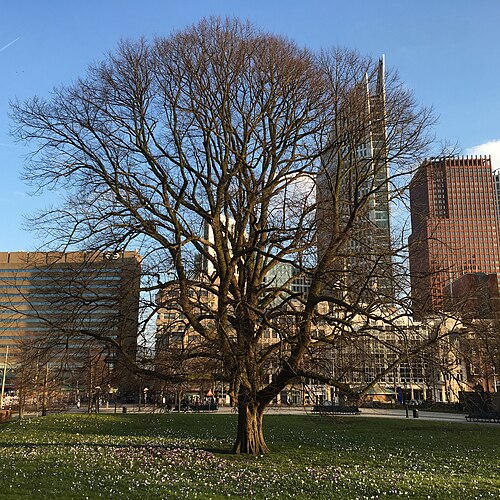
The Hungarian Oaks of Huijgenspark
NetherlandsThe HagueStationsbuurt
Hungarian oak is a species most Dutch park visitors walk past without recognising, a large-leaved Balkan and southeast European oak that reaches the Netherlands only through deliberate 19th and early 20th-century planting rather than any natural range of its own. This group of three, dated by the register to around 1900 to 1910, grows on the west side of Huijgenspark, a generation younger than the park's own planes but from the same era of civic tree planting that filled Dutch municipal parks with species collected from across the continent. The park itself replaced a busy coaching-inn district on the old road to Delft, renamed in 1873 for the polymath Constantijn Huygens after having carried the considerably less flattering name Bogt van Guinea for its first two centuries. Hungarian oak's leaves are larger and more deeply lobed than the native pedunculate oak's, worth a close look for anyone wanting to tell the two apart on sight. The trees stand in the open, free, a short walk from the park's older plane grove on the opposite side of the same green space.
Huijgenspark, west side, opposite Huijgensstraat 12-17, Den HaagYou can recognise it by leaves larger and more deeply lobed than a native oak's, on a group of three. It stands on the west side of Huijgenspark, opposite Huijgenstraat 12 to 17.
Free, public park, open at any time
Stationsbuurt, Den Haag; about a 10 minute walk from Den Haag Centraal station
Sources
Where the facts on this page come from.
- In the official register: Landelijk Register Monumentale Bomen v2024
- Landelijk Register Monumentale Bomen v2024 (LRMB), Bomenstichting (nr 1686871)
- nl.wikipedia.org