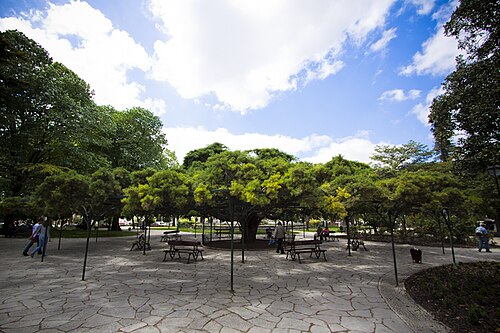
Lisbon's first legally protected tree is not a cedar at all.
Photo: Alatryste (CC BY-SA 3.0)
Cupressus lusitanica
A Mexican tree carries the name lusitanica, meaning Portuguese, and the tree responsible for the mistake is still standing. We map 9 of them, in 5 cities.
When Philip Miller described the species in 1768 he was working from cypresses growing at Bucaco, where Carmelite monks had planted them, and named it for where he found it rather than where it came from. The Cedro de Sao Jose, about 380 years old, is one of those trees, and a second stands further along the Via Sacra beside the station marking Christ's first fall. Portugal has called the species cedro-do-Bucaco ever since, which compounds the error, since it is a cypress and no kind of cedar. Lisbon's first legally protected tree, presiding over the Praca do Principe Real, goes by that name too. The oldest is in Granada at roughly 440 years, named for San Juan de la Cruz.
Lisbon's first legally protected tree is not a cedar at all.
Photo: Alatryste (CC BY-SA 3.0)
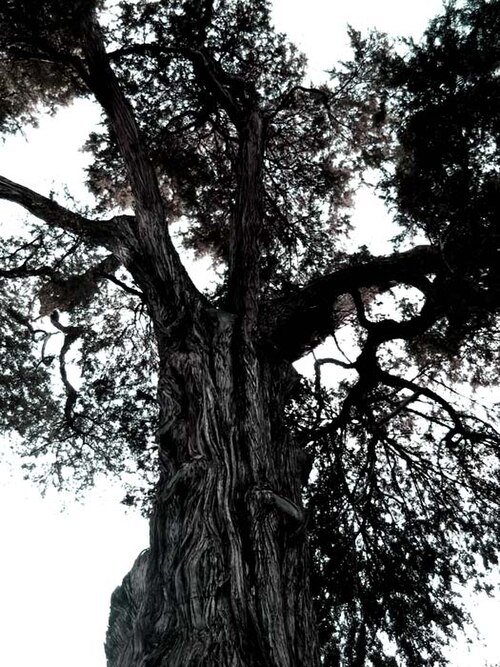
This cypress is not native to Spain, or even to the continent it is usually associated with.
Photo: Jose Manuel ("Mazintosh") (CC BY 2.0)
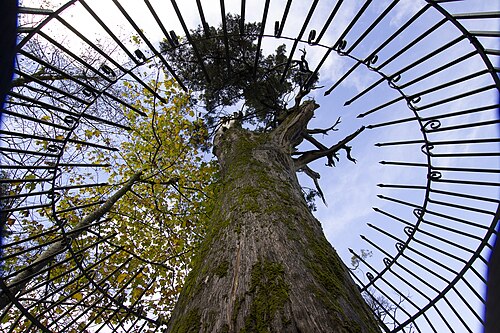
This tree is the reason a Mexican cypress is named after Portugal.
Photo: Soniapampa, CC BY-SA 4.0 (CC BY-SA 4.0)
Stop at the wrong shrine and you might miss it: this cypress stands beside the station on the Via Sacra that marks Christ's first fall, one of the roughly twenty small chapels barefoot Carmelite fr...
This is among the thickest cypresses in Bucaco's protected collection and, on the register's own figures, much the youngest of them.
A third Cedro-do-Bucaco grows here, beside the ruin of the Ermida do Sacramento, 30 metres from the Passo de Anas.
Bucaco keeps two protected cypresses within sixty metres of each other on this path, and this is the smaller one: 3.68 metres round, 27 metres tall, with a crown nineteen metres across on the state...
Madeirans call this species cedro-das-barracas, the shed cedar, because the young leading shoot was traditionally cut off so the crown would thicken outward into a roof of shade.
This tree won a national popularity contest in January 2026, beating 51 other candidates for the title of Arvore do Ano Portugal, Portugal's Tree of the Year, with more than 3,000 public votes.
Explore by city: Lisbon · Granada · Bucaco · Madeira · Prague · Brussels · Porto · Brisbane · every city · or browse all species.