The temple arrived second.
Japanese Nutmeg-yew
Torreya nucifera
Torreya nucifera, called kaya in Japan, is a slow evergreen conifer that looks the same in February as in August, which is part of why its oldest specimens went unnoticed for centuries; its wood is what every serious go player wants a board cut from. We map 7 of them, in 6 cities.
Japan names three great kaya trees. The one at Yokomuro in Maebashi earns its place on girth, 8.1 metres round, and the one at Kitahama stands alone behind a white fence on farmland near Hamamatsu, viewed from the road. Yono no Okaya in Saitama City is traditionally dated to the 1030s. The kaya at Nagoya Castle carries a stranger claim: the first Owari lord ate its nuts before marching on Osaka in 1615, and his successors kept eating them every New Year after. None gives up its age easily; surveys and temple tradition disagree, sometimes by centuries.
Tokyo
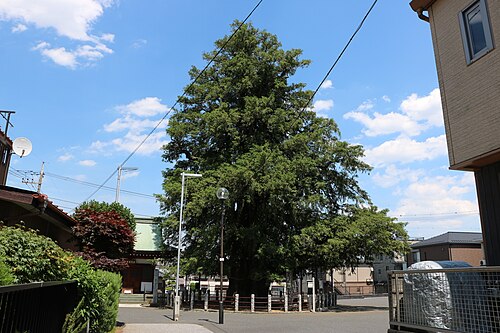
By the temple's own history, this nutmeg-yew went into the ground in the 1030s, and four hundred years later, in the Oei era, it was already known as the largest tree in the Kanto plain and used by...
Photo: さかおり (CC BY-SA 4.0)
Hiroshima
A go board cut from a single block of this species can cost more than a car.
Nagoya
In 1615 the lord of Owari ate this tree's nuts before going to war, and his successors kept eating them every New Year for two and a half centuries.
Nara
Nara's most famous tree at Nigatsu-do is a cedar of about sixty years, a replanting after the typhoon of 1961.
Iwata
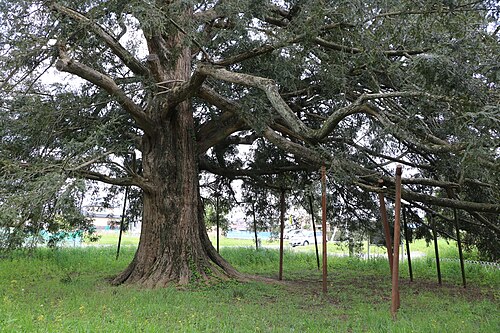
Japan names three great kaya trees, and this is one of them.
Photo: さかおり (CC BY-SA 4.0)
Maebashi
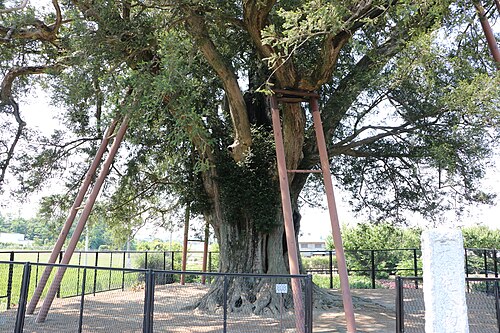
Japan keeps a short list of its three greatest kaya trees, and this one earns its place by sheer girth: 8.1 metres round, a trunk that makes even its two neighbours on the list, in Saitama and Hama...
Photo: さかおり (CC BY-SA 4.0)
Explore by city: Tokyo · Hiroshima · Nagoya · Nara · Leiden · Brussels · Brisbane · Munich · every city · or browse all species.