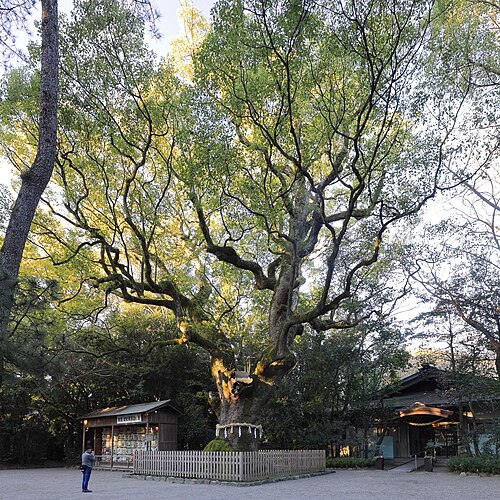
The Kaya of Nagoya Castle
You need a ticket to see this treeAdmission to the castle grounds is 1,000 yen for adults and free for junior high school and younger; open 9:00 to 16:30 (grounds entrance closes 16:00), closed 29 December to 1 January. The fee is revised from 1 October 2026, so check the castle site before you go.
In 1615 the lord of Owari ate this tree's nuts before going to war, and his successors kept eating them every New Year for two and a half centuries. The signboard records it plainly: Tokugawa Yoshinao, first lord of the Owari branch, took the nuts of this kaya before setting out for Osaka, and the summer campaign that followed finished the Toyotomi and settled the Tokugawa on Japan for good. After that the Owari lords ate its nuts each January to open the year. The tree has been a National Natural Monument since July 1932. It splits into several trunks from the base, the form Japanese calls a broom kaya or a thousand-stem kaya, and it is held up now by a crowd of props with wire on some of the limbs; the thin lower branches would be better off cut, and cannot be, because it is a national monument. What makes the New Year story land is what came next. Nagoya Castle and its honmaru palace burned in the air raid of 1945, and the kaya took the fire and did not die.
Honmaru, Nagoya Castle, Naka-ku, Nagoya 460-0031You can recognise it by its many stems fanning from the base, the shape locals call a broom kaya, propped and wired at 8.1 metres round. It stands in the Honmaru of Nagoya Castle.
Subway to Shiyakusho, about 5 minutes on foot
Sources
Where the facts on this page come from.