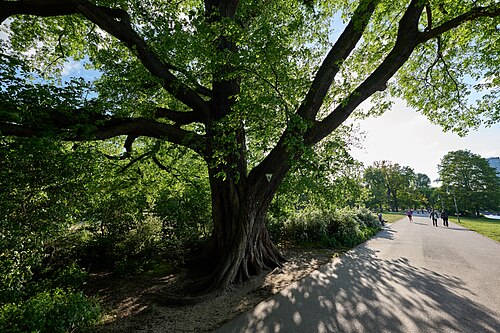
The newest tree on Germany's national heritage register has its roots in a river.
Ulmus laevis
This is the elm that likes wet feet. We map 17 of them, in 10 cities.
Ulmus laevis is a floodplain tree, and Berlin's Great Elm of Treptower Park takes that literally: its roots run straight into the Spree, which foresters credit for a vigour unusual at 250 years. It was added to Germany's national heritage list on 25 September 2025. The damp ground it favours is also why it mostly escaped Dutch elm disease, which took nearly every other big elm in Europe. Gdansk's stands by the pond in Park Oliwski, 4.2 metres round and 30 metres tall, protected together with the ivy that flowers up its trunk in October. The Dutch register calls the Elm of Heure, on an estate near Borculo, the thickest elm in the Netherlands and records no girth to back it. Munich's register says no older elms are known anywhere in the city than its twin trees in the Englischer Garten.
The newest tree on Germany's national heritage register has its roots in a river.
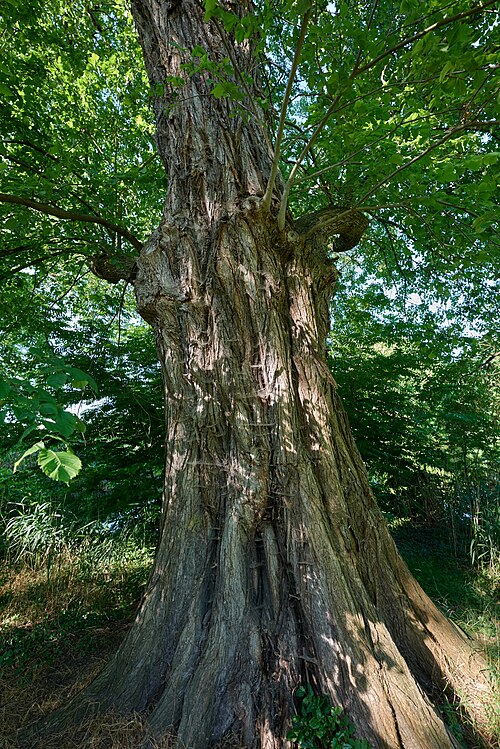
Nobody knows how old this elm is, and that is the honest answer rather than a gap waiting to be filled.
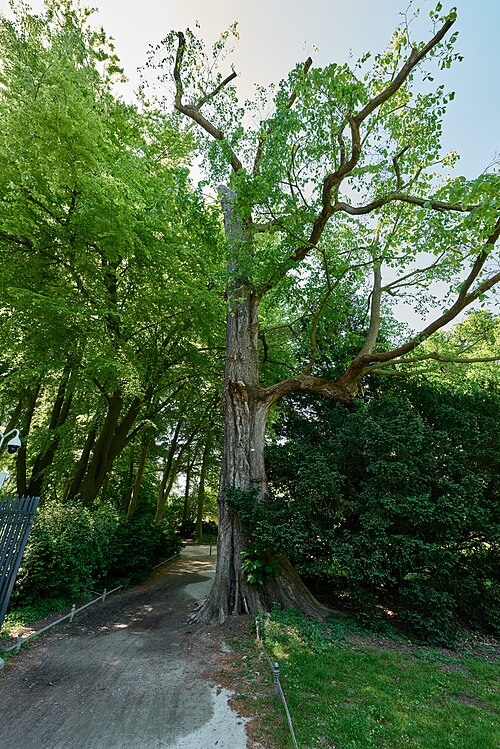
German calls this tree the Flatter-Ulme, the flutter elm, after flowers that hang on stalks long enough to shake in a breeze.
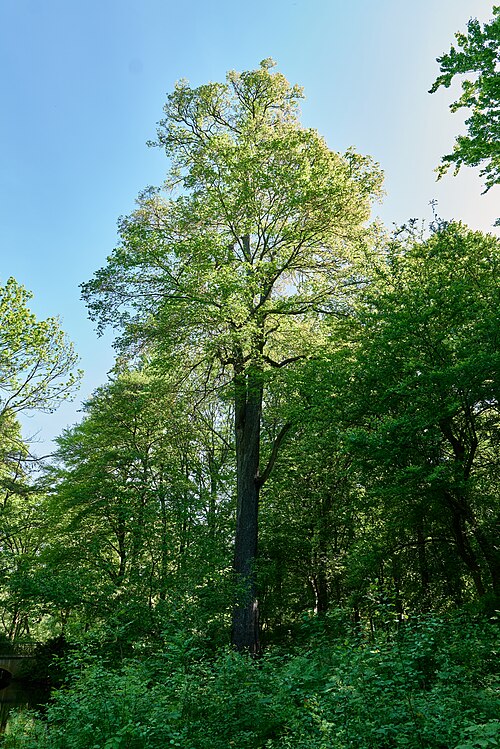
This elm flowers in March, weeks before its own leaves, in small purple-brown tassels that dangle on threads and are easy to mistake for nothing at all.
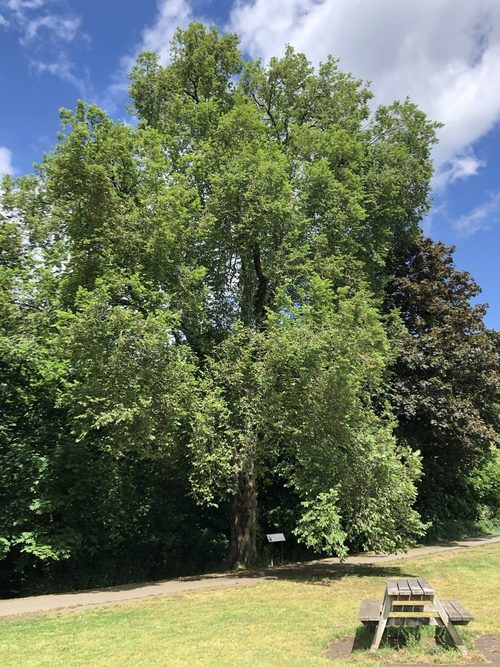
Dutch elm disease killed some 20 million English elms.
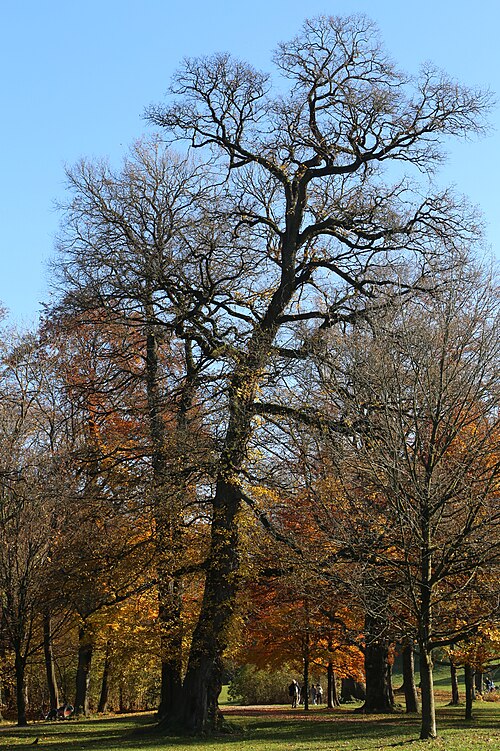
Munich's own natural monument register makes a specific, checkable claim about these two trees, that no older elms are known anywhere in the city.
Photo: Peterf (CC BY-SA 4.0)
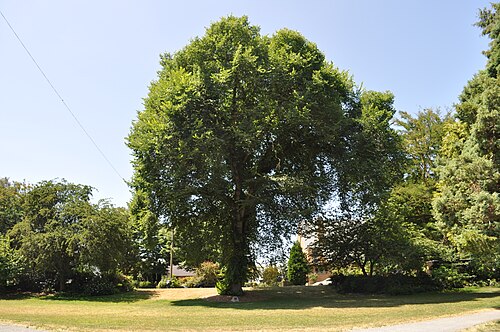
By the city's own estimate, this elm's crown is as wide as the tree is tall: 76 feet each way.
Photo: Joe Mabel (CC BY-SA 3.0)
Leipzig's own records cannot agree on how tall this elm is.
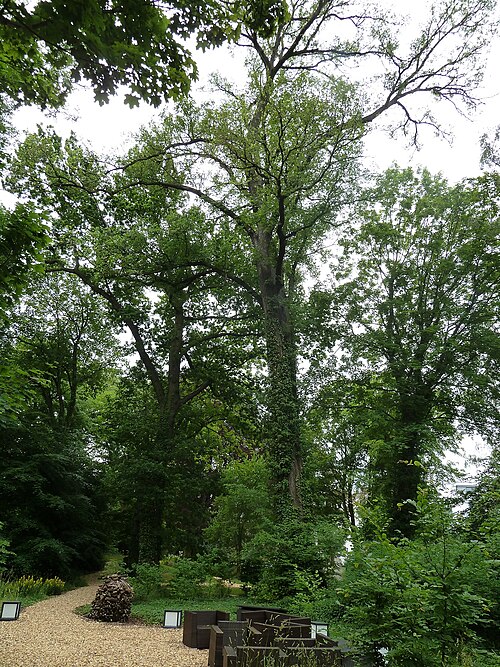
European white elm is the one native elm that mostly shrugged off Dutch elm disease, because it favours damp ground the beetle that spreads the fungus rarely bothers with, and this specimen has gro...
Photo: Edlerin (CC BY-SA 4.0)
The records cannot agree on what this tree is.
An elm marks a bus terminus outside Nadrazi Holesovice, and it is the last thing standing from a street.
Most of Europe's big elms are dead, and this one is standing on a side street between Wenceslas Square and the main station.
At 399 centimetres round, this is the thickest elm on this list, and the two sources describing it cannot agree on when Poland decided to protect it.
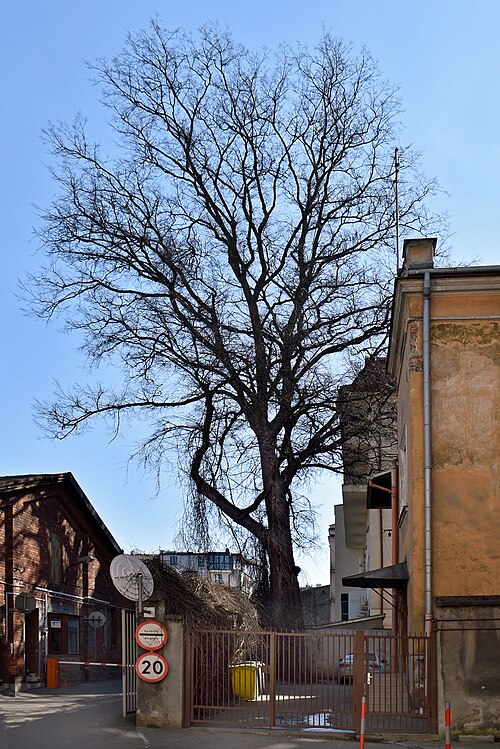
Elms are the trees Europe mostly lost, which is why a protected one standing on a working Krakow street is worth the quarter hour it takes to walk out from the Main Square.
Photo: Zygmunt Put (CC BY-SA 4.0)
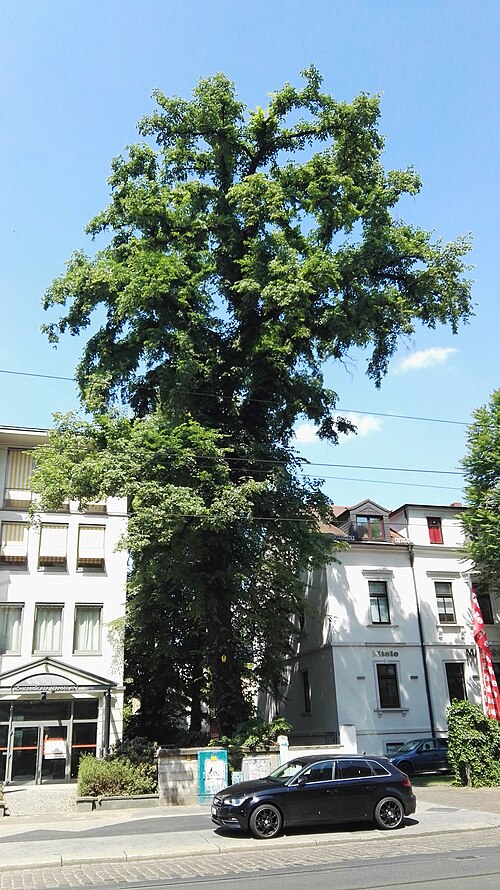
Dresden protected this elm in 2015 for surviving something most of its kind have not.
Photo: Z thomas (CC BY-SA 3.0)
The thickest elm in the country is not the kind of elm that died.
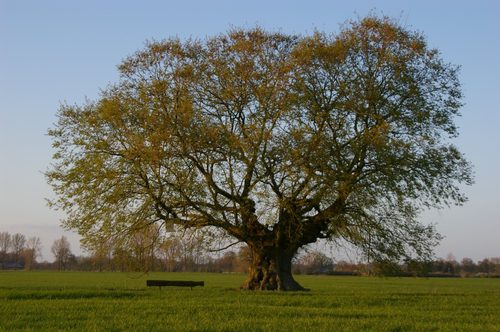
You can stand inside this elm.
Photo: Wolfgang Schürmann
Explore by city: Berlin · London · Munich · Leipzig · Dresden · Borculo · Münsterland · Malaga · every city · or browse all species.


