Three live oaks, and each one changed what a tree could be here. The Candler Oak, on Drayton Street beside Forsyth Park, was the first single tree in the United States to be given a conservation easement, at a point when cars were parking over its roots. The Wormsloe avenue, fifteen minutes southeast on the Isle of Hope, is four hundred oaks along a mile and a half of dirt road. And in a quiet residential circle nearby stands the Majestic Oak, wider than either, with houses built to face it.
0 of 3 visited in Savannah
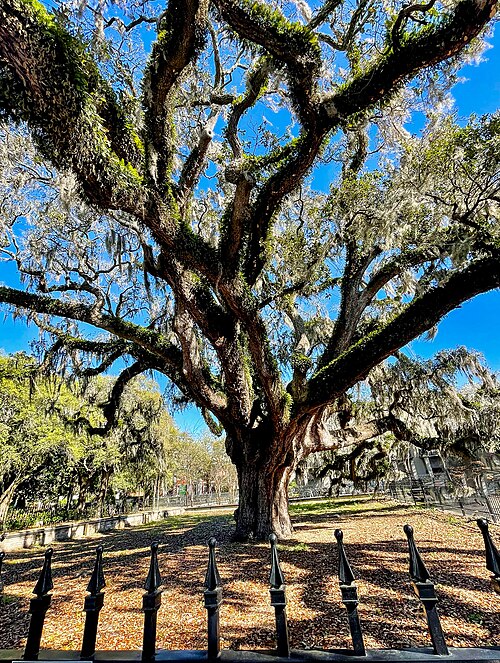
Southern Live Oak (Quercus virginiana) · 300-450 years · Historic District, beside Forsyth Park
The first conservation easement granted to a single tree in the United States went to an oak that cars were parking on. Asphalt from the hospital lot next door ran right up around the trunk, vehicles stood over the root plate, and arborists gave the tree about twenty years. The Savannah Tree Foundation lifted the asphalt, pruned it, fenced off the root zone and has looked after it since. Forty five years on it reports the tree thriving.
The paperwork is oddly slippery for something this well known. One account dates the easement to 1984, the Foundation's own page says 1985, and its size appears as 6,804 linear feet in one source and 6,804 square feet in the other. Same number, different units, nobody has reconciled it.
The age is softer still. Estimates run from over 300 years to 450 and none of them comes from a core sample; they are figures repeated rather than derived, and live oak ages are habitually overstated. What was measured is the trunk, 17 feet round, and the height, about 16 and a half metres.
It has stood through the site's whole run of owners: Candler Hospital, then a law school that added cameras and a fence of its own before it closed, and now SCAD. You look at it from the Drayton Street sidewalk, which is what the fence is for.
Photo: MrsHoldridge (CC BY 4.0)
Southern Live Oak (Quercus virginiana) · 130 years · Isle of Hope
The most photographed thing at Wormsloe is the youngest thing at Wormsloe. Noble Jones took this land in the 1730s alongside Oglethorpe, and the tabby ruin at the far end of the site is the oldest standing structure in the Savannah area. The avenue has nothing to do with that. Two independent sources put its planting in the 1890s, by Wymberley Jones De Renne, a descendant, and one of them says it marked the birth of a sixth-generation Jones. That makes the oaks about 130 years old, which is young for a live oak and long enough for the crowns to have closed overhead completely.
More than four hundred of them line a mile and a half of dirt road. Planted in two ranks and planted close, so the drive works as a tunnel: the branches meet, the Spanish moss hangs down into the gap, and the light arrives already green. It is the single image most people carry of coastal Georgia, and it was made deliberately, by a Victorian with a plan and a nursery order.
Entry is through the visitor centre and is paid, this being a Georgia state historic site. The avenue starts at the gate, and nothing obliges you to drive it. Walking is the better way to see how carefully it was set out.
Southern Live Oak (Quercus virginiana) · 300 years · Bona Bella-Majestic Oaks, Savannah
The Candler Oak downtown is about 5.2 metres round. The oak in the middle of a quiet cul-de-sac in the Isle of Hope area is 8.4, and its branches reach more than 165 feet from tip to tip, roughly fifty metres.
Those numbers come from the plaque beside it: 27 feet 8 inches round at the base. The setting does the rest. The tree stands alone in the centre of Majestic Oaks Circle, with the houses arranged around it facing in, the way buildings face a statue in a square. One house across the street describes itself simply as across from the Majestic Oak.
How old it is, nobody knows exactly. The plaque says more than 300 years. A travel writer who went to see it puts it at 300 to 400. Both are estimates, and that range is as tight as the evidence allows.
You may also hear that it was already full grown when Oglethorpe founded Savannah in 1733, or that it watched the city's Grand Prize car races go past in 1910 and 1911. Those stories circulate widely and no reliable source stands behind either one, so treat them as local lore. The same goes for the tale linking it to the old Wormsloe plantation, several kilometres away.
It is free and visible from the street at any hour. Park considerately: people live around it.