Three entries, and one of them is why anyone drives out to Johns Island. The Angel Oak is a live oak wide enough to shade a quarter of an acre, standing in a free city park twenty five minutes from downtown, and the age printed on the souvenirs is roughly four times the age in the records. Out at Middleton Place stands another live oak claimed even older, though its number is legend rather than measurement. In town, the fenced yard of oaks around an 1857 cistern at the College of Charleston completes the list.
0 of 3 visited in Charleston
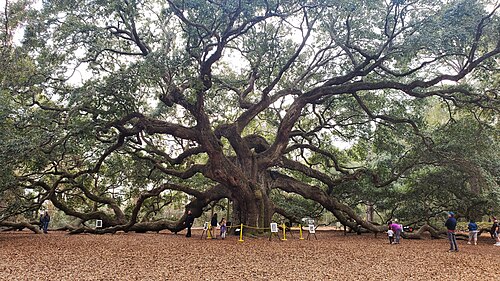
Southern Live Oak (Quercus virginiana) · 300-500 years · Johns Island
The souvenirs say 1,500 years. The city that owns the tree says 300 to 400, and an academic estimate stretches it to 500. That gap is not carelessness, it is live oak. The species grows fast when young, slows unpredictably and rots out from the middle while the crown is still healthy, so there is no core to pull and nothing to count. What can be measured is girth, and every estimate that starts from the tree itself lands in the hundreds of years rather than the thousands.
None of the size is in dispute. The trunk runs 25 and a half feet round by the city's figure, 28 by another. The crown shades around 17,000 square feet, a quarter of an acre under one tree, and the longest limb travels 187 feet before it stops. Live oak does not race upward; it spreads until the branches come back down and rest on the ground, which is why most of this tree is at eye level.
The name is prosaic. Justus Angel and Martha Waight Tucker Angel owned the estate, and the tree took their surname. The local stories about the spirits of enslaved people appearing among the branches came afterwards.
Hurricane Hugo went over it in 1989 and it recovered. The city bought the land in 1991 and now runs it as a free park taking around 400,000 visitors a year.
Southern Live Oak (Quercus virginiana) · Downtown Charleston / College of Charleston campus
Nobody has published an age for a single tree in this yard, and the honest reason is that they are not all the same age. Hurricane Hugo came through Charleston in 1989 and took some of these oaks with it, so what stands now is a mix of the survivors and what went in afterwards. It reads as one thing regardless, which is the whole point of the place: a compact, iron-fenced yard of live oaks hung with Spanish moss, closed at the end by the portico of Randolph Hall.
That building went up between 1828 and 1830 and is a National Historic Landmark. The cistern the yard is named for came later, in 1857, a sunken brick reservoir that once held the campus water supply and now works as the low stage everyone ends up sitting on. Before the College took the ground over in 1785 it was a colonial military barracks.
It is still a working space rather than a lawn to look at. Commencement happens here, and the Spoleto Festival puts performances under the trees, so it is occasionally roped off.
Come in from George Street and stand at the cistern. If anyone has ever dated the older oaks, the College's own records would settle it, and we would like to know.
Southern Live Oak (Quercus virginiana) · 900-1,000 years · Middleton Place plantation gardens, Ashley River, near Summerville
Until 2012 this oak was described as the largest tree in the eastern United States. It has also been losing large parts of its crown since 2008, which has cut into the volume of wood that made the claim. It is still standing and still alive.
The numbers from a 2004 measurement are still the ones people quote: a trunk 10.44 feet across, about ten metres round, a height of 67 feet and some 4,820 cubic feet of wood. It has been called the largest measured southern live oak. The Live Oak Society, whose members are the trees themselves, lists it as its First Vice President.
Charleston Magazine puts it at 900 to 1,000 years old. That is a figure repeated from one account to the next rather than measured, and it would make this oak several centuries older than the Angel Oak, so read it as a generous estimate rather than a date.
In 1997 a young oak propagated from it was planted just to the north, to help protect the old tree. That offspring is now about 26 feet tall, a reasonable start on the next thousand years.
The oak stands in the Sundial Garden at Middleton Place, about half an hour by car from downtown Charleston. Garden entry is paid.