San Diego's trees were planted, not inherited. In 1892 the city leased Kate Sessions park land on condition she plant a hundred trees a year in Balboa Park, and the 1915 exposition brought in much of the rest. The oldest anyone can date here is around 130 years, genuinely old for this city. All six are free: two Moreton Bay figs, a cypress from an island off Baja, a kauri from New Zealand, a tipu that outlived its nursery, and a low tangle of tea tree Sessions likely planted herself.
0 of 6 visited in San Diego
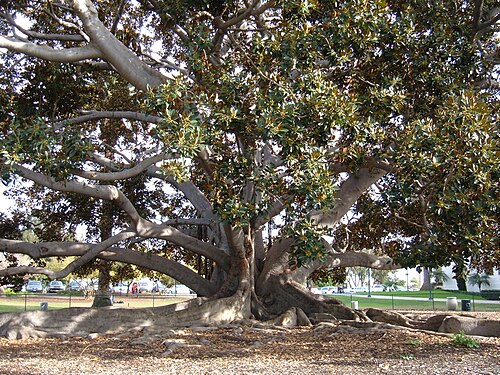
Moreton Bay Fig (Ficus macrophylla) · 112 years · Balboa Park
This fig went into the ground as a five-gallon sapling. That was 1914, planted for the San Diego County garden exhibit at the Panama-California Exposition the year after, and it is the last plant from that exhibit still alive. A survey for the California Registry of Big Trees in 1996 put it at 24 metres tall with a crown 37 metres across and a trunk 12.3 metres round, though that last figure is a buttressed fig mass rather than one clean stem. Moreton Bay figs do not so much grow a trunk as accumulate one.
Its worst years came from being admired. Decades of visitors walking the ground under the crown compacted the soil and damaged the surface roots, and by the 1980s the tree was going backwards. In 1989 it was trimmed and the ground beneath it fenced off. It recovered. The aerial roots now hanging from the limbs are the sign of a fig doing well rather than merely holding on.
Some accounts credit the planting to Kate Sessions, who supplied a great deal of what grows in this park. The Natural History Museum, whose north entrance the tree stands outside, says flatly that there is no documentation for that. A hundred and twelve years on, nobody knows whose hands put it in.
The measurements above are thirty years old. The tree has not stopped growing since.
Photo: BrokenSphere (CC BY-SA 3.0)
Tipu Tree (Tipuana tipu) · ~100 years · Pacific Beach
This tipu is the last living thing from Kate Sessions' final nursery. Sessions, the horticulturist San Diego calls the mother of Balboa Park, bought seven acres at Garnet and Pico in Pacific Beach in the 1920s, one source dating the purchase to 1924, and ran Soledad Terrace on the land. The nursery is gone. The tree is what is left of it.
She planted it in 1928 according to katestrees.org, a site kept by a researcher of her work, which also records it as a protected heritage tree. The California Historical Landmarks record gives the looser 'planted in the 1920s', which agrees. Nobody has published a girth or a height for it, so if you happen to be carrying a tape measure, we would like the number.
The bronze plaque beside it is California Historical Landmark No. 764, dedicated in 1961. Read it carefully, because it commemorates the nursery site and Sessions herself rather than this tree. The distinction matters here: her name gets attached to a great many San Diego trees without any document behind it, and this one is the exception, independently credited to her by several sources.
Tipuana tipu comes from Bolivia and Argentina. In early summer it drops sprays of yellow-orange flowers over whatever is underneath, which here is a street corner.
Guadalupe Island Cypress (Cupressus guadalupensis) · 130 years · Balboa Park (Bankers Hill edge)
San Diego Magazine went looking for the oldest tree in the city in 2020 and came back with this cypress, then about 128 years old. It is one of the trees Kate Sessions planted under the deal she struck in 1892: the city leased her park land at Sixth and Upas, and in exchange she put a hundred trees a year into Balboa Park. This is among the oldest of her plantings still standing.
The species makes it stranger than the date does. Cupressus guadalupensis grows wild in exactly one place on earth, Isla Guadalupe off Baja California, where feral goats have long been the main threat to what is left of the groves. A large mainland specimen of a tree that rare, on a public lawn beside a chess club, is an odd survival.
Both the Natural History Museum's own account of Sessions and San Diego Magazine name the species, the tree and the spot, and both describe it as enormously tall. Neither publishes a girth or a height, which is the frustrating part of a tree everyone agrees is remarkable. If you can measure it, we will take the number.
A hundred and thirty years is not old in most of the places this site covers. In a city that had to plant its own shade, it is close to the beginning.
Kauri (Agathis australis) · Balboa Park
There is a New Zealand kauri on the Plaza de Panama and almost nothing about it is written down. Agathis australis is barely grown anywhere in Southern California, which is what makes a mature one standing beside the House of Charm worth crossing the park for, whatever its size turns out to be. The record that confirms it is a single geotagged, photographed observation made in July 2016, still the only record of the species anywhere near San Diego on that platform.
Local pieces have described what is almost certainly this same tree, one of them calling it possibly the most valuable plant in the park, and quoting a height and a rough planting decade. None of those pages could be read directly, so none of their numbers are repeated here. This entry carries no age and no height rather than a figure nobody has checked.
What is left is the tree itself, and it does not look like its neighbours. Kauri grow a straight grey column of a trunk and hold the crown right at the top of it, which reads oddly on a plaza planted with spreading subtropicals.
If you know when it went in, or how tall it is now, tell us. Somebody in San Diego knows, and it is not written down anywhere we can reach.
Australian Tea Tree (Leptospermum laevigatum) · 120 years · Balboa Park (northwest corner, near Hillcrest)
This tree grows sideways. Its trunks run out almost level with the ground, and where a limb comes down far enough to touch the soil it sometimes puts down roots and carries on. The result, on the grounds of Marston House in Balboa Park, is a low, gnarled tangle that visitors compare to something out of a fantasy novel. Somebody has called it Gandalf. It is not the only name it has been given.
It is an Australian tea tree, and it earns its place here by shape rather than size. Nothing about it is tall. Everything about it is twisted.
The park ranger Kim Duclo says it was likely planted around 1906 by Kate Sessions, the horticulturist remembered as Balboa Park's godmother, the same woman whose last nursery left the tipu tree in Pacific Beach. That would make it about 120 years old. It is one person's informed guess rather than a record, and it is the only date anyone has offered. What is documented is that a professional survey of the Marston garden in 1989 listed Australian tea tree among its plants, though it does not say which specimen.
It stands on the paved walkway just past the entrance to the Marston House grounds, at the park's northwest corner near Seventh Avenue and Upas Street. The garden is free to walk; the house charges for tours inside.
Moreton Bay Fig (Ficus macrophylla) · 90 years · Balboa Park, central mesa
The roots of this fig do not stay underground. They pour over the edge of Palm Canyon and run down the slope in great ridged buttresses, and one landscape history of the park compares them to flying buttresses. That is the reason to come, and the reason photographers and wedding parties climb down into the canyon below it.
It is a Moreton Bay fig, and not the famous one. Balboa Park's best-known fig, planted in 1915, stands by the Natural History Museum. This is a separate, younger tree over Palm Canyon, planted around the mid 1930s by one account, or in the 1930s or 1940s by another, which puts it at roughly ninety years.
It has had the better part of a century on the lip of this canyon, and it has used the time to go over the side. The trunk is the anchor. The roots are the show.
The best view is from the wooden footbridge that crosses Palm Canyon from near the Alcazar Garden toward the Organ Pavilion. The pin is an estimate for that stretch of canyon rather than a fix on the trunk, so start at the bridge and look over the side. It is free, open parkland.