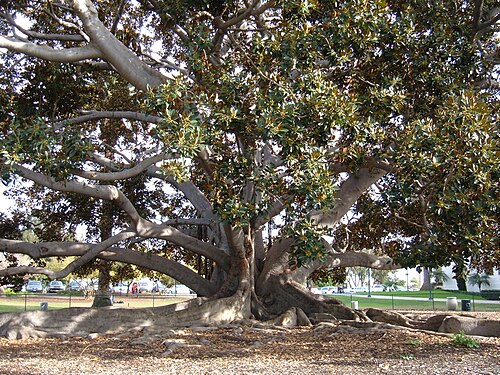
The Moreton Bay Fig of Palm Canyon
Approximate location.
The roots of this fig do not stay underground. They pour over the edge of Palm Canyon and run down the slope in great ridged buttresses, and one landscape history of the park compares them to flying buttresses. That is the reason to come, and the reason photographers and wedding parties climb down into the canyon below it. It is a Moreton Bay fig, and not the famous one. Balboa Park's best-known fig, planted in 1915, stands by the Natural History Museum. This is a separate, younger tree over Palm Canyon, planted around the mid 1930s by one account, or in the 1930s or 1940s by another, which puts it at roughly ninety years. It has had the better part of a century on the lip of this canyon, and it has used the time to go over the side. The trunk is the anchor. The roots are the show. The best view is from the wooden footbridge that crosses Palm Canyon from near the Alcazar Garden toward the Organ Pavilion. The pin is an estimate for that stretch of canyon rather than a fix on the trunk, so start at the bridge and look over the side. It is free, open parkland.
Palm Canyon footbridge, near Alcazar Garden, Balboa Park, San Diego, CA 92101 You can recognise it by the massive buttress roots spilling over the canyon edge and running down the slope. It stands beside the wooden footbridge over Palm Canyon, between the Alcazar Garden and the Organ Pavilion.
Free; stands beside a public footbridge and steps into Palm Canyon, part of Balboa Park
Central Balboa Park, a short walk south of the Alcazar Garden and west of the Organ Pavilion; served by Balboa Park's free tram and multiple bus routes