Los Angeles kept its old trees in odd places: a hotel built its driveway around one, a church was built around another, the city's oldest palm has been dug up and moved three times, and a kauri at the Huntington survived having its taproot burned shut. Five of the eleven here are Moreton Bay figs, which is what the city's documented tree history is made of. They are spread across sixty kilometres, so treat this as several trips: downtown, Griffith Park, Santa Monica, San Marino, Arcadia and the hilltop bunya pine of East Los Angeles.
0 of 11 visited in Los Angeles
Moreton Bay Fig (Ficus macrophylla) · 135 years · Santa Monica
The hotel arrived second. This fig was planted around 1889 in the rose garden of the Jones mansion by Georgina Jones, whose husband, Senator John Percival Jones, had founded Santa Monica a decade and a half earlier. The mansion is long gone. The tree went on growing and the Fairmont Miramar was built around it, which is why a five star hotel now has a Moreton Bay fig standing in its front courtyard like a doorman.
It is over 80 feet tall with a canopy about 120 feet across, one of the largest of its kind in California. Moreton Bay figs come from the Australian east coast and were planted all over southern California in the 1880s by people who wanted shade quickly and got rather more than they bargained for; this is the specimen that shows why. Santa Monica made it a city landmark on 17 August 1976, among its first, citing both the tree and its link to the family that started the town.
Nobody has published a girth for it, so if you get a tape around the trunk we would like the number.
You can walk straight up to it from Ocean Avenue, free and at any hour, but this is a working hotel entrance rather than a park, so read the room.
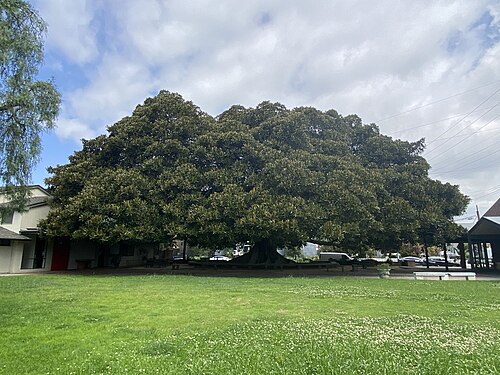
Moreton Bay Fig (Ficus macrophylla) · 150 years · Palms
Los Angeles has protected this fig as Historic-Cultural Monument No. 19 since 1963, which makes it older on the city's list than most of the buildings on it. The tree is older still. It was planted in 1875 by the Smith family to shade their cottage on the La Ballona ranch, by one account in honour of their first son, and it stood alone in farmland for close to ninety years before the Presbyterian church complex went up around it in 1962.
That makes it one of the two oldest documented tree plantings in the city, level with the figs at the old Plaza downtown and older than every other Moreton Bay fig on this list.
Its modern history is a slow argument with the power company, which has cut into the crown repeatedly over the years to keep the overhead lines clear. The tree has absorbed it and kept spreading over the corner of National Boulevard and Military Avenue.
You can see it from the public sidewalk at any time. For a closer look the church grounds are open on weekday mornings and Sunday. No girth or height figure has been published for it, which for a tree this size is a gap worth closing: if you measure it, tell us. The pin marks the church corner rather than the trunk.
Photo: Jengod (CC BY-SA 4.0)
Moreton Bay Fig (Ficus macrophylla) · 150 years · Downtown Los Angeles / El Pueblo
On 2 March 2019 one of these figs came down during a Chinese lantern festival in the plaza. It was 144 years old. Nobody was hurt, which given the crowd and the size of the tree was a considerable piece of luck. Three of the original four are still standing.
All of them were planted in 1875 by the horticulturist Elijah Hook Workman around the old Plaza, the square the pueblo of Los Angeles was laid out from and the closest thing the city has to a founding address. That makes them among the oldest documented plantings in Los Angeles, level with the fig at St John's church in Palms and older than the figs of Beverly Hills and Figueroa Street by a generation.
This is one entry for the group rather than three. The gazebo at the centre of the plaza is the place to stand, with the survivors around it and Olvera Street a few steps north.
After the collapse the city inspected the remaining trees and found no risk to the public, and El Pueblo began a process to decide what should be planted in the gap. That is the last dated word we have on their condition, from 2019. If you have walked through the plaza lately, tell us how the three of them look.
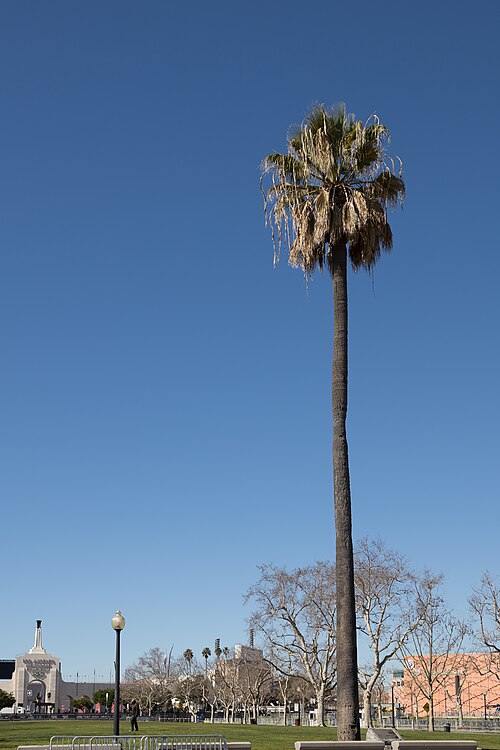
California Fan Palm (Washingtonia filifera) · 170 years · Exposition Park
The oldest palm in Los Angeles has been dug up and moved three times, and it is still going. It was taken out of a desert oasis and planted on San Pedro Street in the 1850s. In 1889 it was hauled across town to shade the entrance of the Southern Pacific Railroad's Arcade Depot on Alameda Street. On 5 September 1914, when the depot closed, someone decided it was worth saving again and moved it to Exposition Park, where it stands beside the drive at the Figueroa Street entrance. A plaque at its base records that last journey.
It is around 100 feet tall now. Its documented life in the city runs to at least 170 years, and the real figure is higher, because it was already a mature palm when it was first dug up and nobody wrote down how long it had been standing in the desert before that.
Washingtonia filifera is the only palm native to California, which is the quiet joke of the Los Angeles skyline: almost every palm you can see was shipped in, and the oldest one was already here. A dent partway up the trunk is old damage of some kind. Crews now use cherry pickers rather than climbing spikes to take the dead fronds down, so it collects no new scars.
The Expo Line stops two minutes away.
Photo: Clyde Charles Brown (CC BY-SA 4.0)
Coast Live Oak (Quercus agrifolia) · 200 years · Arcadia
This oak was already a big tree when the Tongva village of Aleupkigna, the place of many waters, still stood on this ground and before the people who lived there were pushed off it. The Arboretum puts it at over 200 years, which means it also predates by a century the Baldwin ranch era of the 1880s that the gardens around it were built from.
Coast live oaks are the tree southern California had before anyone planted anything: evergreen, wide rather than tall, holding their leaves through the dry season on a root system that goes looking for water. This one is stop 2 on the Arboretum's own walking tour, uphill and north of the entrance rotunda, near the Celebration Garden.
Two things to know before you go. The age comes from the Arboretum's own signage and tour notes rather than from an independent measurement, so read it as a careful institutional estimate. And the tree has been under treatment for a fungal disease, with visitors asked to keep out from under the branches while it is being worked on. Look from the edge of the canopy rather than standing beneath it, and check at the gate for the current advice.
The Arboretum charges admission and is open daily, with parking on site.
Moreton Bay Fig (Ficus macrophylla) · 100 years · Beverly Hills
Everyone in Beverly Hills tells the same story about this fig and nobody has produced the paperwork. The story is that Burton Green planted it: the oil man who founded the city in 1906, laid out Beverly Gardens Park and hired Wilbur D. Cook to design it. The park's history is documented and the tree's is not, so treat the planting as local tradition rather than record.
The tree itself needs no defending. It is over a century old, it gets described as one of the largest Moreton Bay figs in the country, and it stands beside the Electric Fountain at Santa Monica and Wilshire, the 1931 fountain given to the city by the family of the silent film comedian Harold Lloyd. The fountain gets the photographs. The fig is the older object and by some distance the stranger one, a low wide dome of a tree with limbs that run out almost horizontally before they think about going up.
Beverly Gardens Park is a long thin public park running for blocks along Santa Monica Boulevard, open at all hours and free. The pin marks the fountain rather than the trunk, and the tree stands beside it.
No girth and no planting year have been published. If you know either, we would like to hear it.
Moreton Bay Fig (Ficus macrophylla) · 130 years · University Park / Downtown-adjacent
Charles C. Chapman planted this fig outside his own house on Figueroa Street in 1894. The house is gone. The tree is not, and when the Automobile Club of Southern California came to build its headquarters on the site it built around the fig instead of felling it, opening the Spanish Colonial Revival building by Sumner Hunt and Silas Burns on 27 January 1923.
A century of undisturbed growth shows. The branches spread over 100 feet, and the aerial roots that Moreton Bay figs drop from their limbs have reached the ground and hardened into buttresses, so that the tree now appears to be standing on several trunks at once.
The Auto Club has treated it as a member of staff ever since. It threw the fig a hundredth birthday party in 1994, and every December it decorates the tree and holds a public lighting event under it, which is a fine time to come and about the only occasion in Los Angeles when people gather to look at a fig.
You can see it from the Figueroa Street sidewalk at any hour; the building is a working AAA branch and open to the public during business hours if you want to stand under the canopy. The pin comes from the street address, so aim for the corner of Figueroa and Adams.
Queensland Kauri (Agathis robusta) · Elysian Park
Long reputed as one of the oldest Queensland kauri in the United States, this one is not in a botanical garden. It stands on an open hillside above Dodger Stadium's parking lots, in a public park with no gate, no staff and no admission.
Chavez Ravine Arboretum was planted in 1893, which makes it one of the oldest collections of trees in Los Angeles and older than the stadium that now wraps around part of the ravine. More than a hundred species went into that slope. The kauri is the one both published accounts of the place single out: Agathis robusta, a Queensland rainforest conifer that grows into a smooth grey column, long described locally as the biggest and oldest of its kind in the country. That reputation now has a rival: a Huntington kauri across town, actually measured, holds the documented California Big Tree record for the species. This one has never been measured at all. The arboretum around it is Los Angeles Historic-Cultural Monument number 48, a formal way of saying the city noticed late that a Victorian planting experiment had turned into a forest.
Nobody has published a girth, a height or a planting date for this particular tree, so the old claim rests on the arboretum's age rather than on anyone's tape measure. Our pin marks the arboretum, not the trunk, so you will be walking the hill to find it. If you do find it, tell us where it stands.
Queensland Kauri (Agathis robusta) · 136 years · San Marino
In 1908 a gardener cut through this tree's taproot and sealed the wound with a blowtorch. The tree was already 40 feet tall, and it lived.
The kauri had been planted in 1890 beside the Shorb family home. When Henry Huntington's mansion was going up, the tree stood in the way, and his master horticulturist William Hertrich chose to move it rather than fell it. Cutting the taproot freed it from the ground; the blowtorch was how he meant it to survive the move. More than a century on, it is the oldest planted tree on the Huntington's grounds.
It has spent that century proving him right. In September 2021, at a ceremony in the Rose Garden, it was named California's biggest Queensland kauri, the Huntington's first California Big Tree. The figures on the state register: 112 feet tall, about 34 metres, with a trunk 235 inches round, close to six metres. That is an Australian rainforest conifer standing in a rose garden in San Marino.
Across town, the kauri in Elysian Park's Chavez Ravine Arboretum has long been called the largest in the country, on reputation rather than on any published measurement. This one was planted three years before that arboretum was begun, and its size is on the record.
California Sycamore (Platanus racemosa) · Griffith Park
In September 2014 more than a hundred people turned up in Griffith Park to protest on behalf of one tree. This California sycamore at the Crystal Springs picnic area stood where the city wanted two youth baseball fields, and the project's own environmental report admitted it could remove up to 49 trees, this one included.
It is an official City of Los Angeles Heritage Tree. The Friends of Griffith Park say it may be as old as 200 years, and nobody has published a firmer number, so read that as an upper bound rather than a measurement. The Friends and the Griffith J. Griffith Charitable Trust sued over the environmental report, and the rally they called was named, plainly, Save the Sycamore.
It worked. A settlement signed on 2 June 2016 names the tree outright, "the Heritage Western Sycamore, a living artifact of Los Angeles", and protects it along with 44 other trees, many of them native coast live oaks. If a ballfield is ever built, it will be a single smaller one of 260 feet, with no protected native tree lost.
Two honest caveats. The newest source we found confirming the tree is that 2016 settlement; the picnic area is still open and nothing suggests the sycamore has gone, but if you stand under it, tell us. And our pin marks the picnic area, not the trunk, so expect to look around.
Bunya Pine (Araucaria bidwillii) · 70 years · Wellington Heights, East Los Angeles
El Pino is a pine that is not a pine, on a lot nobody may enter, and East Los Angeles once petitioned to save it from a felling that was never coming.
It is a bunya pine, an Australian conifer of the monkey puzzle family, on a private lot at the southeast corner of Folsom Street and North Indiana Street, where Boyle Heights meets East Los Angeles. From the crest of the hill it is visible for miles, near Evergreen Cemetery, and that visibility is how it became a landmark. The 1993 film Blood In Blood Out used it as a location, and the neighbourhood took it up as a symbol of resistance to the gentrification changing the streets around it.
In December 2020 a rumour spread that it was about to be cut down. It was false, and a petition followed anyway. In March 2021 the lot's owner told the Los Angeles Times he had no plan to develop it, and accounts from 2022 still describe it standing.
Its age is soft. One local history source says it arrived on the lot in the late 1940s, which would make it roughly seventy years old or more, and nobody we found has measured it. We have no sighting dated after 2022 either, so if you pass it, tell us how it looks.
The lot is private. This is a tree to see from the pavement on Folsom Street, not to walk up to.