General Sherman is not the tallest tree here, and it is probably not the oldest in its own grove. It is the largest known living single-stem tree on Earth by volume, on the Main Trail in the Giant Forest. A short walk away, the Congress Trail passes five more giants measured just as carefully: the President, second largest on Earth by one count, plus four more named for a president, a Cherokee scholar and each other, including one that lost half its height to a 2005 snowstorm and simply kept growing. The Sentinel Tree waits on the museum plaza.
0 of 7 visited in Sequoia National Park
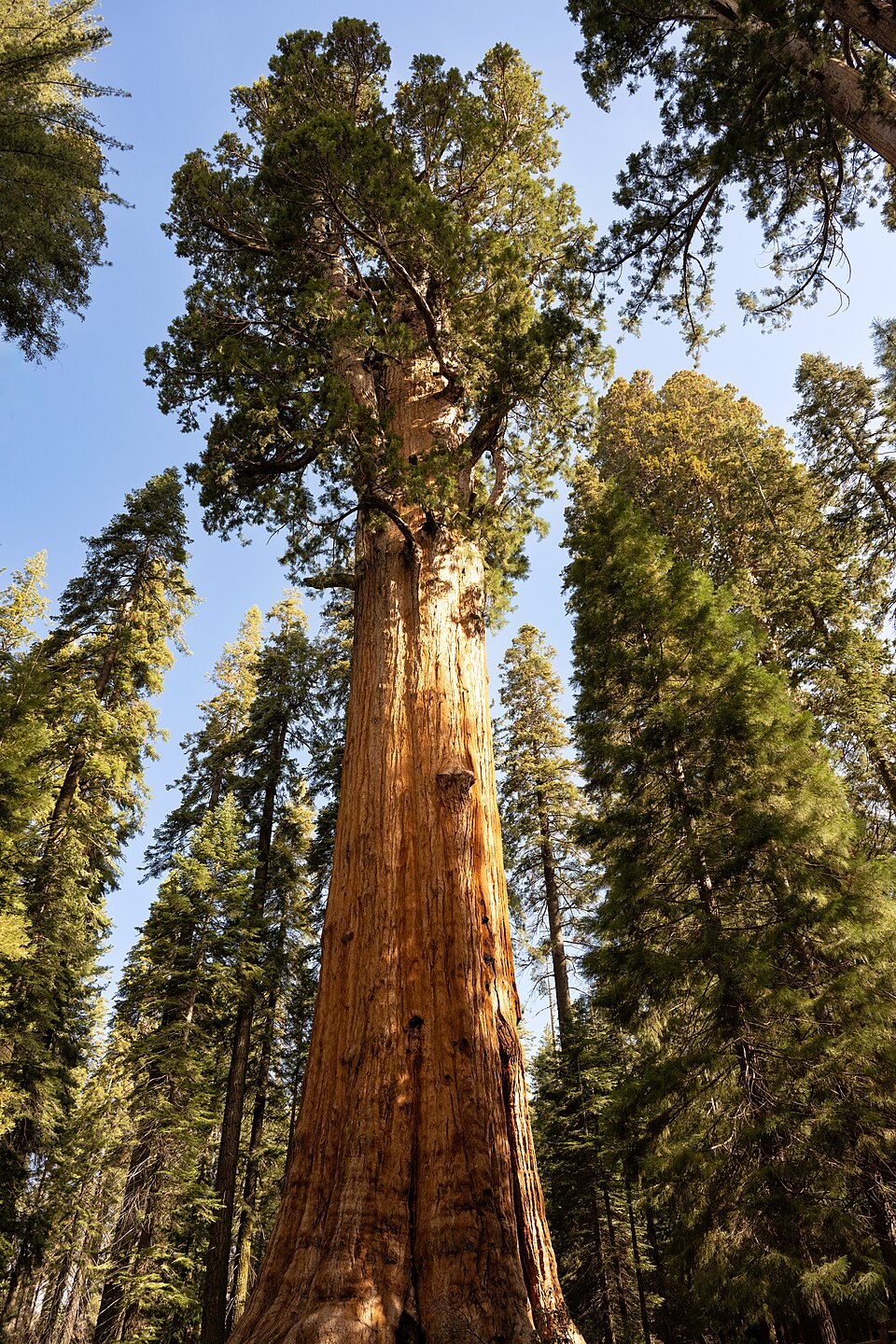
Giant Sequoia (Sequoiadendron giganteum) · 2,300-2,700 years · Giant Forest, on the Main Trail, about 0.5 miles from the Wolverton/Sherman Tree parking lot
In September 2021, with the KNP Complex Fire burning into the Giant Forest, park staff wrapped the base of this tree in aluminium foil. It worked. The fire came through the grove and the tree was unharmed.
That is roughly the class of trouble a sequoia is built for. This one holds about 1,487 cubic metres of trunk, which makes it the largest known living single-stem tree on Earth, and the number doing the work is girth rather than height. At 83.6 metres it is a fairly ordinary tall sequoia. At about 31 metres round the base it is not.
Its age is genuinely unsettled. Most estimates land between 2,300 and 2,700 years, older ones ran as high as 3,200, and nobody is going to core it to settle the argument, so both figures stay on this page.
It stands on the Main Trail in the Giant Forest, about half a mile from the Sherman Tree parking lot. The walk down is short and part paved; the walk back is the uphill half, and a seasonal shuttle runs for anyone who would rather not. Sequoia National Park charges at the gate. Once you are through it, the most famous tree in the country costs nothing to stand in front of.
Photo: Eric Kilby from Somerville, MA, USA (CC BY-SA 2.0)
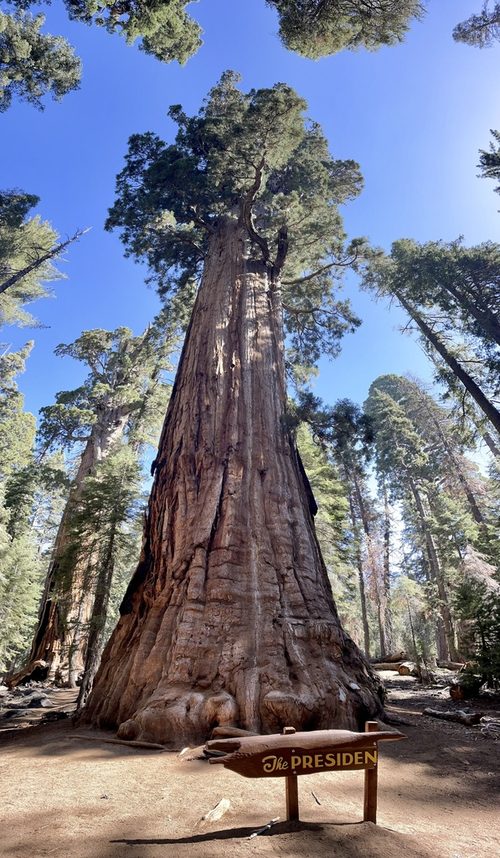
Giant Sequoia (Sequoiadendron giganteum) · 3,200 years · Giant Forest, on the Congress Trail loop, reached from the Sherman Tree parking lot
The oldest known living giant sequoia stands on a trail loop a short walk from General Sherman. The President is reckoned at roughly 3,200 years, a figure that came out of an extensive measuring campaign in 2011 and 2012.
That same work made it one of the most thoroughly measured trees on Earth. Count trunk and branches together and it is the second-largest tree known: about 1,278 cubic metres of trunk and some 255 more in limbs. Count the trunk alone and it slips a few places down the list, which is why rankings of the biggest trees do not agree on where to put it. Both numbers are honest. They are measuring different things.
It was named in 1923 for Warren G. Harding, the sitting president, by which point it had already been standing for around three thousand years. Fire has been through here many times in that span, and the prominent white burn scar on its north side is the record of it. The crown is unusually dense for a tree this old, and the first large limb does not branch out until 37 metres up.
It stands on the paved Congress Trail, reached from the Sherman Tree parking lot, about 140 feet downhill from the Chief Sequoyah Tree. The park charges at the gate; the tree itself asks nothing.
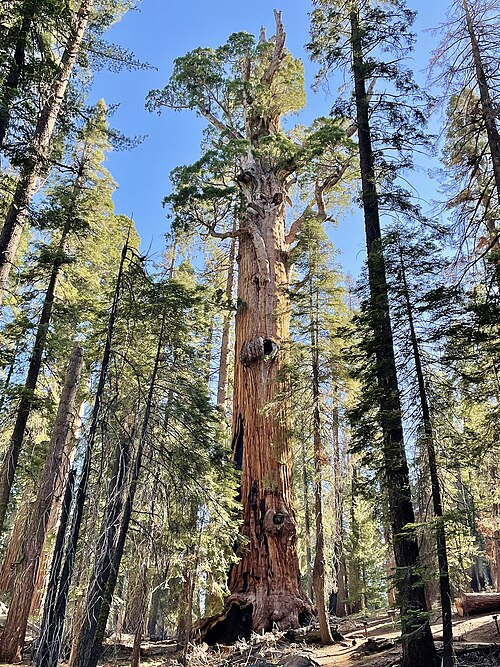
Giant Sequoia (Sequoiadendron giganteum) · Giant Forest, on the Congress Trail loop, about 140 feet uphill from the President Tree
This tree is named for the man who gave the Cherokee a written language. Sequoyah finished his syllabary in 1821, and a century later one of the largest trees in the Giant Forest was given his name.
Park superintendent Colonel John R. White gave it the name in the 1920s. One source says 1926 and another 1928, and neither has corrected the other, so both years stay here. The sources also disagree slightly on where it ranks: 27th largest giant sequoia in the world by one count, 30th by another, and ninth largest in the Giant Forest itself. The quarrel is about places on a list, not about scale. The trunk is roughly 27.5 metres round at the base and the tree stands close to 70 metres tall.
Walk round it and two things mark it out. On the southern face is an enormous burl, a swollen knot of wood bulging from the trunk. On the western face is fire scarring, the ordinary damage of a tree that has lived through centuries of fires in this forest.
It stands on the paved Congress Trail, about 140 feet uphill from the President. Nobody has published an age for it. If you know of one, tell us.
Photo: Marty Aligata (CC BY-SA 4.0)
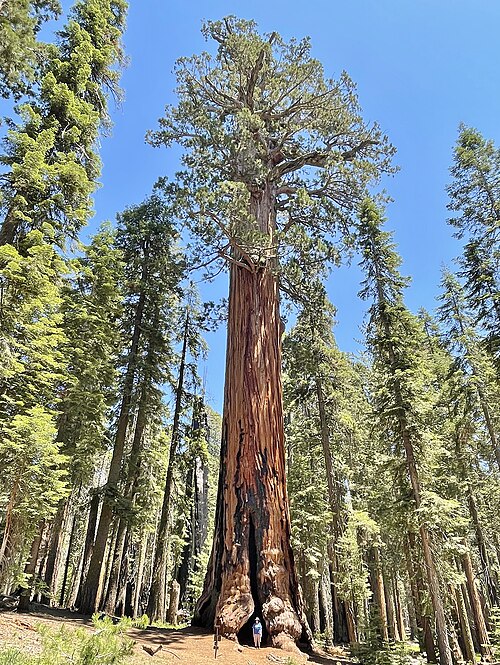
Giant Sequoia (Sequoiadendron giganteum) · Giant Forest grove, near the Congress Trail loop
Depending on who held the tape, this tree holds 44,471 cubic feet of wood or 51,000. That gap of some 6,500 cubic feet is the argument between the measurers, and it is why the Lincoln Tree is usually called the fourth largest tree on Earth rather than simply stated to be.
The lower figure was calculated by the dendrologist Wendell Flint. The higher one came from earlier measurements by White and Pusateri. Neither side has been proved wrong, and the ranking survives both: whichever number you take, very few trees anywhere are bigger.
The base alone is about 30 metres round, irregular rather than neatly cylindrical, and the tree stands close to 80 metres tall. It carries the marks of a long life in a forest that burns. There are prominent fire scars on its north, south and west faces, a white burl swelling out of the northeast side, and at the top a bleached, broad-branched crown that looks weathered from the ground.
It stands in the Giant Forest grove near the Congress Trail, within walking distance of General Sherman and the President. Nobody has published an age for it. If you know one, tell us.
Photo: Marty Aligata (CC BY-SA 4.0)
Giant Sequoia (Sequoiadendron giganteum) · Giant Forest grove, near the Washington Tree
The eighth largest giant sequoia in the world went unrecognised until the 1950s, and the likely reason was the neighbour. The Franklin Tree stands near the much larger Washington Tree, and a trunk nearly 29 metres round the base could apparently pass as supporting cast beside it.
It was the dendrologist Wendell Flint who measured it properly, during his campaign in the 1950s, and who named it for Benjamin Franklin. So the name arrived late, attached to a tree that had been standing in plain sight for a very long time.
The years since have added an irony. The Washington Tree had its crown cut down by a lightning fire and then lost half its height to a snow load in 2005, and now ranks around 55th. The Franklin Tree, at about 68 metres tall, still ranks eighth. The tree that hid it is now far down the list, and it is the one that was overlooked that holds its place.
It grows above 1,800 metres in the Giant Forest grove. The pin is approximate, so expect to look for it near the Washington Tree rather than walk straight to it. Nobody has published an age. If you know one, tell us.
Giant Sequoia (Sequoiadendron giganteum) · Giant Forest grove, near the Franklin Tree
Until 2005 this was the second largest tree known on Earth. Then a winter did what centuries of fire had not.
The trouble started with lightning. A strike set the tree burning in September 2003, by one source, or September 2002 by another, and the fire cut back the crown. In January 2005 a heavy load of snow finished the job, collapsing the upper half and leaving what remained of the upper trunk hollow. The Washington Tree went from about 77 metres tall to somewhere between 35 and 37. It had held 49,550 cubic feet of wood. It now holds a little over 30,000, and that figure counts the hollows.
Most trees would be a stump after that. This one is not. Both sources report new foliage and small branches growing back on the south side, and it has been put back on the lists of the largest trees, around 55th, from second. A giant sequoia's answer to catastrophe is apparently to keep going at a lower altitude.
It stands in the Giant Forest grove near the Franklin Tree, and it is the easier of the two to spot: look for the shortened, broken-topped column with green coming back on one side. Nobody has published an age for it. If you know one, tell us.
Giant Sequoia (Sequoiadendron giganteum) · Giant Forest
The Sentinel Tree has moved up the rankings by standing still. It was counted the 43rd largest giant sequoia known, and may now be 41st or 42nd, because the fires of 2015 to 2017 killed trees that stood above it.
It is also the easiest giant in the park to reach. It stands on the plaza in front of the Giant Forest Museum, with no walk at all from the car park, and the Park Service has laid a ruler along the sidewalk so you can pace out its height on the ground.
That height is 78.5 metres. The trunk is 7.65 metres across at chest height, which works out at roughly 24 metres round, and it holds about 790 cubic metres of wood. Two burn scars mark its base, the record of fires it lived through long before anyone was counting.
In September 2021 the KNP Complex fire came toward the Giant Forest. Firefighters wrapped the museum and the sequoias around it, and the fire stopped short of the grove. We have not found a dated sighting of this particular tree since, so if you stand under it, tell us how it looks.
Nobody has published an age for it either. Size is what it offers, and it offers it at the door: General Sherman, the largest of them all, stands under three kilometres to the north-east, and the Sentinel is the giant you meet before you have even set off.