The Twisted Tea Tree of Marston House
Approximate location.
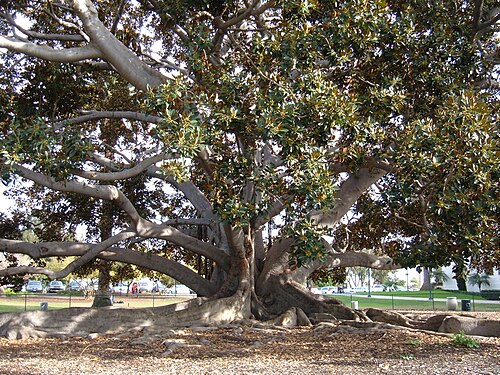
This tree grows sideways. Its trunks run out almost level with the ground, and where a limb comes down far enough to touch the soil it sometimes puts down roots and carries on. The result, on the grounds of Marston House in Balboa Park, is a low, gnarled tangle that visitors compare to something out of a fantasy novel. Somebody has called it Gandalf. It is not the only name it has been given. It is an Australian tea tree, and it earns its place here by shape rather than size. Nothing about it is tall. Everything about it is twisted. The park ranger Kim Duclo says it was likely planted around 1906 by Kate Sessions, the horticulturist remembered as Balboa Park's godmother, the same woman whose last nursery left the tipu tree in Pacific Beach. That would make it about 120 years old. It is one person's informed guess rather than a record, and it is the only date anyone has offered. What is documented is that a professional survey of the Marston garden in 1989 listed Australian tea tree among its plants, though it does not say which specimen. It stands on the paved walkway just past the entrance to the Marston House grounds, at the park's northwest corner near Seventh Avenue and Upas Street. The garden is free to walk; the house charges for tours inside.
Marston House Museum grounds, 3525 Seventh Avenue, Balboa Park, San Diego, CA 92103 You can recognise it by the low, twisting trunks that run almost flat along the ground, some rooting where they touch. It stands beside the paved walkway just past the entrance to the Marston House grounds.
Free to view on the Marston House Museum grounds (part of Balboa Park); the house museum itself charges admission but the garden path this tree stands on is on the museum's public grounds
Balboa Park, northwest corner at Seventh Avenue and Upas Street; bus routes serve Sixth/Seventh Avenue, roughly 10-15 minute walk from central Balboa Park