Olympic National Park runs to nearly a million acres, and this page maps four of its most striking conifers. The Kalaloch cedar, split by a 2014 storm, still stands half alive off Highway 101. A short walk from Kalaloch's own campground, a Sitka spruce holds its trunk over open air on an eroding root arch. By Lake Quinault stands the world-record Quinault Big Spruce. And fifteen miles south of Forks, on state land just outside the park boundary, the vast, mostly-dead Duncan Cedar somehow keeps growing.
0 of 4 visited in Olympic National Park
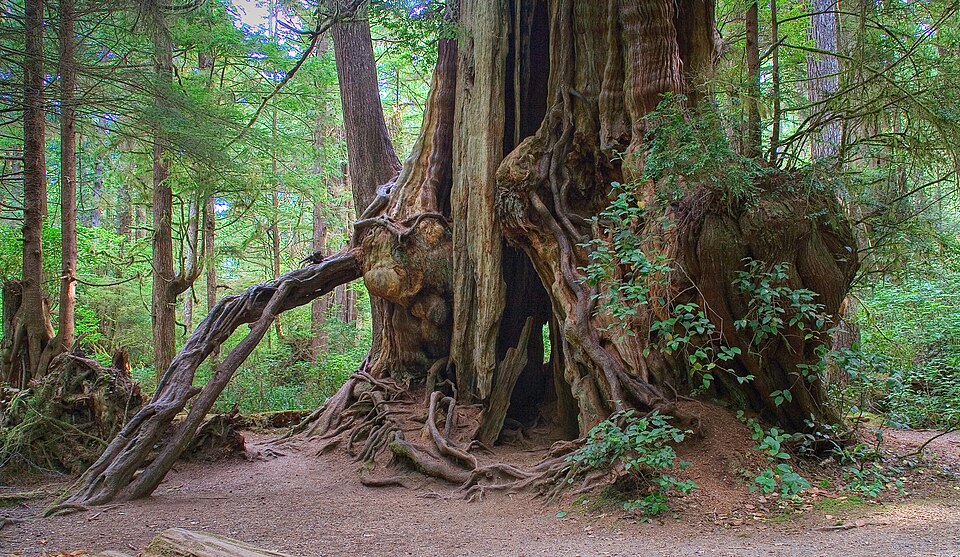
Western Red Cedar (Thuja plicata) · 1,000 years · Kalaloch Big Cedar Nature Trail, a short flat walk from a signed roadside parking area
Half of this tree is lying on the ground. On 8 March 2014 a storm off the Pacific split the Kalaloch cedar down its length and roughly half the trunk and crown came down. The other half is still standing, and still alive.
That changes what to expect. The figures this tree is famous for, close to six metres through and about fifty three metres tall, are pre-2014 numbers from when it ranked among the largest western red cedars anywhere. Nobody has published a remeasurement since. What you walk up to now is a ruined column of a tree, somewhere between eight hundred and twelve hundred years old, described by everyone who has looked at it as alive but in slow decline.
It is worth the stop anyway, and arguably it is a better stop than it was. A cedar this size takes a millennium to build and one night of weather to halve, and here you can see both facts at the same time: the intact side going up, the wreckage of the other side where it fell.
The Big Cedar trail leaves a signed pull-off on Highway 101 between Ruby Beach and Kalaloch. It is a few hundred feet, flat, and free with the park. Read the signs when you get there. The 2014 damage is the reason they exist.
Photo: rachel_thecat (CC BY-SA 2.0)
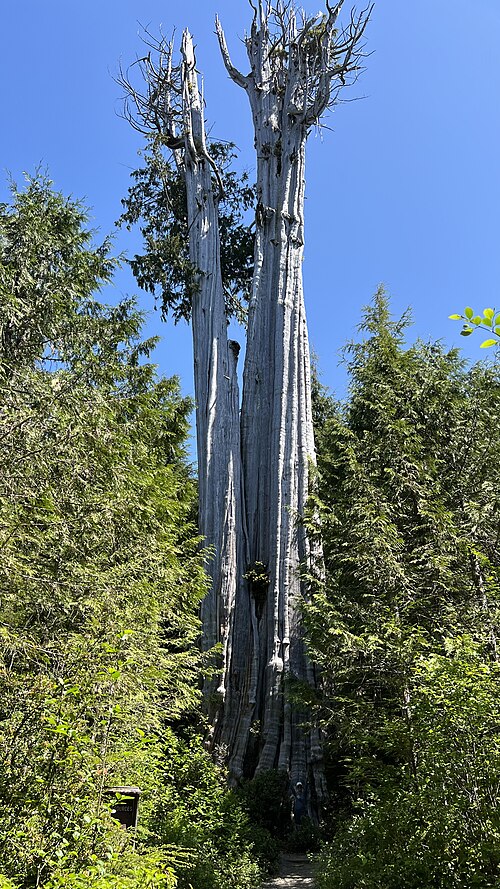
Western Red Cedar (Thuja plicata) · 1,000 years · Near Forks, off a logging road from Highway 101, at a boardwalk trail marked by a tree-shaped sign
The largest known western red cedar in the world is mostly dead wood, and it is still alive. A strip of living bark runs up one trunk and keeps the whole thing going, and a red cedar's resistance to rot means it can hold on like that for a very long time. One forestry expert has said it may manage centuries more if nothing knocks it down.
The Duncan Cedar is also the largest tree of any species in Washington state: about 5.9 metres through, 54 metres tall, and more than a thousand years old by the usual estimate. Loggers found it in 1975, and it survives because local people argued for it to be left standing.
One thing to know before you drive out. It does not stand in Olympic National Park. It is on Washington State Department of Natural Resources land just outside the boundary, which is why a state Discover Pass is needed to park, and why it is grouped with the park only by geography and habit.
The road in is about four miles of unpaved logging track off Highway 101, south of Forks, ending at a small pull-off marked by little more than a tree-shaped sign. A short boardwalk does the rest. Visitors report green growth still coming. Pair it with the Kalaloch Redcedar, a short drive down the coast inside the park, for two very different ways a cedar refuses to die.
Photo: Marrstree (CC BY-SA 4.0)
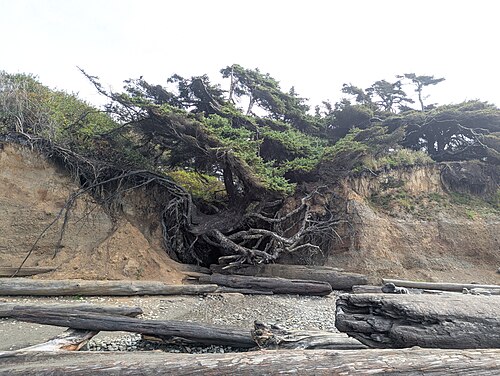
Sitka Spruce (Picea sitchensis) · On the beach about 200-400 feet from the Kalaloch Campground day-use parking lot; the tree grows over a small eroded creek gap, its roots forming an arch/cave with the trunk suspended above
There is nothing under this tree. A creek has cut through the bluff beneath it and carried the soil away, and the Sitka spruce now hangs over the gap on an arch of its own exposed roots, with open air where the ground used to be. Locals call the hollow underneath the root cave.
It is one of the most photographed single trees on the Washington coast, and it has been a known sight for a long time. Staff at Kalaloch Lodge say people have been coming to look at it since at least the 1950s, and that it is probably much older than that. Nobody has dated it or measured it, so how old it really is stays an open question. If you know, tell us.
What is known is that the clock is running. The erosion that made it famous has not stopped. A 2025 feature reported branches in decline, and the recurring line in everything written about it since is that no one knows how much longer it will stand. As of the most recent reports in 2026, it is still there, still alive, still holding on.
From the Kalaloch Campground day-use parking, walk onto the beach, turn right and go a few hundred feet. The pin marks the campground rather than the trunk, but on this stretch of sand you will not miss it.
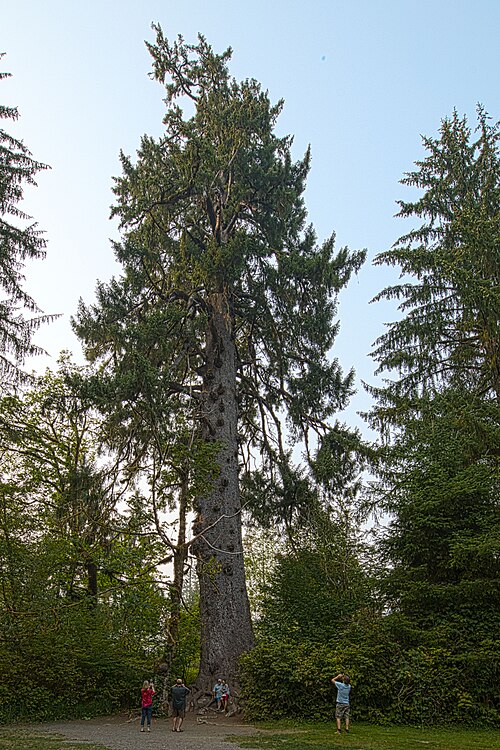
Sitka Spruce (Picea sitchensis) · 1,000 years · Big Spruce Trailhead, South Shore Road, at Lake Quinault
This is the biggest Sitka spruce on record anywhere, and it is a few minutes' walk from a resort car park. American Forests lists it as the champion of its species, and by volume it ranks among the largest trees of any kind in the continental United States outside California's redwoods and sequoias.
The numbers are the kind that stop meaning anything until you stand next to them. Nearly 18 metres round the trunk. About 58 metres tall. A crown reaching some 29 metres across. Visitor sources usually give its age as around a thousand years, and that is a loose figure passed from one writer to the next rather than anything counted, so read it as somewhere between eight and twelve centuries. Nobody has published a proper dating.
What is missing from this tree's story is also worth noting: drama. The cedars and the beach spruce out to the west are famous partly for what is happening to them, split by a storm, reduced to a strip of living bark, undercut by a creek. No one has reported any damage or decline here. It is simply very large and, as far as anyone has reported, healthy.
It is also the easy visit. It stands inside Olympic National Park, the trail is flat and 0.4 miles out and back from the Rain Forest Resort Village on South Shore Road by Lake Quinault, and it costs nothing.