Berlin Zoo calls it the eternal oak, and says it has been giving shade for 500 years.
Ancient Trees in the Tiergarten
Berlin, Germany
The Tiergarten began in the sixteenth century as the Electors' hunting forest, and the oldest age anyone claims for a tree in it is 500 years, Berlin Zoo's word for a pedunculate oak in its grounds.
That is the owner's figure, not a measurement. Most of what stands here is younger, for a hard reason: in the hungry winters after 1945 Berliners cut most of the park down for firewood, and it was replanted from 1949. A giant sequoia planted in 1891 near Schloss Bellevue came through. Queen Elizabeth II added a red oak by the Teehaus in 1965, on her first visit to West Berlin. Around them, Berlin protects trees as natural monuments, many of them listed on a single day, 2 March 1993, and the register says why: beauty alone for the tulip tree on the Luiseninsel, rarity for a Lebanon oak from the mountains of the Near East, and four reasons at once, science among them, for a sessile oak by the Carillon. A black locust grows on the traffic island under the Victory Column, reached through the pedestrian tunnels. Almost none of them has a published age or girth, so a tape measure is a fair thing to bring. The park is free and open at all hours; the zoo oak needs a ticket.
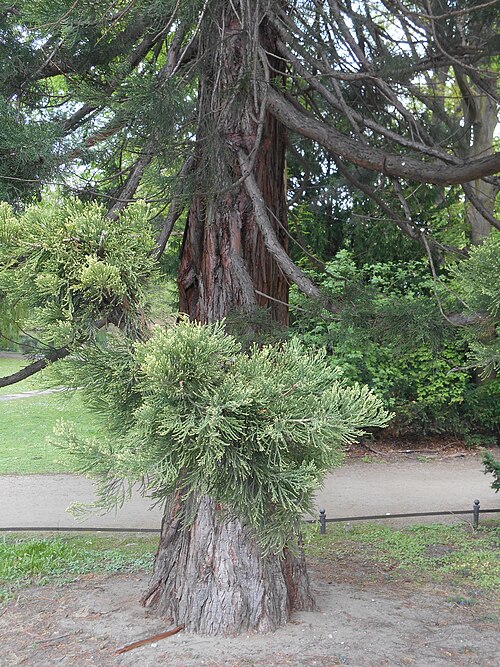
A tree that can live 3,000 years in California has had 135 of them in central Berlin.
Photo: Miriam Guterland (CC BY-SA 3.0)
Autumn colour
Queen Elizabeth II planted this oak herself, on 27 May 1965, on her first visit to West Berlin.
Berlin protected this tree in 1993 on two stated grounds, Eigenart und Schönheit, character and beauty, and recorded nothing else at all.
This oak is protected by law for one reason only: Berlin has hardly any others like it.
Every leaf on this tree is two colours: dark green on top, silver-white felt underneath, so the crown flickers pale whenever the wind turns it over.
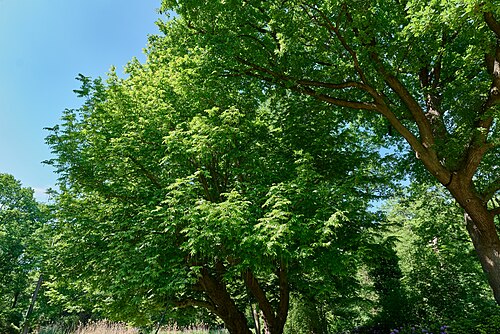
German calls this tree the Flatter-Ulme, the flutter elm, after flowers that hang on stalks long enough to shake in a breeze.
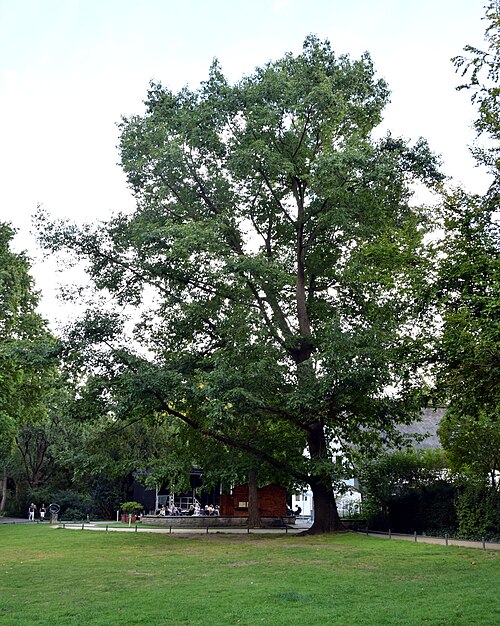
Of the protected oaks in this corner of the Tiergarten, this is the only one whose species belongs here.
Autumn colour
In October the air under this tree smells of burnt sugar.
Most of Berlin's protected trees made the list for being rare, old or tied to the city's history.
Berlin's natural monument register lists more than six hundred trees, and only two of them are protected for four reasons at once.
Berlin's most famous traffic island holds a 67-metre column, a gilded Victoria and a protected tree from North America.
On the night of 15 January 1919, Freikorps soldiers shot Karl Liebknecht in the dark beside the Neuer See and reported that he had been killed trying to escape.
The London plane may not be from London at all.
This oak grows on a strip of park squeezed between two kinds of water: the Neuer See on one side, the Landwehr Canal on the other.
Two protected oaks stand on this stretch of canal bank, about 25 metres apart, and Berlin lists them as separate natural monuments, 1-20/B and 1-97/B.
Berlin's register and the photographer who has followed this oak through every season cannot agree on what it is.
Autumn colour
Berlin's register takes the trouble to say exactly which beech this is: Gewoehnliche Buche, Rot-Buche, the plain green common beech.
This elm flowers in March, weeks before its own leaves, in small purple-brown tassels that dangle on threads and are easy to mistake for nothing at all.
More parks worth the walk: every park we map. Or explore by city: Prague · Brussels · Porto · Brisbane · Munich · Cambridge