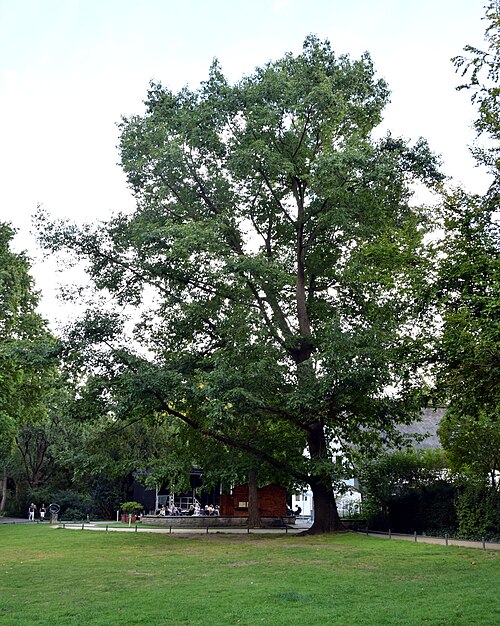
This oak is protected by law for one reason only: Berlin has hardly any others like it. The city's register lists rarity and nothing else, which is fair. Quercus libani comes from the mountains of the Near East, from Lebanon and Syria into Turkey, and a grown specimen in the middle of the Tiergarten is a long way from home. Berlin made it Naturdenkmal 1-36/B on 2 March 1993. It does not look much like the oaks around it. Its leaves are long and narrow, edged with small bristle-tipped teeth, closer to a sweet chestnut's than to the rounded lobes of a native oak. This corner of the park lets you check that for yourself. A pedunculate oak protected on the same day grows a short walk east, and Queen Elizabeth II's red oak of 1965 stands about 80 metres off. Three oaks from three continents, within a few minutes of each other. Nobody has published its age or its girth, and here that leaves a real question open. In the hungry winters after 1945, Berliners cut most of the Tiergarten down for firewood, and the park was replanted from 1949. Whether this tree came through that or arrived with the replanting, no source we have found says. If you know, or you have a tape measure with you, tell us.
Grosser Tiergarten, east of the Englischer Garten, Berlin-Mitte You can recognise it by the leaves, long and narrow with small bristle-tipped teeth like a sweet chestnut's rather than an oak's rounded lobes. It stands east of the English Garden, about 80 metres from the Queen's red oak.
Free, open public park (Grosser Tiergarten), no gate; open at all hours.
S Bellevue (S3/S5/S7/S9), roughly 400 m, 5 to 8 minutes on foot.
Sources
Where the facts on this page come from.