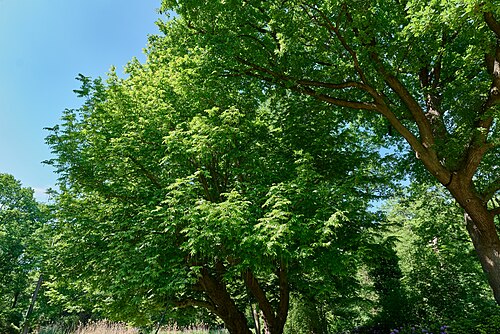
In October the air under this tree smells of burnt sugar. Katsura leaves give off the scent as they colour and dry, which is why German calls the species the Kuchenbaum, the cake tree. You tend to smell it before you have worked out which tree it is coming from. The katsura comes from Japan and China, and in Berlin it is a rarity by the register's own word. The city made this one Naturdenkmal 1-35/B on 2 March 1993, for its beauty and its rarity, and the register places it precisely: north of the Strasse des 17. Juni, south of the Fauler See. That pond, at the western end of the Tiergarten, is a protected nature area, and the tree stands between it and the traffic on the great east-west axis. The rest of the year it is a quieter tree, with small rounded heart-shaped leaves that open with a reddish tinge in spring and stay a soft green through summer. October is when it earns the walk, as the crown goes apricot and gold. Berlin has at least two other katsuras on our map, one in the Hansaviertel on Altonaer Strasse and one in the TU Schaugärten. This is the one in the open park. Nobody has published its age or its girth. If you know either, tell us.
autumn colour
October, when the crown turns apricot and gold and the path smells of burnt sugar
Grosser Tiergarten, north of Strasse des 17. Juni, south of the Fauler See, Berlin-Mitte You can recognise it by the small, rounded heart-shaped leaves, and in October by the burnt-sugar smell under it. It stands north of the Strasse des 17. Juni on the south side of the Fauler See, about 350 metres from S Tiergarten.
Free, open public park (Grosser Tiergarten), no gate; open at all hours.
S Tiergarten (S3/S5/S7/S9) roughly 350 m, about 5 minutes on foot.
Sources
Where the facts on this page come from.