Oahu's most remarkable trees are spread across Honolulu. Foster Botanical Garden holds the biggest group behind one modest entrance fee, among them a baobab, a Bodhi tree of the Bodh Gaya lineage, a kapok older than the garden and a quipo. Moanalua Gardens keeps the Hitachi Tree, famous from Japanese television, under its own ticket. Everything else is free: banyans at Thomas Square, Iolani Palace, the Honolulu Zoo gate and along Waikiki, a monkeypod in Nuuanu Valley Park, three trees on the UH Manoa campus, and a baobab and a pink bombax at Queen's Medical Center.
0 of 21 visited in Oahu
Baobab (Adansonia digitata) · ~100 years · Chinatown / Downtown Honolulu
Honolulu calls this one the Dead Rat Tree. The nickname is the seed pods: grey, furred, hanging on long stalks all around the crown, and once you have seen them you cannot unsee them. Under the pods is an African baobab, planted in Foster Botanical Garden in the 1930s and already carrying a trunk close to thirteen metres around. Ninety-odd years for that waistline is quick work, even for a species that grows a trunk largely to store water in it. The city's Exceptional Trees register gives its height as about twenty metres and rates its condition good.
Baobabs belong to dry African savanna, where they stand bare for months and flower at night for bats. This one has spent its whole life on fourteen acres of downtown Honolulu at the edge of Chinatown, on ground that was a private botanical collection long before the city took it over. It sat out a 1.26 million dollar renovation that closed the garden completely, and was still standing when the gates reopened in August 2023.
About twenty five of Oahu's hundred or so protected Exceptional Trees grow inside these same fourteen acres. That is the argument for the entrance fee: nowhere else on the island puts this many designated trees within a five minute walk of each other.
Bodhi Tree (Ficus religiosa) · 113 years · Chinatown / Downtown Honolulu
The tree the Buddha is said to have sat under has descendants, and one of them grows in downtown Honolulu. This sacred fig was raised from a cutting of the Bodh Gaya lineage in India and arrived as a sapling in 1913, a gift to Mary Foster from Anagarika Dharmapala, the Sri Lankan reformer who spent his life campaigning to return that Indian temple to Buddhist hands. Foster planted it in her garden and went on to become a major patron of Buddhism in Hawaii, paying for the islands' first Buddhist temple.
The tree is about 113 years old now, roughly fifteen metres tall, with a trunk over seven metres around, and the city's Exceptional Trees register rates its condition excellent. Sacred figs are easy to identify once someone shows you the leaf: heart-shaped, drawn out into a long thin tail, hung so loosely on its stalk that the whole crown moves in air you cannot feel on your own skin. A tree that moves on a still day is the sort of thing people build religions around.
It is one of the few trees in this garden whose value has nothing to do with its size. There are bigger and far stranger specimens within a hundred metres of it. This is the one with a paper trail back to India and a woman who knew exactly what she had been given.
Kapok (Ceiba pentandra) · 175 years · Chinatown / Downtown Honolulu
The oldest tree in Foster Botanical Garden is older than the garden, because the man who planted it lived here first. William Hillebrand, the German physician and botanist who made this ground his homestead, put a kapok in at around 1851. That gives it roughly 175 years. It was already a mature tree when the Hawaiian Kingdom was overthrown in 1893, and a very large one when Pearl Harbor was bombed.
Its height is not in doubt. Honolulu Magazine and the city's Exceptional Trees register both give 88 and a half feet, about 27 metres, which is also how we know the two are describing the same trunk. The trunk itself they disagree on, and not by a little. The magazine reports 151 inches around, a shade under four metres. The register records 6.98 metres. The two have never been reconciled, so both stand here rather than one being quietly chosen. Some of the gap is probably method: a kapok throws out buttress roots like thin walls, and the answer changes depending on the height at which you measure.
Standing at the base, the buttresses are the point anyway. They rise past head height and divide the ground around the trunk into separate rooms, which is what a rainforest giant does when it has to hold itself up in shallow soil.
Cannon Ball Tree (Couroupita guianensis) · Chinatown / Downtown Honolulu
The garden has put up a sign beside this tree warning visitors about falling cannonballs, and it is not a joke. Couroupita guianensis grows its fruit straight out of the trunk rather than from the branches, woody spheres somewhere between a grapefruit and a shot put, hanging on thick stalks that push out of the bark itself. Botanists call the habit cauliflory. Gravity calls it a hazard. A ripe one comes down from height and splits open with a smell that carries.
The flowers work the same way and are the reason to come: waxy, orange and pink, each one a shell-shaped hood over a dense spray of stamens, opening in ropes down the trunk at eye level while the crown sails on 29 metres above. It is a South American tree, from the Amazon and the Guianas, soft-wooded and fast, and the city's Exceptional Trees register rates this specimen's condition excellent. It is the most straightforwardly strange thing in a garden that is not short of competition.
One thing about it is missing: nobody has recorded when it went into the ground. If you know the planting date, or know someone at the garden who does, tell us and it goes on the page.
Quipo (Cavanillesia platanifolia) · 96 years · Chinatown / Downtown Honolulu
This trunk is soft enough to cut with a knife. The quipo comes from the forests of Panama and Colombia, where it grows wood about as dense as balsa and gets felled for rafts and dugout canoes rather than for anything expected to hold weight. The tree wears that wood in a shape to match: smooth, greenish-grey, swollen low down and tapering upward, closer to a water tank than to anything with bark on it. Honolulu Botanical Gardens' own record puts the planting at 1930, which makes this one about 96 years old.
It has reached roughly 26 metres. That figure comes from the city's Exceptional Trees register alone and has not been checked against a second measurement, so treat it as the best number available rather than a settled one. Its seedpods are the other reason to look up: large, papery and winged, built to spin on the way down. The register rates the tree's condition excellent.
It stands near the centre of the garden, which is about right, because it is the specimen most visitors cannot name and cannot walk past either. Nothing else on these fourteen acres looks less like a tree, and that includes a baobab.
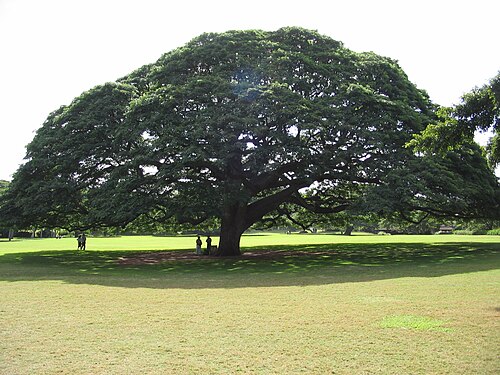
Rain Tree (Samanea saman) · 130 years · Moanalua
This rain tree is on Japanese television most weeks, and almost nobody watching knows it is in Honolulu. Hitachi has used it as the company emblem since 1973, with a jingle that begins "this tree, what tree", and it is famous enough in Japan that visitors arrive at Moanalua Gardens asking for it by the company's name rather than the tree's.
What brought the advertising people here is obvious from the lawn. A rain tree grows outward rather than upward, and this one has spent about 130 years doing it: roughly 25 metres tall and a crown wide enough to shade some three thousand square feet of grass, held up on limbs that reach almost horizontally before turning. Stand under the middle and the canopy closes overhead like a roof.
The leaves do something worth timing your visit for. The leaflets fold shut in the late afternoon and before rain, which is where the name comes from, and the light through the canopy changes completely when they do. Hawaii knows the species as the monkeypod, and that is the name on the sign.
The gardens are privately owned and charge admission, which is unusual for a tree on this site and worth knowing before you drive out. The lawn around the trunk is open, so you can walk right up to it.
Photo: KeithH (CC BY-SA 3.0)
Indian Banyan (Ficus benghalensis) · 140 years · Downtown Honolulu
Honolulu's oldest public park did not always have shade. Thomas Square was set aside as parkland in 1850, but the banyans came decades later, when the Scottish merchant Archibald Scott Cleghorn took over as steward in 1882 and brought cuttings from Ainahau, his own Waikiki estate, to plant here. The overhauled park reopened to a brass-band crowd on 7 April 1887, and by the 1930s four banyans ringed the new central fountain, where they still stand.
They are Indian banyans, Ficus benghalensis, named in a University of Hawaii extension guide that singles out this exact grove as the reference specimen for the species in the islands, adding dryly that Disneyland's own banyan nearby is artificial. Cleghorn is better known today as the father of Princess Kaiulani and, later, Governor of Oahu; Ainahau, the estate these cuttings came from, held its own famous banyan, the one under which Robert Louis Stevenson used to read poetry to his young daughter.
Thomas Square has been public land since 1850, protected as a city park since 1925, and free to walk every day, no ticket and no gate, with King Street traffic on one side and the Honolulu Museum of Art across Beretania. Come toward evening and the fig-eating mynahs that roost here nightly make the banyans' size obvious from the noise alone.
Black Olive (Bucida buceras) · Ala Moana
Ala Moana Beach Park has roughly forty banyans planted for its 1937 Banyan Garden, and one tree in the park belongs to none of them. Officially it is a Black Olive, Bucida buceras, but it earned its nickname, the Geometry Tree, from the way it grows: branches stack outward in flat, level tiers rather than the tangled shape most trees settle into. Some Black Olives are pruned hard to force that look; this one has done most of the work on its own.
The species is native to the Caribbean and Central America and arrived in Hawaii as a landscaping ornamental, prized for exactly this tiered habit. The City and County of Honolulu designated it an Exceptional Tree under the state's 1975 tree-protection law, recording a trunk just over three metres round and a crown reaching about fourteen metres, rated in excellent health at its last survey.
Ala Moana itself has been public land since the 1930s, built from reclaimed wetland into Honolulu's busiest beach park, free to enter every day between four in the morning and ten at night. No ticket, no gate, and the tree stands among the park's open lawns rather than off any marked path, worth hunting down once you know the odd, stacked shape to look for.
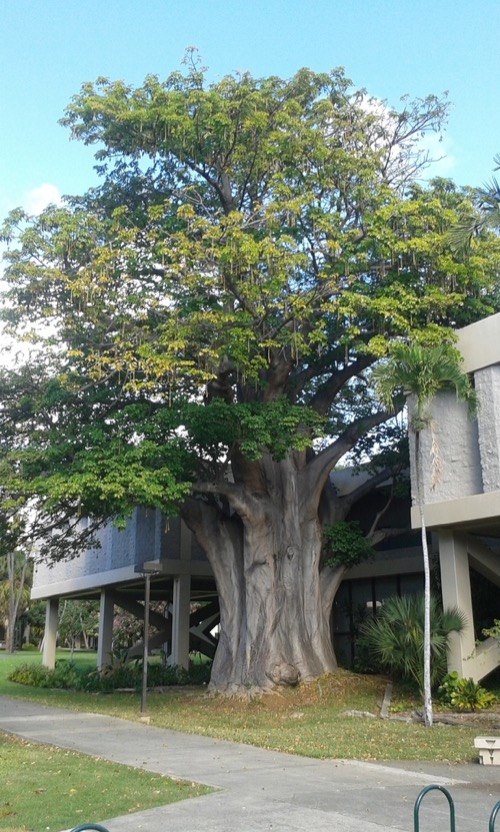
Baobab (Adansonia digitata) · 80 years · Manoa (UH Manoa campus)
When the University of Hawaii tore down Gilmore Hall in 1973, one thing did not move. Art faculty and students had grown fond of the baobab already standing beside the old building, and when its replacement went up, the tree stayed exactly where it was and the new Art Building was built around it. More than fifty years later it still stands pressed against the exterior wall, close enough that photographs make it look almost part of the structure.
The University calls it the largest baobab in the United States, and the claim is plausible: baobabs are native to Africa and Madagascar and rarely reach this size far outside the tropics they evolved in, let alone on a university campus in the middle of the Pacific. The tree was already about 30 years old when the building rose around it, which puts its planting somewhere in the early 1940s, before Hawaii became a state.
Nobody has taped its girth for the record, and no register lists one. What survives instead is the story everyone on campus already knows: a tree stubborn enough, and loved enough, that an entire building changed shape to keep it standing.
Photo: Floyd A. Reed (CC BY)
Cannon Ball Tree (Couroupita guianensis) · Manoa (UH Manoa campus)
Its flowers grow straight out of the trunk, and so, eventually, does fruit the size of cannonballs. Couroupita guianensis is native to the rainforests of Guiana, and on the UH Manoa campus, tucked between Bachman Hall and Sinclair Library near the visitor parking kiosk, one specimen has grown a trunk 314 centimetres round with the species' strange, tangled flower stems still running down its bark.
The flowers themselves are large, fragrant and short-lived, which is presumably why UH's own news office photographed one in bloom for its January 2025 'Image of the Week'. The fruit that follows is genuinely cannonball-sized, round and hard-shelled, and it drops rather than clings, so anyone standing directly underneath should keep half an eye up.
No age is recorded for this tree anywhere UH has published. A widely repeated claim online says it was planted in 1933 by the playwright Thornton Wilder during a stint teaching at the university; it could not be independently confirmed this pass, so it is left out rather than repeated on faith. Free to see, on open campus ground, a short walk from Sinclair Library.
Rain Tree (Samanea saman) · Nuuanu
Someone has wedged a rock under one of the low branches here, presumably to help visitors reach it, because the rain trees of Nuuanu Valley Park, known locally as monkeypods, grow their canopy close enough to the ground that children climb, sit and walk along the branches themselves. The largest carries a trunk 585 centimetres round, registered by the City and County of Honolulu as an Exceptional Tree and rated in excellent health.
The rain tree, Samanea saman, is native to Central and South America and was brought to Hawaii as shade. It grows fast and wide rather than tall, which is exactly what makes its low, spreading branches so easy to reach. Nuuanu Valley Park itself sits a short drive up Pali Highway from downtown Honolulu, an ordinary public playground and picnic ground with its own parking lot, and a second Exceptional Tree, an enormous banyan more than thirteen metres round, grows in the same park.
No age or planting record survives, and girth alone cannot fix one honestly for a fast-growing species like this. Free, open, no ticket, and the shade is the point.
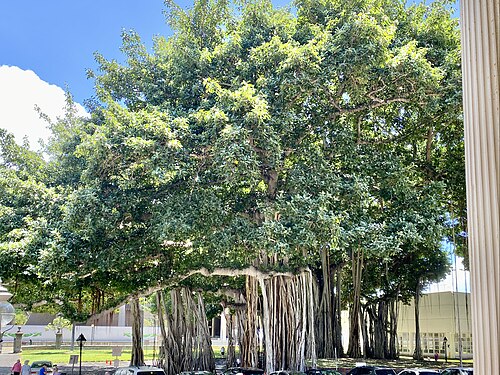
Indian Banyan (Ficus benghalensis) · 140 years · Downtown Honolulu
The register gives this banyan a girth of nearly twenty-two metres. That number is not one trunk. Roughly sixteen major trunks have fused around the original stem and the tape goes round the whole cluster, which is how an Indian banyan works: aerial roots come down, thicken, root, and become trunks in their own right until one tree occupies a courtyard.
It is the most prominent tree on the mauka side of the Iolani Palace grounds. Who put it there is disputed. One account credits Queen Kapiolani with planting it; another says it arrived as a gift from Indian royalty to King Kalakaua, with Kapiolani again doing the planting. Both point at the same window, the early 1880s, when Kalakaua was building the palace itself between 1879 and 1882. That gives roughly 140 years, and the band stays wide because the planter is genuinely in question even though the era is not.
So the tree is about as old as the palace it shades, and it was already large when the Hawaiian Kingdom was overthrown in 1893. Cuttings from it were reportedly carried to Kailua Bay in Kona and to Hulihe'e Palace.
It is still in service. The palace rents the ground beneath it as the Banyan Terrace, so people now get married under a tree a queen is said to have planted.
Photo: w_lemay (CC BY-SA 2.0)
Pink Bombax (Pseudobombax ellipticum) · ~160 years · Downtown Honolulu
For a few days in late March this tree covers itself in pink flowers shaped like shaving brushes, garish enough that Honolulu Magazine reached for exactly that word. The new leaves follow deep red and only settle into green later, and while the tree is actively growing the bark takes on a green tone and visibly swells.
It was planted by William Hillebrand, the German botanist who served as royal physician in nineteenth-century Honolulu and whose kapok still stands in Foster Botanical Garden. The reason is on record: Queen Emma wanted the hospital grounds to be welcoming to the people who came to them, and Hillebrand planted to that brief. Honolulu Magazine puts the tree at more than 150 years old, which is the only figure anybody offers. Read it as a floor rather than a measurement, because nobody has narrowed it since.
The trunk has been taped once, by the city's Exceptional Trees register, at 3.75 metres round, with its condition rated good. That single entry is the whole measurement record.
It stands to the right of the roundabout on the Queen's Medical Center campus, a working hospital whose outdoor grounds anybody can walk through, a few minutes from Iolani Palace. Fifty weeks of the year it is a well-shaped green tree on a hospital lawn. The last week of March is the one to put in the diary.
Baobab (Adansonia digitata) · Downtown Honolulu
A sign in Foster Botanical Garden sends visitors away from its own baobab. The oldest baobab in town, it says, is not the one in the garden but this one, under a mile away on the lawn of a working hospital.
Older, then, but not bigger. This trunk goes 11.8 metres round and Foster's is thicker still, so the claim rests entirely on age, and age is the one thing nobody has. The city's Exceptional Trees register records the species, the girth and a condition of good, and leaves the age blank. The enthusiast survey that has catalogued Honolulu's baobabs one by one, and that walked here with a hand-held GPS to fix the spot on the ground, found no planting date either. A second Honolulu photographer gets as far as massive and ancient. So nobody has dated this tree. If you know when it went in, tell us and it goes on the page.
What is not in question is the bulk. Adansonia digitata puts on that kind of trunk largely to hold water through a dry African season it will never meet on Punchbowl Street, and having been planted somewhere it never has to ration anything, it has simply kept going. It stands outdoors on the street side of the hospital grounds, free to walk up to, ten minutes from Iolani Palace.
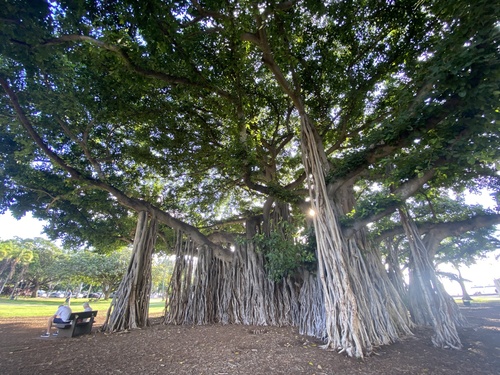
Indian Banyan (Ficus benghalensis) · Waikiki / Kapiolani Park
The best tree at the Honolulu Zoo is outside the ticket gate. Two banyans flank the entrance on Kapahulu Avenue, standing in the public grounds of Kapiolani Park rather than in the zoo, and benches have been built in a ring around the trunk of the seaward one. Sitting under it costs nothing.
The city's Exceptional Trees register carries them as two separate entries, the mauka tree and the makai tree. That is bookkeeping rather than something a visitor experiences: walk up to the gate and it is one cluster of banyans over one entrance, which is how the Historic Hawaii Foundation describes it too. The makai tree's measurements are the ones worth quoting, 16.5 metres round and a little over five metres across the trunk. Its neighbour's numbers contradict each other in the register and are best left alone until somebody re-measures.
Neither has been dated. Banyans arrived in Hawaii in the late 1800s as a species, but that is a fact about the species and not a planting date for these two, and no register or historic listing supplies one. If you know, tell us.
An Indian banyan does not grow upward so much as outward. Aerial roots drop, thicken and set as trunks, and the tree walks across the ground over decades. These two have had long enough to throw shade over the whole entrance, and over everyone queuing to pay.
Photo: Linzy L (CC BY-SA)
Indian Banyan (Ficus benghalensis) · 122 years · Waikiki
This banyan was already seven years old when somebody planted it, and it was about seven feet tall. That was 1904, and the man with the spade was Jared Smith, who ran the territory's Department of Agriculture experiment station. He put it into the seafront courtyard of the Moana hotel on Waikiki beach.
It now stands around 23 metres high and throws its crown about 46 metres across, which is another way of saying the tree ate the courtyard. The courtyard is named after it. Everything that has happened in the Banyan Court for a century, and Waikiki has done a great deal of happening in that time, has happened under this tree. In 1979 it was among the first names on Hawaii's Rare and Exceptional Tree List, and it was later designated a Millennium Landmark Tree.
One number here is worth distrusting. The city register gives this tree a girth of 45.7 metres, which is exactly 150 feet, which is exactly the canopy spread every other source reports. That is a mislabelled column rather than a trunk, so we have left the girth blank instead of repeating a spread as a waistline. If you have put a tape around it, tell us.
The Banyan Court is open to walk through whether you are staying at the hotel or not, and the bar under the branches serves anyone.
Indian Banyan (Ficus benghalensis) · 100-176 years · Waikiki
Don the Beachcomber ran his office out of this tree. In the 1950s the restaurateur Donn Beach had a workspace built up in the branches of the banyan at the centre of the International Market Place, and the tree has outlasted him and two versions of the shopping centre around it.
How old it is depends on who you ask, and the gap is wide enough to notice. Hawaii Magazine and Wikipedia both settle for a century old. Honolulu Magazine tells a longer story: planted in the mid-1850s by the New Zealand entrepreneur Harry Macfarlane, on ground that later belonged to King Lunalilo, who died there in 1874, and after him to Queen Emma. That version makes it about 170. We have not picked a winner, so the honest answer is somewhere between 100 and 176 years, and it was standing here long before the market place opened around it in 1957.
What is not in dispute is 2013. The whole place was demolished and rebuilt at a cost in the hundreds of millions, and the banyan stayed. The new open-air canopy was engineered to route its steel around the tree rather than take the tree out, and an arborist looks it over daily. That arborist, Steve Nimz, has been minding it since 1971.
It is free to walk up to, in the open middle of the shops on Kalakaua Avenue.
Skunk Tree / Java Olive (Sterculia foetida) · Manoa (UH Manoa campus)
Once a year part of the University of Hawaii's Manoa campus starts to smell like a stable, and it takes people a while to work out why. The source is this one. Sterculia foetida flowers once a year, the flowers stink for about three weeks, and the Latin means foul-smelling; the campus calls it the skunk tree. A library staffer told the student paper that on a hot, humid day the smell settles into the open space and sits there. Richard Criley, emeritus professor of tropical plant and soil sciences, was kinder: this is one of the sort of tree that calls attention to itself.
When to catch it is not settled. The Ka Leo O Hawaii feature that put all this on the record in 2019 has it blooming around that May, while other accounts give a January to March window, so pick your month at your own risk. Nobody has dated the tree either. The city register gives a trunk 2.9 metres round on a tree only about 7.5 metres tall, condition good, and no age at all.
Nor is it perfectly clear which tree. The register puts its entry near George Hall. The same student feature describes two skunk trees on campus, one by Sinclair Library and one beside the Architecture Building, and names neither as George Hall. All of those stand a few hundred metres apart, so the pin sits on George Hall and says approximate. In flower, your nose will settle it.
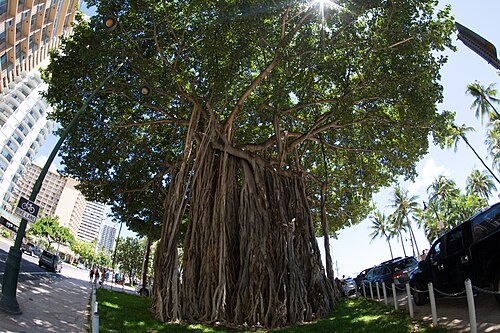
Indian Banyan (Ficus benghalensis) · Waikiki (Kuhio Beach Park)
The register puts forty metres of circumference around this tree, and not one centimetre of it is a trunk.
Banyans grow sideways and downward. The limbs throw out aerial roots, the roots reach the sand and thicken into pillars, and the pillars fuse into a mass that a tape measure has to treat as one object because there is no honest way to treat it as several. Honolulu's exceptional tree register, set up under a 1975 state law that let the counties protect individual trees by name, records this one at 4,053.8 centimetres around and about 21 metres tall, vitality good. That circumference is the whole fused base rather than a stem, and it cannot be turned into an age: growth rate dating assumes a single trunk, and nothing about a banyan is single.
So nobody knows how old it is. No planting date has surfaced anywhere, which is a strange gap for a tree with a stage underneath it.
The Hula Mound sits directly beneath the crown, on Kuhio Beach, and on Saturday evenings the free hula and music shows run there with the banyan as the roof. The Duke Kahanamoku statue stands about sixty metres up the sand. No gate, no ticket, no closing time.
If anyone has a date for it, we will take it.
Photo: Daniel Ramirez (CC BY 2.0)
Rainbow Shower Tree (Cassia x nealiae 'Wilhelmina Tenney') · 78 years · Chinatown / Downtown Honolulu
Every rainbow shower tree in Hawaii is a clone of a tree that no longer exists, and this garden holds a cutting taken from it while it was still alive.
In 1918 territorial forester David Hughes hand-pollinated a yellow shower tree with a pink-and-white one. The hybrid is sterile, which is why it puts its energy into flowering rather than seed pods and blooms longer than either parent. Businessman Edward Tenney planted an early specimen at his Makiki Heights home around 1920. That original tree is gone. What survives is what his descendant Wilhelmina Tenney cut from it and gave to this garden in the late 1940s, which is why the cultivar carries her name rather than the forester's.
A grafting method perfected in 1960 let the city plant the hybrid everywhere, and in 1965 Honolulu made it the official tree of the city and county, an odd honour for a plant that cannot reproduce on its own. This one, on the garden's Daibutso Terrace, measures just over three metres round the trunk and stands about sixteen metres tall, rated excellent at its last inspection.
Since 2024 a plaque beside it has told a second story: a local history project's research into the tree's place in Hawaii's mahu and queer histories, marked with talks held under its branches that October.
Chaulmoogra Tree (Hydnocarpus anthelminthica) · Chinatown / Downtown Honolulu
For decades before antibiotics, this tree's seed oil was one of the only real treatments for leprosy, and in 2020 gardeners carried its pods to the one place in Hawaii where that history still matters most.
Chaulmoogra oil, pressed from the seeds of Hydnocarpus anthelminthica, treated Hansen's disease across Asia for centuries and then in the West through the early twentieth, before sulfone drugs replaced it in the 1940s. This is not the chaulmoogra tree on the University of Hawaii's Manoa campus that honours chemist Alice Ball, who worked out how to make the oil injectable; that is a separate tree, a gift from the King of Siam in 1935. This one stands in Foster Botanical Garden with no plaque, just a trunk pushing three metres round and a crown thirteen metres up, rated in good health.
In 2020 Oahu's Master Gardeners collected its pods and took them to Kalaupapa, the Molokai settlement where people with Hansen's disease were once confined by law, to grow an exhibit tree on that ground. Nobody has recorded when this one itself went in. If you know, the page is asking.