San Francisco was a town of a few hundred people in 1848 and Golden Gate Park was bare dunes into the 1870s, so every tree here was planted on purpose, and 150 years counts as old. Seven of the eight are city Landmark Trees, designated one at a time by ordinance: a cork oak atop a stairway street, an Australian fig outside a hospital, two flowering ash at a library door, the Dolores Street palms, the Quesada Avenue palms, and a Cole Valley pohutukawa that flowers yellow instead of red. The eighth is the tree the city lights every Christmas.
0 of 8 visited in San Francisco
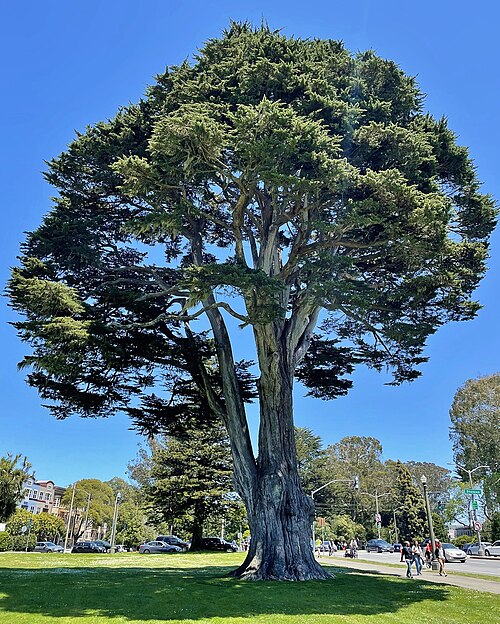
Monterey Cypress (Cupressus macrocarpa) · 145 years · Golden Gate Park (Panhandle / east end)
San Francisco's Christmas tree has roots. The Monterey cypress on the lawn outside McLaren Lodge was first strung with 800 bulbs in 1929, on the birthday of John McLaren, the park superintendent the lodge is named for, and it has been lit almost every December since. McLaren asked on his deathbed that the lighting go on. He died in 1943, and it has.
The tree took his name too. Park historians put its planting at around 1880, which makes it roughly 135 to 155 years old and one of the oldest things growing in a park that was bare sand dunes when the city started work on it in the 1870s. Monterey cypress grows wild on a couple of headlands of the California coast and nowhere else on earth, which means a large one in a city park is a planted tree by definition rather than a survivor of anything.
No girth or height has been published for it, and no register carries a coordinate for the trunk, so the pin here marks McLaren Lodge, the parks department's own headquarters building at the Stanyan Street corner of the park. Walk to the front entrance and the cypress is the big one on the lawn.
Photo: Marty Aligata (CC BY-SA 4.0)
Canary Island Date Palm (Phoenix canariensis) · Dolores Heights / Mission
The city's landmark list names this one block of Dolores Street twice. Once for the Canary Island date palms in the median, and once for a pair of cliff date palms, Phoenix rupicola, a rarer and finer-leaved cousin standing in the same strip of grass. Two designations, one address: 730 Dolores, the median between 19th and Liberty.
That is why this entry is a block rather than an avenue. Palms run down the middle of Dolores Street for most of its length, and a row of trunks a mile long is a view rather than somewhere to stand; the city itself picked out this stretch, and the two rare palms in it are the likeliest reason. The San Francisco Standard, writing in 2023 about whether the city's palms have a future, called them beloved, which for a street tree is a measurement of something.
Nobody we could reach has dated them. Canary Island date palms grow slowly and take decades to reach this height, and Dolores Street was rebuilt after the 1906 earthquake, but no source we read joins those two facts to these particular trunks, so this page leaves the age empty. If you have a planting record, or a photograph of this median without palms in it, tell us.
Flowering Ash (Fraxinus ornus) · Bernal Heights
Somebody chose well for a branch library door. Two flowering ash stand either side of the entrance at 500 Cortland Avenue, and the pair is on San Francisco's Landmark Tree list, which runs to only about twenty-five trees in the whole city. One of those designations went to the doorway of a neighbourhood branch library in Bernal Heights.
Fraxinus ornus is a southern European and Near Eastern tree, growing wild from Spain through Austria to Lebanon and Armenia, and it is an odd thing to find flanking a civic building in California. It is small, it is neat, and it earns its common name once a year when the whole crown goes over to creamy plumes of flower. Mike Sullivan, who wrote the book on this city's trees, has the pair on his own Bernal Heights walking tour, one stop, both trees.
That is how to treat it. You stand at the library door and you have seen the entry; there is nothing to hunt for. No planting date exists for either tree in the city's file or in Sullivan's, so their age is anybody's guess, and a librarian or a neighbour who remembers them going in would settle it in a sentence. Cortland Avenue is the main street of the neighbourhood, so the walk up is worth having anyway.
Cork Oak (Quercus suber) · Dolores Heights / Eureka Valley
San Francisco Landmark Tree No. 15 grows in the middle of a street. Not beside one: 20th Street at Noe is one of this city's stairway streets, a public right-of-way that was never paved as a roadway, and the hillside garden climbing it stands where the road would have gone. The cork oak stands at the top of it, on ground that legally belongs to the street.
In October 2025 the neighbourhood association that tends the garden renamed the whole thing after the tree, so it is now the Cork Oak Tree Community Garden. They keep it watered with help from the city's public works and water departments, which is an unusually specific piece of care for a tree nobody owns.
Quercus suber is the tree the cork industry is built on, a Mediterranean oak grown in Portugal and Spain for a bark thick enough to be stripped every nine years or so and grow back. Nobody harvests this one. It is evergreen, so there is no season to wait for, and no source we found gives a planting date or a girth, which leaves the age open; if you know when it went in, that is worth a message. The climb up from Noe Street is the price of admission.
Moreton Bay Fig (Ficus macrophylla) · Bernal Heights / Mission
Los Angeles, Santa Barbara and San Diego have the grand Moreton Bay figs. San Francisco has this one, and the species is genuinely uncommon this far up the coast, where the summers are cool and the fog comes in for days at a time. It is an Australian rainforest tree, a banyan relative whose big specimens spread a wide crown over roots that buttress out along the ground, and Mike Sullivan, who wrote the standard book on this city's trees, files it simply as a very large specimen.
The city's Landmark Tree list carries it, and a local history blog photographed it in 2009 and noted it had lately lost a branch, which is what happens to a crown this heavy on a street corner.
The address is the thing to know before you go. The city register files it under 3555 Cesar Chavez Street, the hospital it stands in front of, and you will not find the tree on Cesar Chavez. It is around the corner on Valencia Street, west side, just south of the junction, fronting the grounds rather than fenced inside them, so the sidewalk is close enough. Nobody has published an age or a girth for it, which for a fig of this size is a gap worth closing.
Bay Laurel (Laurus nobilis) · Financial District / Jackson Square
The tree the Romans cut their victory crowns from is growing on a Financial District sidewalk, outside a federal customs house. Sweet bay, bay laurel, Grecian laurel: one Mediterranean species, Laurus nobilis, the laurel of laureates and of the leaves in a pot of stock, standing at the northwest corner of Battery and Jackson.
San Francisco landmarked it formally. The Board of Supervisors passed resolution 670-05 in 2005, which is the kind of paperwork usually spent on buildings, and Mike Sullivan's Trees of San Francisco pins it to the same corner, in front of the United States Customs House. The tree is on the public right-of-way, so the federal building behind it changes nothing about walking up.
It is a sensible tree for this city, whatever the classical associations. Laurus nobilis comes from a climate of dry summers and wet winters, which is San Francisco's own, and it takes wind and fog without complaint, both of which the corner supplies. No age, girth or height has been published for it anywhere we could reach, so how long it has stood on this corner is an open question, and one a reader with the right city record could close in a sentence. Jackson Square around it is a good walk regardless.
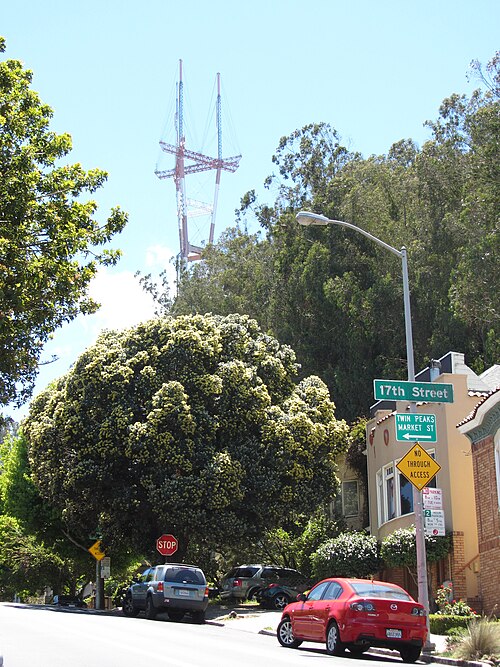
Pohutukawa (Metrosideros excelsa) · ~70 years · Cole Valley
The pohutukawa, the New Zealand Christmas tree, flowers red. This one flowers yellow. The yellow form began as a natural mutation, found on Motiti Island in New Zealand's Bay of Plenty in 1940, in a species that otherwise blooms crimson.
Victor Reiter got hold of a cutting in the late 1950s and his family planted it in front of their home at 1221 Stanyan Street, on the edge of Cole Valley. The local tree writer Mike Sullivan, writing in 2016, called it his favourite tree in the city and found it thriving more than seventy years after that first yellow plant turned up. In 2019 the Urban Forestry Council voted unanimously to make it an official Landmark Tree.
Its moment comes around Memorial Day, at the end of May, when it blooms, and the flowers can still cover it in late June. Every other New Zealand Christmas tree you pass in the city flowers red.
This is a front garden, not a park, and the right way to see it is from the public pavement on Stanyan Street, without stepping off it. Our pin marks the address rather than the trunk.
The city still lists it among its landmark trees, but the newest dated photograph we have found is from June 2012, when it was in full yellow flower. Nobody has published its girth. If you photograph it from the pavement in flower, send it to us.
Photo: Akos Kokai (CC BY 2.0)
Canary Island Date Palm (Phoenix canariensis) · ~100 years · Bayview
Thirteen Canary Island date palms line the median of Quesada Avenue in the Bayview, and San Francisco counts all thirteen as one Landmark Tree. Public Works lists them that way: the Quesada Street median, from just west of 3rd Street to the dead end, 13 palms.
They are the same species as the far better known palms down the middle of Dolores Street. Local history has the Quesada median planted with them around 1920. One account puts it closer to 1932, and we have not been able to settle which, so call them roughly a century old, give or take a decade.
What they have seen since is most of the Bayview's twentieth century, and they outlasted all of it; the city's current landmark list still carries all thirteen. A palm of this kind holds no rings to count, and nobody has published the height or the girth of any of the thirteen, so the age rests on the planting date alone.
This is a street, not a park, and that is the appeal: the whole landmark stands on one compact block, so there is one place to go and thirteen trees to count. Walk the sidewalk rather than the median itself.
Our pin is a mid-block point that has not been checked against aerial imagery, so treat it as the street rather than a spot. The 3rd Street end is the easy one to find. If you know when these palms were really planted, tell us.